
When to Avoid a Medication Family After a Severe Drug Reaction
 Jan, 30 2026
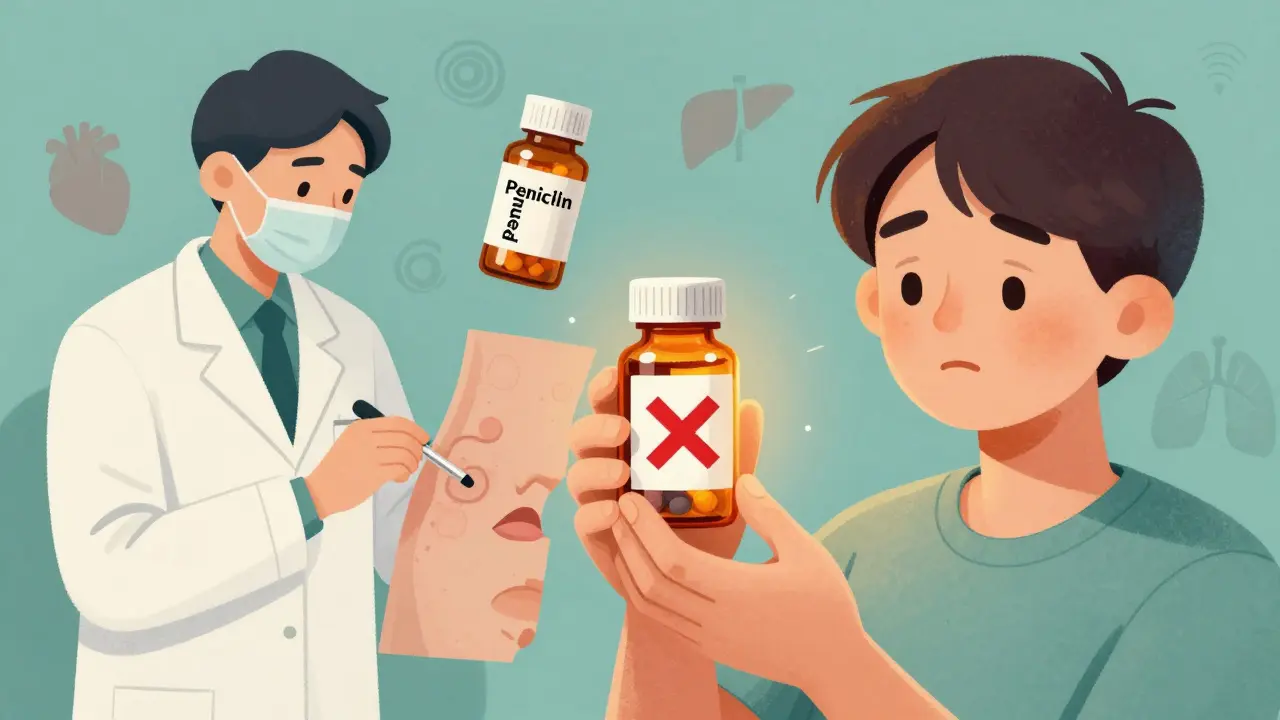
When a medication causes a severe reaction, it’s natural to want to avoid everything in that family. But not every bad reaction means you need to say no to the whole class. Too many people are told to avoid penicillin, sulfa drugs, or NSAIDs for life based on a single bad experience-only to find out years later they could have taken them safely. The truth is, severe drug reaction doesn’t always mean total class avoidance. It depends on what kind of reaction it was, how it happened, and whether your immune system was truly involved.
What Counts as a Severe Drug Reaction?
A severe drug reaction isn’t just a rash or upset stomach. The FDA defines it as something that’s life-threatening, forces you into the hospital, causes permanent disability, or leads to birth defects. In real terms, that means anaphylaxis-where your throat swells and you can’t breathe-or conditions like Stevens-Johnson syndrome, where your skin starts peeling off like a burn. These aren’t side effects. They’re emergencies.
Most people think any bad reaction is an allergy. But here’s the catch: 80 to 90% of reported drug reactions aren’t allergic at all. They’re side effects. If you got diarrhea after taking an antibiotic, that’s not an allergy-it’s your gut reacting to the drug. If you got a mild rash after amoxicillin, it’s probably not IgE-mediated. But if you broke out in hives within minutes, your tongue swelled up, or you passed out, that’s a different story. That’s your immune system screaming.
When to Avoid the Whole Family
There are three situations where you absolutely should avoid the entire medication family:
- True IgE-mediated anaphylaxis-If you’ve had a reaction with low blood pressure, wheezing, or swelling within minutes of taking a drug like penicillin, you’re at risk for another one. Cross-reactivity in beta-lactam antibiotics (penicillins, cephalosporins, carbapenems) is real, though not as common as people think. Studies show only 0.5% to 6.5% of people allergic to penicillin react to cephalosporins, but if your first reaction was severe, doctors will usually advise avoiding all of them unless you’re tested.
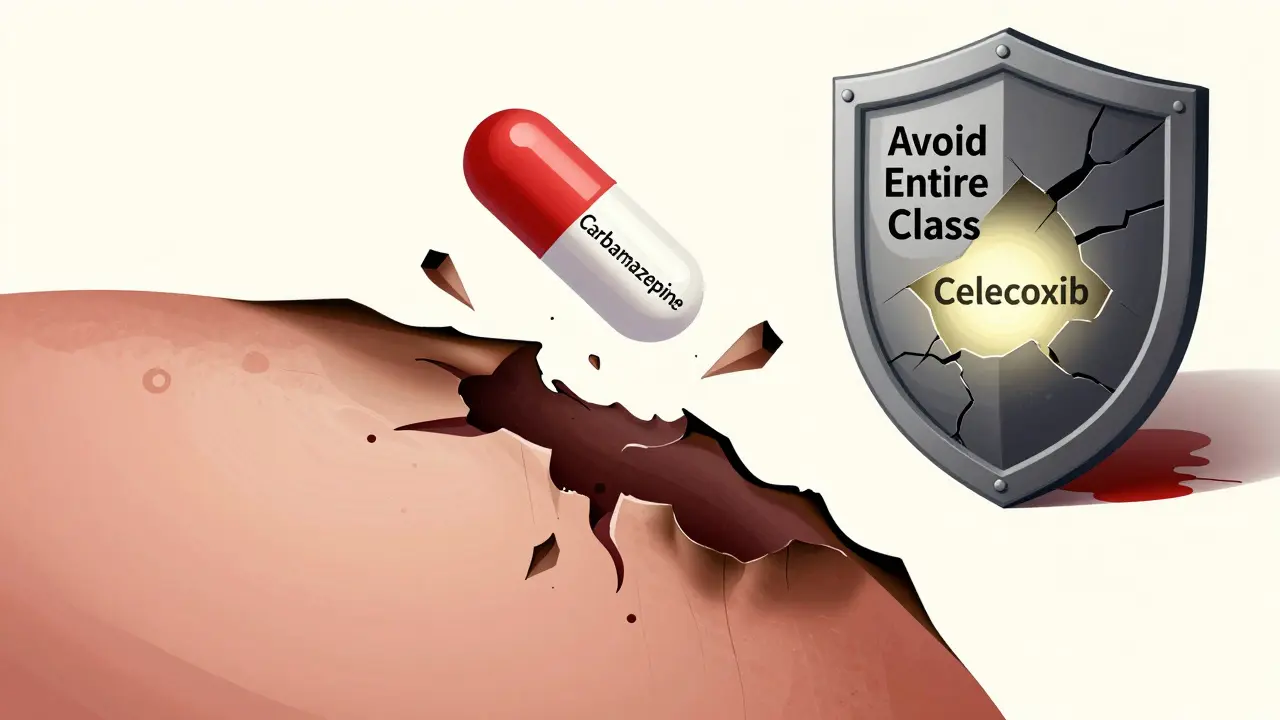
- Severe cutaneous adverse reactions (SCARs)-If you’ve had Stevens-Johnson syndrome, toxic epidermal necrolysis, or DRESS syndrome, you need to avoid the entire class. These aren’t just rashes. They’re deadly. For example, if you had DRESS from an anticonvulsant like carbamazepine, you can’t take any other drugs in that class. The European Medicines Agency found that 95% of TEN cases come from just six drug classes, and once you’ve had one, your risk of another is extremely high.
- Drug-induced liver or kidney failure-If a drug caused your liver to shut down or your kidneys to fail, you’re not taking that class again. Even if it’s a different drug in the same family, the mechanism might be the same.
For example, if you had a life-threatening reaction to Bactrim (a sulfa antibiotic), you should avoid all sulfonamide antibiotics. But you can still take non-antibiotic sulfa drugs like furosemide (Lasix) or sulfonylureas for diabetes. The chemical structure is different. Most doctors miss this distinction, but it matters.
When You Don’t Need to Avoid the Whole Family
Many people are wrongly labeled allergic because of a mild reaction that had nothing to do with their immune system.
Take maculopapular rashes from amoxicillin. They’re common-happening in 5 to 10% of kids and adults. But they’re not allergic. They’re just a side effect. Studies show 95% of people labeled with penicillin allergy can take it again after proper testing. That’s not a guess. That’s from skin tests and drug challenges done in clinics.
Same with NSAIDs. If you got stomach bleeding from ibuprofen, switching to celecoxib (a COX-2 inhibitor) might be safe. The risk isn’t cross-reactive-it’s about how the drug affects your stomach lining. You don’t need to avoid all NSAIDs. Just avoid the one that hurt you, and pick a different one with lower risk.
Even statins-used for cholesterol-have low cross-reactivity. Only 10 to 15% of people who had muscle pain with one statin get it with another. Most can switch without issue.
The Danger of Over-Avoidance
When you avoid a whole class unnecessarily, you’re not safer-you’re at higher risk. Why? Because doctors have to use broader-spectrum, more expensive, or more toxic alternatives.
Take penicillin allergy labels. About half of all hospital-acquired infections are treated with beta-lactams. If you’re labeled allergic, you get vancomycin or fluoroquinolones instead. Those drugs are more likely to cause C. diff infections, kidney damage, or antibiotic resistance. A 2023 study found patients with false penicillin allergy labels had 43% higher risk of C. diff and stayed in the hospital 2 days longer on average.
On patient forums, people report being denied antibiotics for UTIs, sinus infections, or pneumonia because of outdated labels. One woman in New Zealand had to wait three days for a proper antibiotic after her UTI worsened because her GP refused to prescribe anything near penicillin-even though she’d never had a real allergic reaction, just a rash at age 7.
How to Know What’s Safe
You don’t have to guess. There’s a process.
- Document the reaction accurately-Write down the drug, the date, the symptoms, how long it lasted, and if you needed emergency treatment. Use terms like “anaphylaxis,” “SJS,” or “rash without swelling.” Avoid vague labels like “allergic to penicillin.”
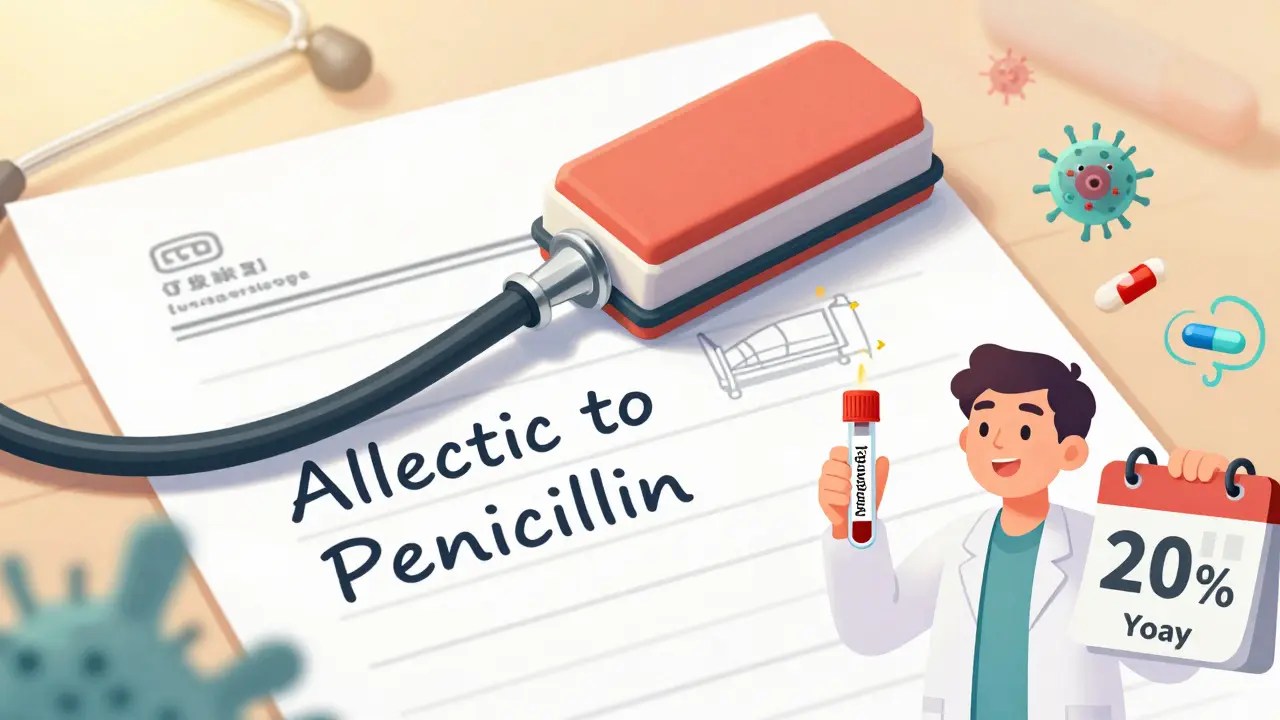
- Ask for allergy testing-Skin tests and blood tests (like ImmunoCap) can now detect true IgE-mediated allergies with 89% accuracy. If you had a mild rash years ago, testing might show you’re not allergic at all.
- Consider a drug challenge-Under medical supervision, doctors can give you a tiny dose of the drug to see if you react. Success rates are 70 to 85% for people with low-risk histories. It’s safe, fast, and often covered by insurance.
- Check your genetic markers-For some drugs, like abacavir (used for HIV), a simple blood test for HLA-B*57:01 can tell you if you’re at risk. If you don’t have the gene, you can take it safely. This is now standard in many hospitals.
Many clinics now offer “penicillin allergy de-labeling” programs. In Auckland, the Waikato Hospital runs one. Patients come in, get tested, and 8 out of 10 walk out with their allergy label removed. That means they can take safer, cheaper antibiotics next time.
What to Do Next
If you’ve ever had a severe reaction:
- Don’t assume you’re allergic to the whole class.
- Get your medical records. Look at how the reaction was documented.
- Ask your doctor: “Was this an immune reaction? Can I be tested?”
- If you’re still avoiding a drug family, ask if a challenge is possible.
- Update your allergy list in your phone, wallet, or medical alert bracelet-only if it’s accurate.
Too many people live with unnecessary restrictions because no one ever checked. You don’t have to. A simple test or a supervised challenge could change your life. You might find out you’ve been avoiding a safe, effective drug for 20 years-just because someone wrote down “allergic” on a chart and never looked again.
What About Over-the-Counter Drugs?
NSAIDs like ibuprofen or naproxen can cause severe reactions too. If you had asthma flare-ups after taking aspirin, you might have aspirin-exacerbated respiratory disease (AERD). That’s not an allergy-it’s a chemical intolerance. About 70% of people with AERD react to all traditional NSAIDs. But COX-2 inhibitors like celecoxib are often safe. Talk to your doctor before assuming you can’t take any pain relievers.
Even acetaminophen (paracetamol) can cause rare but serious skin reactions. If you’ve had a severe reaction to any OTC drug, don’t just avoid it forever. Get it evaluated.
Final Thought: Don’t Let a Label Control Your Care
A drug allergy label is not a life sentence. It’s a starting point. Many people are told they’re allergic because of a mild rash, a stomach upset, or even a coincidence. But science now gives us tools to find out the truth.
Severe drug reactions are rare. But mislabeling them is common. And the cost? Longer hospital stays, more side effects, and worse outcomes.
You deserve better than guesswork. Ask for testing. Ask for clarity. Ask for your safety to be based on facts-not fear.
calanha nevin
January 31, 2026 AT 10:30Severe reactions are not a one-size-fits-all label. Too many patients are told to avoid entire drug classes based on a rash they got as a child. The data is clear: over 90% of penicillin allergies are misdiagnosed. Testing isn't optional-it's essential. Your life depends on accurate documentation, not fear-based avoidance.
Stop letting outdated charts dictate your treatment options. Ask for a challenge. Demand a skin test. You deserve better than guesswork.
Sheila Garfield
February 1, 2026 AT 18:20I had a rash after amoxicillin at 8. Got labeled allergic. 20 years later, got tested. Turned out I was fine. Now I take penicillin like it's candy. Why didn't anyone check before? So many people are needlessly scared. This post should be mandatory reading for every GP.
Kelly Weinhold
February 2, 2026 AT 12:44OMG YES. I spent years avoiding all NSAIDs because I got a stomach ache once. Then I found out celecoxib was safe for me. No more joint pain, no more walking like an old lady. I wish I’d known this sooner. Your body isn’t broken because one drug gave you a side effect. Sometimes it’s just the wrong fit. Don’t give up on meds-find the right one. You’ve got this.
And if you’re scared, talk to your doctor. They’re not mind readers. You have to speak up.
Shawn Peck
February 2, 2026 AT 16:39Everyone’s acting like this is some big secret. It’s not. I’ve been a nurse for 15 years. I’ve seen people die because they were given vancomycin instead of penicillin. C. diff. Kidney failure. All because some idiot wrote ‘allergic’ on a chart in 1997. Stop being lazy. Get tested. It’s 2025. We have blood tests. We have skin tests. Stop letting fear kill people.
Lisa McCluskey
February 2, 2026 AT 20:11I think the real issue isn’t just the mislabeling-it’s how little follow-up happens. A patient gets a rash, gets labeled, and that’s it. No reevaluation. No education. No testing. The system fails them at every step. Doctors don’t have time, patients don’t know to ask, and the label sticks forever. We need better protocols, not just awareness.
April Allen
February 3, 2026 AT 17:26The epistemological rupture here is profound. We treat drug reactions as binary events-either immune-mediated or benign-when in reality, the immune system operates on a spectrum of reactivity, often mediated by non-IgE pathways like T-cell activation or metabolic idiosyncrasies. The conflation of pharmacological side effects with immunological hypersensitivity reflects a broader diagnostic reductionism in clinical medicine. We must move from categorical avoidance to mechanism-based stratification. HLA-B*57:01 testing for abacavir is the gold standard; why isn’t this paradigm applied universally? The cost of inaction isn’t just economic-it’s existential.
Jason Xin
February 5, 2026 AT 10:58Wow. So the real allergy is to doing the work. Doctors don’t want to explain the difference between a sulfa antibiotic and a diuretic. Patients don’t want to dig through their medical records. We’d rather just say ‘no’ and move on. Convenient. Safe. Wrong.
And yet here we are. Still avoiding penicillin because someone wrote ‘rash’ in 1992. Meanwhile, your UTI’s getting worse. The irony is delicious.
Kimberly Reker
February 7, 2026 AT 07:55My mom had DRESS from carbamazepine. She was told never to take any anticonvulsant again. Last year, she needed seizure meds after a brain injury. Turns out lamotrigine is fine-different metabolic pathway. She’s alive because someone finally looked beyond the label. This isn’t just about antibiotics. It’s about every drug class. Don’t let one bad experience erase your future options.
Diana Dougan
February 8, 2026 AT 10:38So let me get this straight. If you get a rash after penicillin, you’re fine to take it again? But if you get a rash after a new skincare cream, you’re allergic for life? Why do meds get a free pass but everything else is a death sentence? I’m just saying… double standards much?
Rohit Kumar
February 10, 2026 AT 07:29In India, we often avoid antibiotics because of cost, not allergy. But I’ve seen patients labeled allergic after a fever that coincided with a dose. No testing. No follow-up. Just a note in the file. The burden falls on the patient to prove they’re not allergic. We need systemic change-not just individual awareness. Knowledge is power, but access is justice.
Lily Steele
February 12, 2026 AT 01:30My doctor finally agreed to do a challenge after I begged for years. Took 20 minutes. No reaction. I cried. I’d been avoiding penicillin since I was 5. Now I can get treated for infections without waiting days for some risky alternative. This isn’t just medical-it’s emotional. You carry these labels like scars. Removing one feels like being set free.