
Venlafaxine and Blood Pressure: What You Need to Know About Hypertension Risk
 Dec, 22 2025
Venlafaxine Blood Pressure Risk Calculator
Estimate Your Blood Pressure Risk
This calculator estimates potential blood pressure changes based on your venlafaxine dose and current readings.
Enter your information to see your potential blood pressure risk.
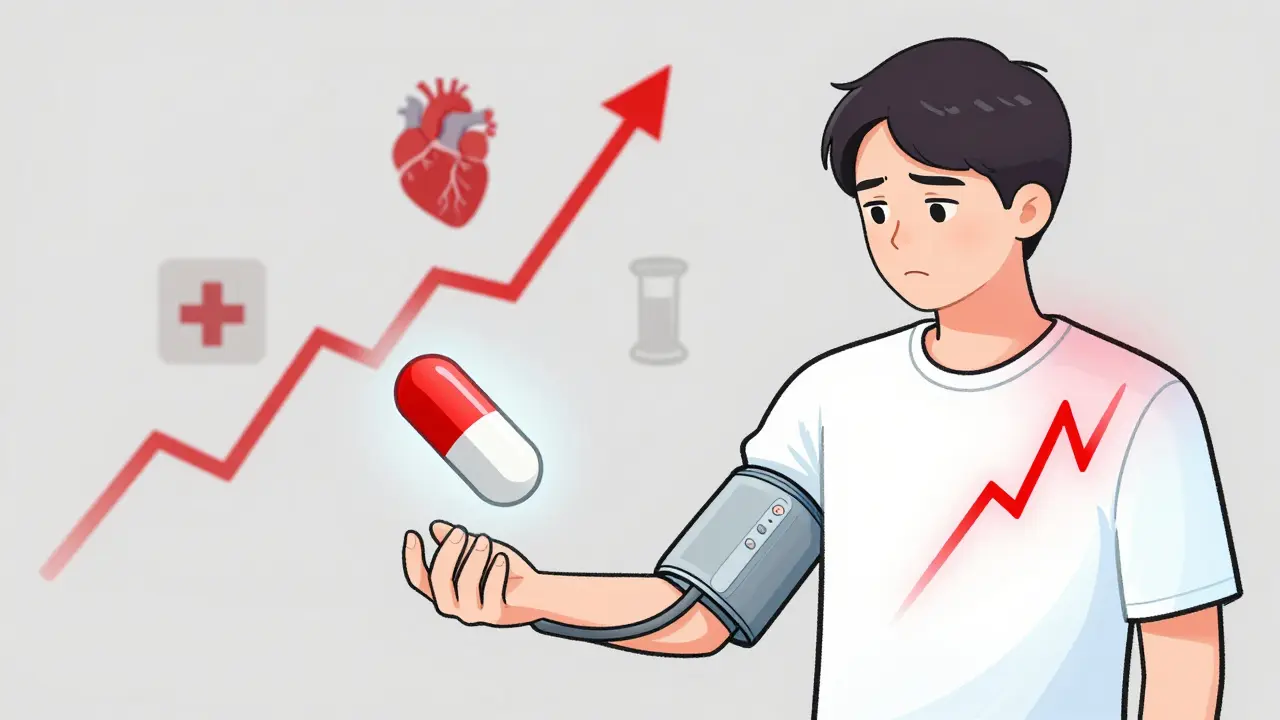
When you start taking venlafaxine for depression or anxiety, your doctor likely focuses on how well it lifts your mood. But there’s another effect-often quiet, sometimes sudden-that deserves just as much attention: blood pressure. For many people, venlafaxine works great. For others, it quietly pushes their blood pressure into dangerous territory. This isn’t rare. It’s documented. And if you’re on this medication, you need to know what to watch for.
Why Venlafaxine Raises Blood Pressure
Venlafaxine, sold under brand names like Effexor and Effexor XR, is an SNRI-serotonin and norepinephrine reuptake inhibitor. That means it boosts two brain chemicals: serotonin (which helps with mood) and norepinephrine (which affects alertness, energy, and your heart). It’s the norepinephrine part that causes trouble.At low doses (under 150 mg/day), venlafaxine mostly affects serotonin. But above that threshold, it strongly blocks norepinephrine reuptake. More norepinephrine in your system means your blood vessels tighten, your heart beats harder, and your blood pressure climbs. This isn’t a side effect you can ignore. Studies show that at doses above 300 mg/day, over 13% of patients develop clinically high blood pressure-compared to just 5% on placebo.
Even more concerning? This doesn’t always follow the dose rule. There are case reports of people developing dangerously high blood pressure-like 210/170 mmHg-on just 150 mg/day. One 23-year-old man with no prior history of hypertension saw his blood pressure spike after 10 months on the drug. He didn’t feel sick until it was almost too late. That’s the problem: it often shows up without warning.
How Much Does Blood Pressure Really Rise?
The numbers matter. A large analysis of over 3,700 patients found that venlafaxine typically raises supine diastolic blood pressure (the bottom number) by 1-3 mmHg at standard doses. That sounds small. But for someone already borderline hypertensive, that extra 3 points can push them over the line.At higher doses-above 300 mg/day-the average increase jumps to 10-15 mmHg diastolic. That’s not just a lab curiosity. That’s the kind of rise that can damage your kidneys, your heart, or your brain over time. And it’s not just the diastolic number. Systolic pressure (the top number) also climbs, sometimes by 10 mmHg or more.
Compare that to SSRIs like sertraline or fluoxetine. Those rarely move the needle on blood pressure at all. Even duloxetine, another SNRI, has less of an effect. Venlafaxine is the outlier. And that’s why guidelines from the American Psychiatric Association and the American Heart Association all say the same thing: if you’re on venlafaxine, monitor your blood pressure.
Who’s at Highest Risk?
You might think only older adults or people with existing heart problems are at risk. But that’s not true.Anyone on venlafaxine can develop this. But some groups are more vulnerable:
- People taking doses above 150 mg/day
- Those with preexisting high blood pressure (even if it’s controlled)
- Patients on other medications that raise blood pressure (like decongestants or stimulants)
- People with kidney disease or thyroid issues
- Those with a family history of hypertension
Here’s something counterintuitive: venlafaxine doesn’t make existing hypertension worse in most cases. In fact, some patients with unstable blood pressure report it actually stabilizes after starting the drug. But that doesn’t mean it’s safe. The real danger is in people who start out with normal blood pressure and suddenly develop severe hypertension-sometimes without symptoms.
What the Data Says About Real People
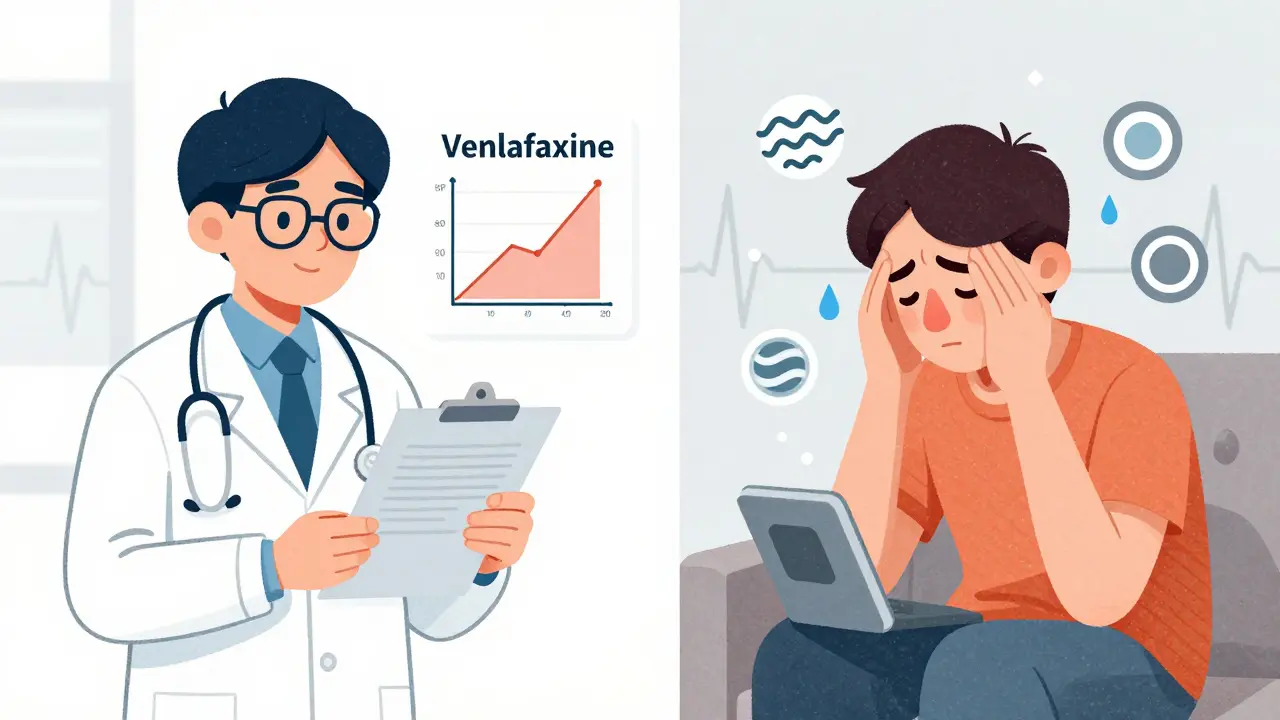
Clinical trials are one thing. Real-world experience is another.On PsychForums, a thread with nearly 150 responses found that 68% of users noticed their blood pressure rise after starting venlafaxine. Twelve percent hit readings above 140/90-the clinical threshold for hypertension. One user wrote: “My BP jumped from 118/76 to 152/98 in three weeks on 75 mg.” Another said: “I stopped venlafaxine after my doctor flagged my BP at 155/102. It went back to normal in three weeks.”
On Drugs.com, 28% of negative reviews mention high blood pressure. On Reddit, users describe headaches, nosebleeds, and blurred vision-all classic signs of rising pressure. One person shared that their doctor didn’t check their BP for months. By the time they did, their systolic was over 180. They were sent to the ER.
The NHS says high blood pressure occurs in up to 1 in 10 people taking venlafaxine. Serious cases-those requiring treatment or hospitalization-are rarer, under 1 in 100. But when they happen, they can lead to stroke, heart attack, or posterior reversible encephalopathy syndrome (PRES), a rare but life-threatening brain condition triggered by sudden high blood pressure.
Monitoring Guidelines: What You Should Actually Do
Knowing you need to monitor isn’t enough. You need to know how.The Mayo Clinic and American Psychiatric Association agree on this protocol:
- Get a baseline reading before starting venlafaxine.
- Check again at 2 weeks and 4 weeks after starting.
- If your dose goes above 150 mg/day, check monthly for the first 3 months.
- After that, check every 3 months-even if you feel fine.
Don’t wait for symptoms. Most people don’t feel high blood pressure until it’s already damaging their body. Use a home monitor if you can. Write down the numbers. Bring them to every appointment.
If your blood pressure rises above 140/90, talk to your doctor. Don’t stop the drug on your own. But don’t ignore it either. Dose reduction often brings BP back to normal within weeks. In many cases, switching to an SSRI like sertraline or escitalopram resolves the issue without losing antidepressant benefits.
What to Do If Your Blood Pressure Spikes
If your systolic pressure hits 180 or higher, or your diastolic hits 110 or higher, that’s a hypertensive crisis. Don’t wait. Don’t call your doctor tomorrow. Go to the ER.Symptoms to watch for:
- Severe headache
- Nosebleeds (especially unexplained ones)
- Blurred or double vision
- Chest pain or tightness
- Shortness of breath
- Nausea or confusion
These aren’t “maybe” signs. They’re red flags. In one documented case, a patient developed PRES after 10 months on venlafaxine. She survived, but only because she got to the hospital in time.

Alternatives If Blood Pressure Becomes a Problem
Venlafaxine is powerful. But it’s not the only option.If hypertension becomes a concern, here are alternatives with lower cardiovascular risk:
- Sertraline (Zoloft) - First-line SSRI, minimal BP effect
- Escitalopram (Lexapro) - Well-tolerated, low risk for hypertension
- Bupropion (Wellbutrin) - Doesn’t affect serotonin or norepinephrine reuptake the same way; often used when SNRIs cause issues
- Mirtazapine (Remeron) - Works differently, rarely raises BP
Some people switch and find their mood stays stable. Others need to try a few before finding the right fit. But the key is: you don’t have to live with high blood pressure to treat depression.
Is Venlafaxine Still Worth It?
Yes-if you’re monitored.It’s one of the most effective antidepressants for treatment-resistant depression. If SSRIs didn’t work, venlafaxine often does. Global sales topped $1.2 billion in 2022. It’s prescribed over 23 million times a year in the U.S. alone. That’s because it works.
But effectiveness doesn’t mean safety without caution. The FDA and EMA both require warnings about sustained blood pressure elevation on the label. The American Heart Association calls it a “reasonable alternative when SSRIs fail”-but only with monitoring.
It’s not about avoiding venlafaxine. It’s about using it wisely. With regular checks, it can be safe. Without them, it can be dangerous.
Bottom Line: Stay Informed, Stay Protected
Venlafaxine can save lives. But it can also silently damage them. If you’re taking it:- Know your baseline blood pressure.
- Check it regularly-don’t wait for symptoms.
- Report any rise above 140/90 to your doctor.
- Don’t ignore headaches, nosebleeds, or vision changes.
- Ask about alternatives if BP stays high.
You don’t have to choose between mental health and physical health. With the right monitoring, you can have both.
Chris Buchanan
December 23, 2025 AT 18:28So let me get this straight - we’re telling people to monitor their BP like it’s a fitness tracker because a drug that helps them breathe again might quietly turn them into a ticking time bomb? Cool. I’ll just add ‘check blood pressure’ to my morning routine right after ‘don’t die’ and ‘remember to exist.’
Delilah Rose
December 25, 2025 AT 09:58I’ve been on venlafaxine for two years now, and honestly, I didn’t realize how much my blood pressure had crept up until my partner started nagging me about how pale I looked during dinner. I got a home monitor, started logging it, and sure enough - my diastolic had climbed from 78 to 94 over six months. I didn’t feel different, didn’t have headaches, didn’t even notice. But when I talked to my psychiatrist and we dropped my dose to 112.5 mg, it went back to 80 in three weeks. It’s wild how something that fixes your mind can mess with your body without you even knowing. I wish more doctors would just say: ‘Hey, get a cuff.’
Bret Freeman
December 26, 2025 AT 18:53Oh wow, a whole article about how a pill might raise your blood pressure? Groundbreaking. Next up: ‘Breaking News: Water Can Cause Drowning in Unsupervised Environments.’ This is why people don’t trust medicine anymore - we’re being fed fear disguised as education. If you’re on venlafaxine and you’re not feeling worse, why are you even checking your BP? You’re not a lab rat. You’re a human being. Let the doctors do their job and stop scaring people into paranoia.
niharika hardikar
December 27, 2025 AT 00:47It is imperative to underscore that the pharmacodynamic profile of venlafaxine, particularly its dose-dependent noradrenergic activity, necessitates vigilant hemodynamic surveillance in clinical practice. The magnitude of diastolic elevation observed in cohort studies exceeds the threshold of clinical significance as defined by the 2023 ACC/AHA guidelines, thereby mandating structured BP monitoring protocols. Failure to implement such protocols constitutes a deviation from evidence-based standards of care.
Rachel Cericola
December 28, 2025 AT 04:05Hey - if you’re reading this and you’re on venlafaxine, I want you to know you’re not alone. I was terrified when my BP spiked too. I thought I was failing at being ‘healthy.’ But here’s the truth: you’re not broken. You’re just on a medication that works differently for different bodies. I switched to sertraline, and my mood stayed solid while my BP dropped back to normal. Your mental health matters, but so does your heart. Don’t wait for a nosebleed to wake you up. Grab a cuff, write it down, and take it to your next appointment. You deserve to feel better - inside and out.
Georgia Brach
December 29, 2025 AT 12:32Let’s be real - this article reads like an ad for SSRIs disguised as medical advice. Venlafaxine is one of the most effective drugs for treatment-resistant depression. If you’re willing to trade efficacy for a 13% chance of elevated BP - which, by the way, is often reversible - then you’re not being cautious, you’re being lazy. The real problem is that doctors don’t monitor BP because they’re overworked, not because the drug is dangerous. Blame the system, not the medication.
Katie Taylor
December 30, 2025 AT 03:51STOP. RIGHT. NOW. If you’re on venlafaxine and you haven’t checked your BP in the last 90 days, you’re playing Russian roulette with your brain. I had a friend who had a ministroke at 34 because she ignored her BP for a year. She’s fine now - but she can’t drive, can’t work, and has to take meds for life. This isn’t ‘maybe.’ This is ‘if you don’t act, you might not wake up.’ Get a cuff. Check it. Do it now. I’m not asking. I’m telling you.
Bhargav Patel
December 30, 2025 AT 21:12The tension between therapeutic efficacy and physiological consequence is not merely pharmacological - it is existential. We seek to alleviate the suffering of the mind, yet in doing so, we risk compromising the vessel that carries it. Venlafaxine, in its molecular precision, illuminates the paradox of modern psychiatry: we treat the soul with chemicals that do not distinguish between synaptic pathways and vascular tone. Perhaps the true question is not whether we should monitor BP, but whether we have the wisdom to accept that healing the mind may require vigilance over the body - even when the body says nothing.
Steven Mayer
December 31, 2025 AT 02:02Interesting how the article cites Drugs.com and PsychForums as primary evidence sources. The sample bias here is staggering. People who have adverse reactions are far more likely to post online than those who don’t. The actual incidence of clinically significant hypertension is closer to 2-3% in controlled populations. The real risk is iatrogenic anxiety - people freaking out over 5 mmHg spikes because they read a Reddit thread. This isn’t medicine. It’s fearmongering with footnotes.
Joe Jeter
January 1, 2026 AT 01:54So if you’re on venlafaxine and your BP goes up, you’re supposed to just quit? What if it’s the only thing keeping you alive? The real danger isn’t the drug - it’s the idea that there’s a ‘safe’ antidepressant. There isn’t. Every pill has trade-offs. The only safe choice is to not take anything - and then you’re back to screaming into the void. So yeah, monitor your BP. But don’t let fear take away your only tool for survival.
Sidra Khan
January 2, 2026 AT 18:09My BP went up on venlafaxine. I switched to Lexapro. Mood? Still good. BP? Normal. My doctor said ‘it’s fine’ for 6 months. I had to Google it myself. 🤦♀️