
Treatment-Resistant Depression: A Guide to Augmentation and Advanced Therapies
 Jul, 21 2026
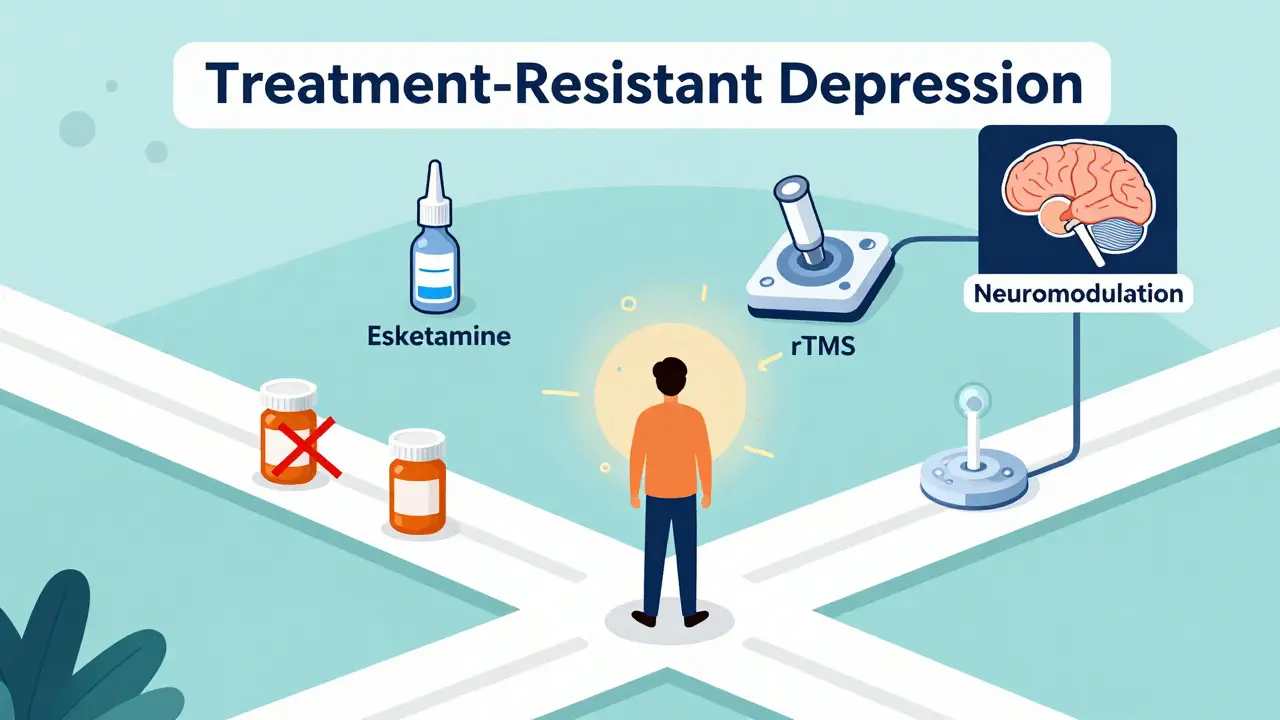
Imagine taking your medication exactly as prescribed for months, only to feel like you are standing still while the world moves on. You are not alone, and more importantly, you are not out of options. When standard antidepressants fail to lift the fog of major depressive disorder, clinicians classify this condition as Treatment-Resistant Depression (TRD). By definition, TRD occurs when a patient fails to respond adequately to at least two different first-line antidepressant trials. The Sequenced Treatment Alternatives to Relieve Depression (STAR*D) trial, one of the largest studies in psychiatry involving nearly 3,000 patients, revealed that roughly 50% to 60% of people do not achieve remission with their first medication. After two failed attempts, about 30% to 40% of patients meet the criteria for TRD.
This is not a dead end; it is a pivot point. The goal shifts from simple monotherapy to more complex strategies known as augmentation and advanced neuromodulation. Understanding these pathways can mean the difference between enduring chronic symptoms and regaining quality of life.
Understanding Augmentation Strategies
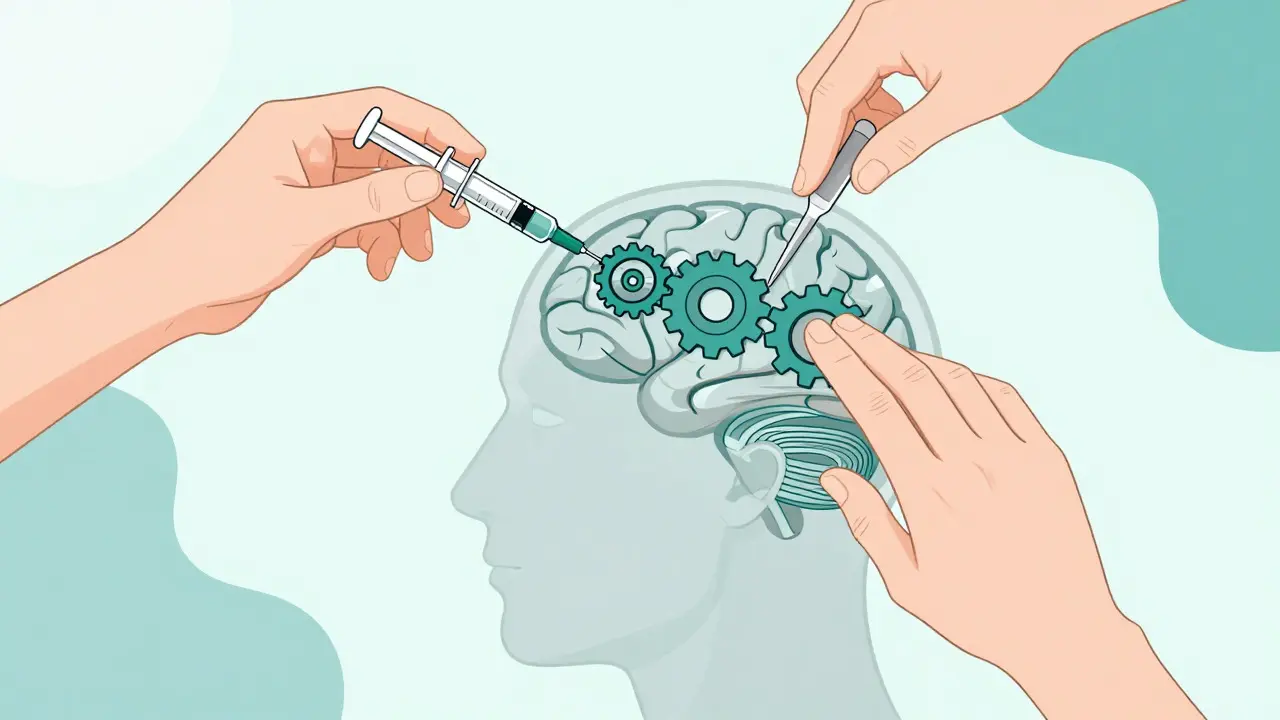
Augmentation is the practice of adding a second medication to your current antidepressant regimen to boost its effectiveness, rather than switching entirely to a new drug. This approach preserves the partial benefit you may have already gained while targeting remaining symptoms. The Food and Drug Administration (FDA) has approved several agents specifically for this purpose, primarily atypical antipsychotics used in low doses alongside Selective Serotonin Reuptake Inhibitors (SSRIs) or Serotonin-Norepinephrine Reuptake Inhibitors (SNRIs).
The most common FDA-approved augmentation agents include:
- Aripiprazole (Abilify): Typically dosed between 2-15 mg/day.
- Brexpiprazole (Rexulti): Dosed between 0.5-3 mg/day.
- Quetiapine Extended-Release (Seroquel XR): Dosed between 150-300 mg/day.
- Olanzapine-Fluoxetine Combination (Symbyax).
A comprehensive network meta-analysis published in 2022, examining over 12,000 patients across 65 studies, highlighted significant efficacy for several agents. Liothyronine, nortriptyline, and aripiprazole showed some of the highest odds ratios for response compared to placebo. For instance, quetiapine at 300mg/day demonstrated up to 48% response rates when combined with SSRIs. However, tolerability varies. Aripiprazole often presents with akathisia (a sense of inner restlessness) in 15-25% of users, while quetiapine frequently causes sedation in 40-60% of patients. Weight gain is another concern, particularly with olanzapine-fluoxetine, which can lead to a 5-7% increase in body weight.
| Medication | Typical Dose Range | Key Side Effects | Clinical Note |
|---|---|---|---|
| Aripiprazole | 2-15 mg/day | Akathisia, insomnia | Favorable balance of efficacy and tolerability |
| Brexpiprazole | 0.5-3 mg/day | Somnolence, weight gain | May cause less akathisia than aripiprazole |
| Quetiapine XR | 150-300 mg/day | Sedation, metabolic changes | Effective but high discontinuation due to drowsiness |
| Olanzapine-Fluoxetine | Fixed dose combinations | Significant weight gain, metabolic syndrome | Reserved for severe cases due to metabolic risks |
Non-FDA approved options also play a role. Lithium remains a gold-standard augmenting agent, though it requires careful blood level monitoring (target 0.3-0.6 mEq/L) due to its narrow therapeutic index. Bupropion is another frequent choice, especially for patients suffering from fatigue or sexual dysfunction caused by their primary antidepressant. The VAST-D trial found that aripiprazole augmentation yielded a 24.8% remission rate at 12 weeks, slightly outperforming bupropion augmentation (19.9%).
Rapid-Acting Treatments: Esketamine
For those needing faster relief, particularly if suicidal thoughts are present, traditional oral antidepressants can feel too slow. Enter Esketamine (Spravato), an FDA-approved nasal spray derived from ketamine. Approved in March 2019, it marked a paradigm shift in treating TRD by offering rapid antidepressant effects, often within 24 hours.
In the TRANSFORM-2 trial, 70.3% of patients achieved response at four weeks compared to 47.5% on placebo. However, this speed comes with caveats. Esketamine must be administered in certified clinics because it can cause dissociation (a feeling of detachment from reality) in nearly 60% of patients, along with potential increases in blood pressure. Patients remain under observation for two hours after each dose. It is not a standalone cure but works best when combined with an oral antidepressant.
Neuromodulation: rTMS and Beyond
If medications prove ineffective or side effects become unmanageable, non-invasive brain stimulation offers a powerful alternative. Repetitive Transcranial Magnetic Stimulation (rTMS) uses magnetic fields to stimulate nerve cells in the brain regions involved in mood regulation. Over 50 randomized controlled trials involving more than 10,000 patients have established its efficacy. Response rates hover around 50-55%, with remission rates of 30-35% in TRD populations.
rTMS is advantageous because it does not require general anesthesia and avoids the systemic side effects of drugs, such as weight gain or sexual dysfunction. A typical course involves daily sessions over four to six weeks. While effective, it requires time commitment and access to specialized equipment.
For even more refractory cases, Electroconvulsive Therapy (ECT) remains the most effective acute treatment for severe depression, despite its stigma. Modern ECT is safe and performed under brief anesthesia. It is often reserved for situations where rapid stabilization is critical, such as catatonia or imminent suicide risk.
Deep Brain Stimulation (DBS) represents the frontier of surgical intervention. Targeting areas like the subcallosal cingulate cortex, DBS involves implanting electrodes into the brain. Early studies showed variable results, but recent small-scale trials have reported response rates as high as 92% at two years post-implantation. Due to its invasive nature, DBS is currently limited to research settings or highly specialized centers for the most severe, untreatable cases.
Psychotherapy and Emerging Biomarkers
Medication is not the only tool. Cognitive Behavioral Therapy (CBT) has shown an effect size of 1.58 in adjunctive treatment for TRD. Combining CBT with pharmacological augmentation creates a synergistic effect, addressing both biological and psychological components of depression.
The future of TRD lies in precision medicine. Research into inflammatory markers, such as high-sensitivity C-reactive protein (hs-CRP), suggests that a subset of TRD patients responds better to anti-inflammatory agents like infliximab. A 2022 study in Molecular Psychiatry found that patients with high baseline inflammation had a 30.5% remission rate with infliximab compared to 13.7% with placebo. Similarly, psychedelic-assisted therapies using psilocybin have shown dramatic results in early trials, with 71% response rates at four weeks in a JAMA Psychiatry study. While regulatory approval is pending, these developments highlight the move toward personalized treatment based on individual biological profiles.
Navigating Your Treatment Path
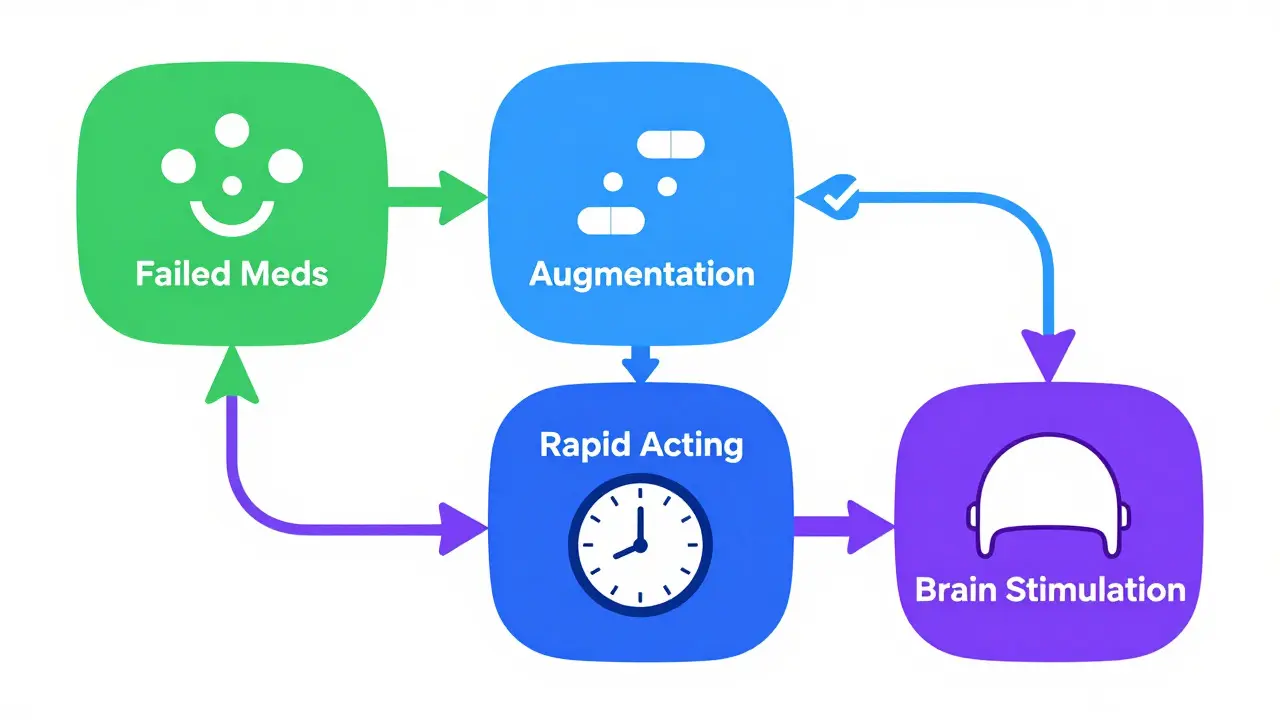
Dealing with TRD requires patience and advocacy. Real-world data from the EU-NEURD registry indicates that only 28.4% of TRD patients achieve remission with standard strategies, underscoring the need for persistence. Work closely with your psychiatrist to track symptoms, side effects, and progress. If one augmentation strategy fails, another may succeed. The economic burden of TRD is staggering-estimated at $210.5 billion annually in the US-but the human cost is higher. With the right combination of augmentation, neuromodulation, and psychotherapy, remission is achievable.
What defines Treatment-Resistant Depression?
TRD is defined as major depressive disorder that has not responded adequately to at least two different antidepressant trials of sufficient dose and duration. Approximately 30-40% of patients meet this criteria after two failed attempts.
Is Esketamine safe for everyone?
Esketamine is generally safe but requires administration in a certified clinic due to risks of dissociation and increased blood pressure. It is contraindicated in patients with a history of seizures or intracranial hemorrhage.
How long does rTMS treatment take?
A standard course of rTMS involves daily sessions, typically five days a week, for four to six weeks. Maintenance sessions may be recommended thereafter to sustain benefits.
Can lithium be used for depression augmentation?
Yes, lithium is a well-established augmentation agent for TRD. It requires regular blood tests to monitor levels (target 0.3-0.6 mEq/L) and kidney/thyroid function due to its narrow therapeutic window.
Are there new treatments emerging for TRD?
Yes, research is ongoing into anti-inflammatory agents like infliximab for patients with high inflammation markers, and psychedelic-assisted therapies such as psilocybin, which have shown promising early results in clinical trials.