
Tendering Systems in Europe: A Guide to Generic Purchasing and Public Procurement
 Apr, 15 2026
Imagine spending 117 hours of your team's time drafting a bid, only to have it rejected because you used the wrong category code. For many companies entering the European market, this is the harsh reality of tendering systems is a structured regulatory framework used by public authorities to purchase goods and services through open and competitive bidding. While the system is designed to be fair, the sheer scale of it-roughly €2 trillion spent annually across the EU-creates a complex maze of rules that can either launch a business or bankrupt its administrative budget.
If you are looking to supply generic pharmaceuticals or infrastructure to European governments, you aren't just selling a product; you are competing in a highly codified legal arena. Success depends on understanding that Europe doesn't just want the cheapest option-they want the most value. Whether you're a small startup or a global giant, navigating these waters requires a shift from "sales mode" to "compliance mode."
Key Takeaways for Bidders
- Value over Price: The MEAT method means quality and innovation often outweigh the lowest bid.
- Digital First: Electronic tendering is the norm, with the TED portal acting as the central hub.
- Strict Proportionality: Authorities cannot demand unrealistic financial backgrounds for small contracts.
- Administrative Hurdle: Small businesses face significantly higher relative workloads during the bidding phase.
How Europe Structures Public Purchasing
The goal of the EU's approach is to stop local governments from only hiring "the guy they know." By enforcing Directive 2014/25/EU the primary regulatory framework governing procurement in the water, energy, transport, and postal sectors , the EU ensures that a company in Estonia has the same shot at a contract in Belgium as a local firm. This removes discriminatory technical specs and forces authorities to advertise contracts community-wide.
For those in the generic purchasing space, this means a massive, transparent marketplace. However, the rules only kick in when contracts hit certain financial thresholds. Below that, national laws take over, but the overarching spirit remains: transparency, non-discrimination, and the pursuit of the best possible deal for the taxpayer.
Choosing the Right Bidding Path
Not every tender is handled the same way. Depending on what is being bought, the authority will choose a specific procedure. If you're entering a bid, you need to know which "game" you're playing because the preparation time varies wildly.
| Procedure | Who can bid? | Best for... | Main Drawback |
|---|---|---|---|
| Open | Anyone | Standard goods/services | High admin burden for buyers |
| Restricted | Pre-qualified only | Specialized expertise | Harder for new entrants to join |
| Competitive Negotiated | Pre-selected few | Complex/Security needs | Risk of perceived favoritism |
| Competitive Dialogue | Invited candidates | Innovation/New Tech | Very long preparation time |
Most generic purchases follow the Open procedure, which accounts for about 45% of all tenders. But if you're dealing with high-tech medical equipment or smart grids, you'll likely encounter the Competitive Dialogue a procedure allowing buyers to discuss requirements with bidders to develop a solution before the final bid . This iterative process can lead to massive savings-one Finnish smart grid project saw a 32% cost reduction-but it requires a huge time investment (often 120+ hours for first-timers).
The Secret to Winning: MEAT Evaluation
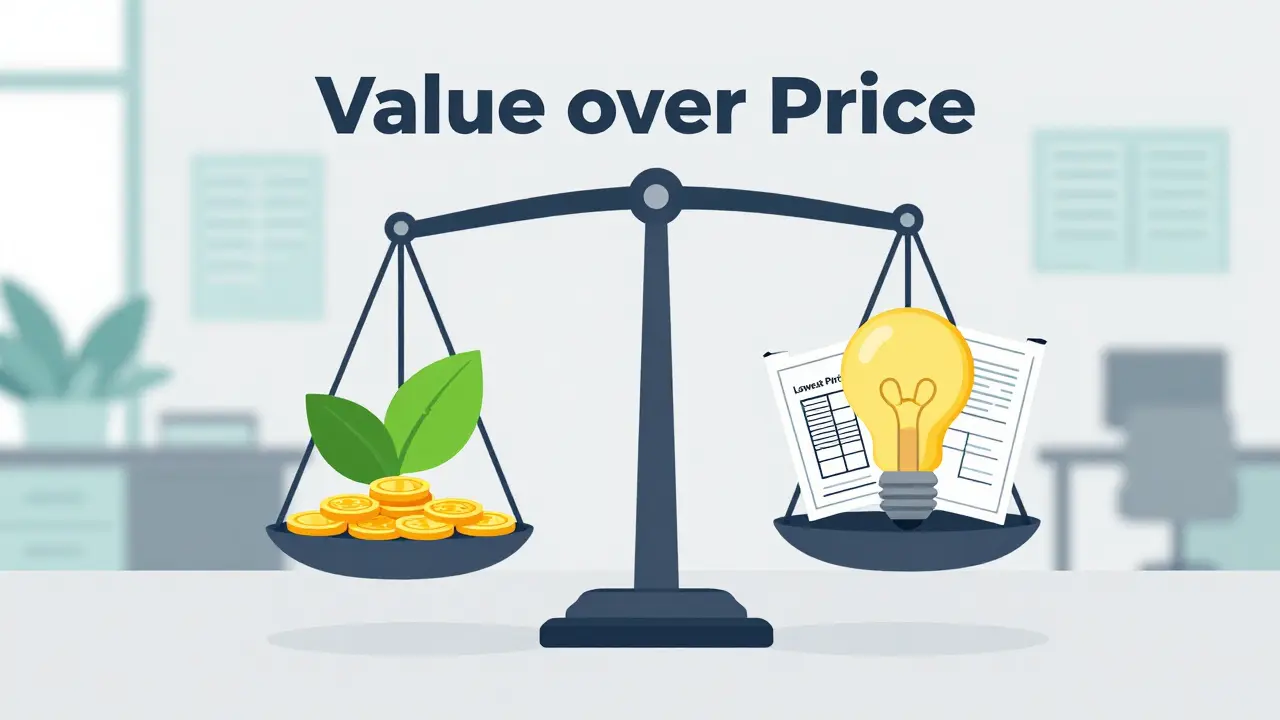
If you're bidding solely on price, you're likely losing. Modern European procurement relies on the MEAT Most Economically Advantageous Tender, a methodology that weighs quality, technical merit, and environmental impact alongside price methodology. It's no longer just about who is cheapest; it's about who provides the best long-term value.
Data from Bocconi University suggests that using MEAT generates 12-18% better outcomes for complex projects compared to "lowest price" wins. For the bidder, this means your technical writing is just as important as your pricing sheet. If you can prove your generic product has a lower carbon footprint or a longer shelf life, you can win even if your price is slightly higher. In fact, new rules now require tenders over €1 million to weight quality criteria at least 50% of the total score.
Practical Steps to Submit a Winning Bid
Winning a contract isn't about luck; it's about a systematic approach. Most successful bidders follow a strict six-step pipeline to avoid the common pitfalls that lead to immediate disqualification.
- Set up Intelligence: Register for alerts on TED Tenders Electronic Daily, the online version of the Supplement to the Official Journal of the EU . If you aren't monitoring this daily, you're missing the window.
- Audit the Notice: Review the contract notice and request all tender documents. Pay close attention to the CPV (Common Procurement Vocabulary) codes; getting these wrong is a primary reason why 23% of bids get rejected.
- The Selection Phase: Complete the pre-qualification. Use the European Single Procurement Document ESPD, a standard self-declaration form used to simplify the pre-qualification process (ESPD) to cut down on the paperwork.
- Draft the Proposal: Build your technical and financial bids. Focus on the MEAT criteria-highlight innovation and sustainability.
- Negotiation: If you're in a Negotiated or Dialogue procedure, engage actively. This is where you can influence the final requirements to align with your product's strengths.
- Notification: Once awarded, ensure all contract terms are mirrored in your operational plan to avoid legal disputes.
Common Pitfalls and How to Avoid Them
Even experienced firms trip up. One of the biggest issues is "requirement ambiguity." A study showed that 68% of supplier complaints stem from vague technical specifications. When you see a requirement that seems contradictory, ask for clarification immediately. Waiting until the bid deadline to realize the specs are impossible is a recipe for failure.
Then there is the "Framework Agreement" trap. You might spend weeks qualifying for a Framework Agreement an arrangement between a buyer and one or more suppliers to establish the terms governing contracts during a given period , only to find that very few "mini-tenders" actually happen. The key is to target multi-supplier frameworks. These provide more predictable revenue and lower bidding costs over time compared to fighting for a single-supplier lock-in.
The Future: Green and Digital
The system is moving toward two major goals: total digitalization and aggressive sustainability. By 2027, the EU aims for 95% electronic tendering. We're already seeing AI-assisted evaluations in France and Finland that speed up the process by 30% while keeping scoring consistent.
Sustainability is no longer a "nice to have." Around 68% of high-value tenders already include environmental criteria, and that number is expected to hit 85% by 2025. If your supply chain isn't green, you're becoming uncompetitive in the European market. The "Circular Economy" isn't just a buzzword here; it's becoming a mandatory requirement in the technical specs of nearly every major contract.
What is the difference between an Open and Restricted procedure?
In an Open procedure, any supplier can submit a full tender. In a Restricted procedure, there is a two-stage process: first, suppliers apply to participate, and then only those who meet specific qualification criteria are invited to submit a final bid. Restricted procedures are usually used when the buyer wants to ensure only highly qualified experts apply.
How does MEAT evaluation work in practice?
MEAT (Most Economically Advantageous Tender) moves away from picking the cheapest option. The buyer assigns weights to different factors-for example, 40% for price, 40% for technical quality, and 20% for environmental impact. The bidder with the highest weighted score wins, even if they aren't the cheapest.
What is the ESPD and why does it matter?
The European Single Procurement Document (ESPD) is a standardized form that allows companies to self-declare their qualifications. Instead of submitting a mountain of certificates for every single bid, you use the ESPD to prove you meet the criteria. The heavy documentation is only required from the winning bidder at the end.
Why are CPV codes so important?
CPV (Common Procurement Vocabulary) codes are the standardized tags used to categorize tenders across the EU. If a bidder misclassifies their product or searches for the wrong code, they might miss the opportunity entirely or have their bid rejected for not matching the tender's intended scope.
Can small businesses realistically compete in EU tenders?
Yes, but it's harder. Small businesses spend significantly more time per bid on paperwork than large firms. To succeed, SMEs should leverage the "proportionality principle," which prevents buyers from demanding unrealistic financial turnovers, and focus on niche technical strengths where they can beat larger, slower competitors on quality.
Cheryl C
April 17, 2026 AT 07:04Why do we even care about these EU rules?? 🙄 USA is way better and dont make us jump thru hoops like some kind of circus act just to sell stuff! 🇺🇸🦅 This whole system sounds like a total nightmare and just a way for them to steal our money with all these "green" rules lol!! Absolute joke 🤡
william wang
April 17, 2026 AT 23:17The ESPD is actually a lifesaver for anyone trying to scale. It basically turns a mountain of paperwork into a simple self-declaration, which lets you focus on the technical proposal rather than hunting down certificates from ten years ago. It's a huge efficiency gain for the whole process.
Randall Barker
April 19, 2026 AT 06:19It is a moral failure to prioritize 'innovation' over the basic economic reality of cost. This MEAT system is just a thin veil for bureaucracy to decide winners based on political whims rather than objective merit. We are witnessing the death of true capitalism in favor of a curated, state-managed illusion of competition. Absolutely pathetic.
Jon lee
April 20, 2026 AT 14:06For those smaller shops feeling overwhelmed by the admin side, remember that the proportionality principle is your best friend. Don't let a massive corporate-looking document scare you off; if the contract is small, they can't legally demand that you have the turnover of a Fortune 500 company. Just keep pushing through!
Anna BB
April 21, 2026 AT 14:11It is so interesting how the shift toward sustainability reflects a deeper collective consciousness...!! I wonder if this will eventually lead to a global standard where the earth's health is the primary metric of value??? It seems like a beautiful way to align business with nature!!!!
Rob Schlautman
April 23, 2026 AT 13:15here we go again with another guide telling us how to navigate a system that was designed by people who love paperwork more than they love actually getting things done and honestly who has the time to spend 120 hours on a single bid when you could be actually running your business instead of playing games with cpv codes that barely make sense to begin with anyway
Richard Moore
April 23, 2026 AT 21:56I totally agree that the technical writing is where the battle is won! ✍️✨ If you can prove your value, the price becomes a secondary detail. Let's all support each other in mastering these MEAT criteria and crushing the competition with quality! 🚀💪
Heer Malhotra
April 24, 2026 AT 06:04The European Union attempts to impose its regulatory hegemony upon the global market under the guise of transparency. It is an affront to national sovereignty when external bodies dictate the procurement standards of an entire continent through rigid directives such as 2014/25/EU. We must remain vigilant against such systemic overreach.
Josephine Wyburn
April 26, 2026 AT 00:23I just can't believe the stress of spending 117 hours on a bid only to be rejected because of a tiny code error 😭 like where is the humanity in that?? I'm literally shaking just thinking about the mental toll that kind of failure would take on a small business owner who put their heart and soul into a proposal only to be cast aside by a robot or some bureaucrat who doesn't even care about the people involved 💔🥀
Michael Lewis
April 26, 2026 AT 14:30Stop complaining about the hours and start optimizing your pipeline! The winners are the ones who treat bidding like a science. Set up those TED alerts, build a library of responses for the common MEAT criteria, and stop treating the administrative part as a chore-it's a competitive advantage! Get after it!
Joshua Nicholson
April 28, 2026 AT 02:34it's alright i guess. sounds like a lot of work for something that might not even pay off in the end lol.
Adele Shaw
April 29, 2026 AT 18:22Typical EU garbage. They want our tech but they want to wrap it in a thousand layers of red tape and "green" nonsense just to feel superior. This is exactly why the US should stop playing nice and start dominating every single market without apologizing for being the best in the world. 🇺🇸