
Shared Decision-Making Scripts for Side Effect Trade-Offs in Medication Choices
 Dec, 4 2025
Medication Side Effect Trade-Off Calculator
Understand Your Side Effect Trade-Offs
This calculator helps you compare different medication options based on side effects that matter most to you. Enter your personal priorities to see which treatment aligns best with your values.
Select Your Medication Type
Medication Options
Drug A
Option 1Drug B
Option 2Why Talking About Side Effects Matters More Than You Think
Imagine you’re prescribed a new medication. Your doctor says it’s effective, and you take it. But two weeks later, you’re too tired to get out of bed, or your stomach is in knots every morning. You stop taking it-not because it doesn’t work, but because the side effects ruined your daily life. This happens more often than you’d expect. In fact, 86% of patients on statins quit because of side effects, even when the drug is medically necessary. The problem isn’t just the side effects themselves-it’s that most patients aren’t given the tools to weigh them against the benefits before they start.
Shared decision-making (SDM) isn’t just a buzzword. It’s a proven way to help patients and doctors make better choices together, especially when side effects are involved. Studies show that when patients use structured scripts to talk about trade-offs, they’re 23% less likely to feel conflicted about their treatment. And when they do feel heard, they stick with their meds longer. That’s not just nice-it’s life-changing.
The SHARE Approach: A Simple Framework for Tough Conversations
The Agency for Healthcare Research and Quality (AHRQ) created the SHARE Approach to make these conversations easier. It’s not about memorizing lines. It’s about guiding the discussion so both sides leave with clarity. Here’s how it works:
- Seek opportunities to include the patient. Don’t assume they want you to decide for them. Start with: “Some people like to be part of the decision when choosing a medication. Is that something you’d want to do?”
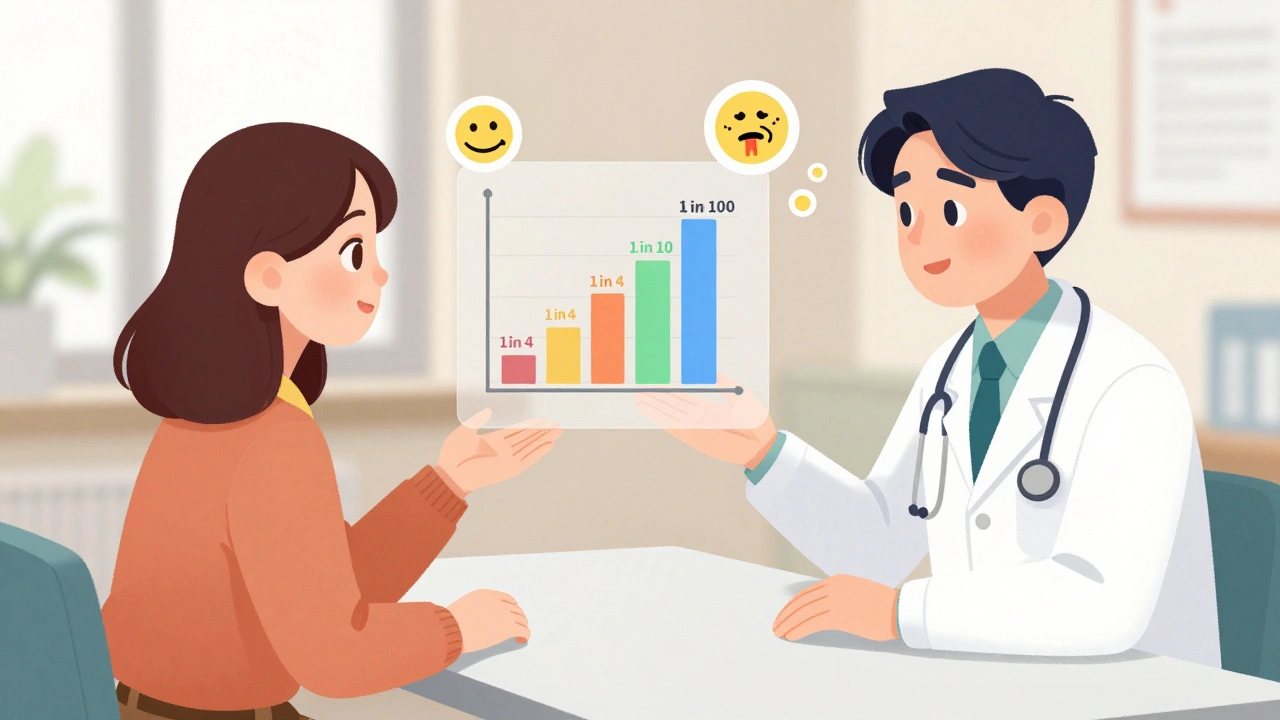
- Help explore options. Don’t just say “this drug works.” Compare alternatives. “We could try Drug A, which helps with pain but causes drowsiness in 1 in 4 people. Or Drug B, which is less sedating but has a 1 in 10 chance of nausea. Which trade-off feels more manageable to you?”
- Assess values and preferences. This is where most conversations fail. Ask: “What side effects would make you stop taking this medication?” or “Is there one effect that would be a deal-breaker for you?”
- Reach a decision together. Don’t push. Say: “Based on what you’ve said, it sounds like avoiding drowsiness is more important than avoiding nausea. Does that match what we’ve discussed?”
- Evaluate the decision later. Follow up: “How’s the medication treating you? Are the side effects worse than you expected?”
This isn’t theory. It’s used in 47 U.S. healthcare systems and backed by data showing fewer patients quit treatment because they were blindsided.
How to Talk About Risk Without Scaring People
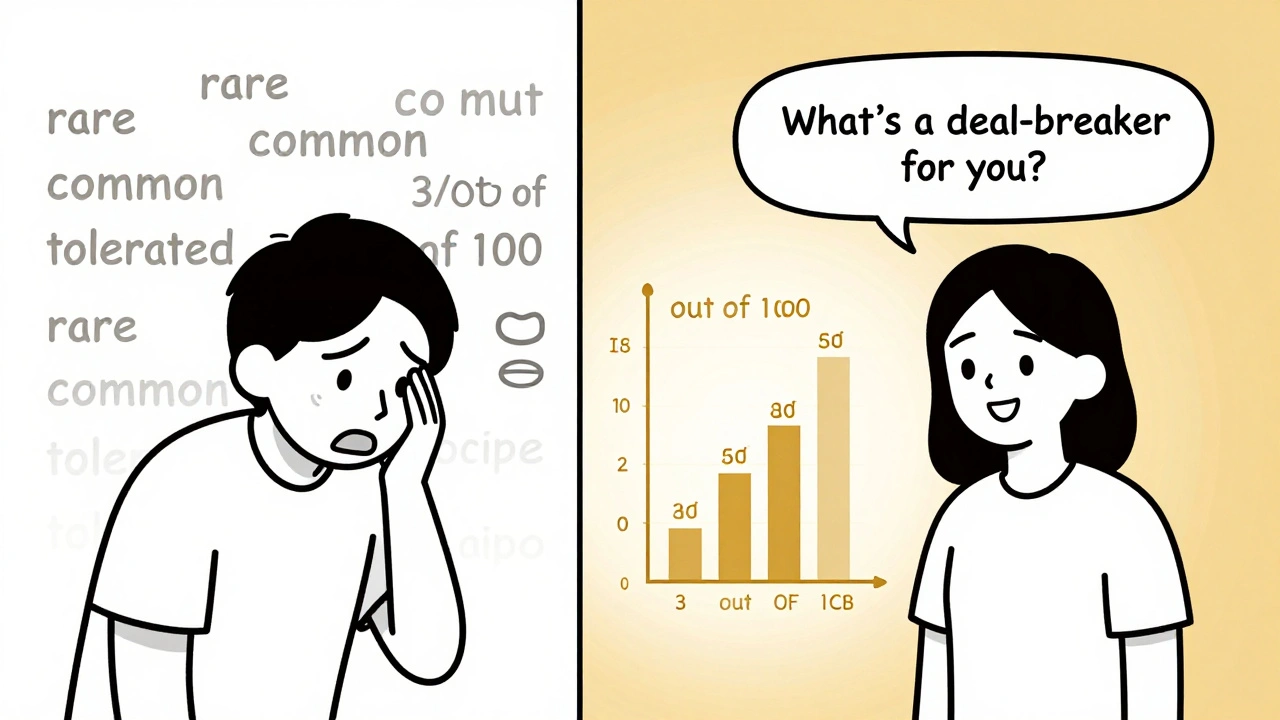
Doctors often say things like “this side effect is rare” or “most people tolerate it fine.” But what does “rare” mean? 1 in 100? 1 in 1,000? Patients hear “rare” and assume it won’t happen to them. That’s a dangerous assumption.
Effective scripts use absolute numbers, not vague terms. Instead of saying “there’s a small risk of bleeding,” say: “Out of 100 people taking this, 3 will have a major bleeding event.” That’s clear. That’s real. And it’s what research shows patients understand best. A 2019 study found that using absolute risk numbers improves patient comprehension by 37%.
Also, avoid framing everything as a loss. Don’t say “this drug reduces your stroke risk by 40%.” That sounds impressive-but it’s relative. Instead, say: “Without this drug, 5 out of 100 people have a stroke in a year. With it, that drops to 3 out of 100.” Now they see the real difference: 2 fewer strokes per 100 people. That’s not magic. That’s math.
What Patients Really Care About (It’s Not Just the Numbers)
Side effects aren’t just medical facts-they’re life disruptions. One patient might tolerate nausea if it means avoiding hospitalization. Another can’t handle brain fog if it means missing work or forgetting to pick up their kid. That’s why the most powerful question in any SDM script is: “Which side effect would be a deal-breaker for you?”
According to a 2023 survey, 78% of patients said this single question helped them feel truly heard. It shifts the conversation from “what can go wrong” to “what matters to you.”
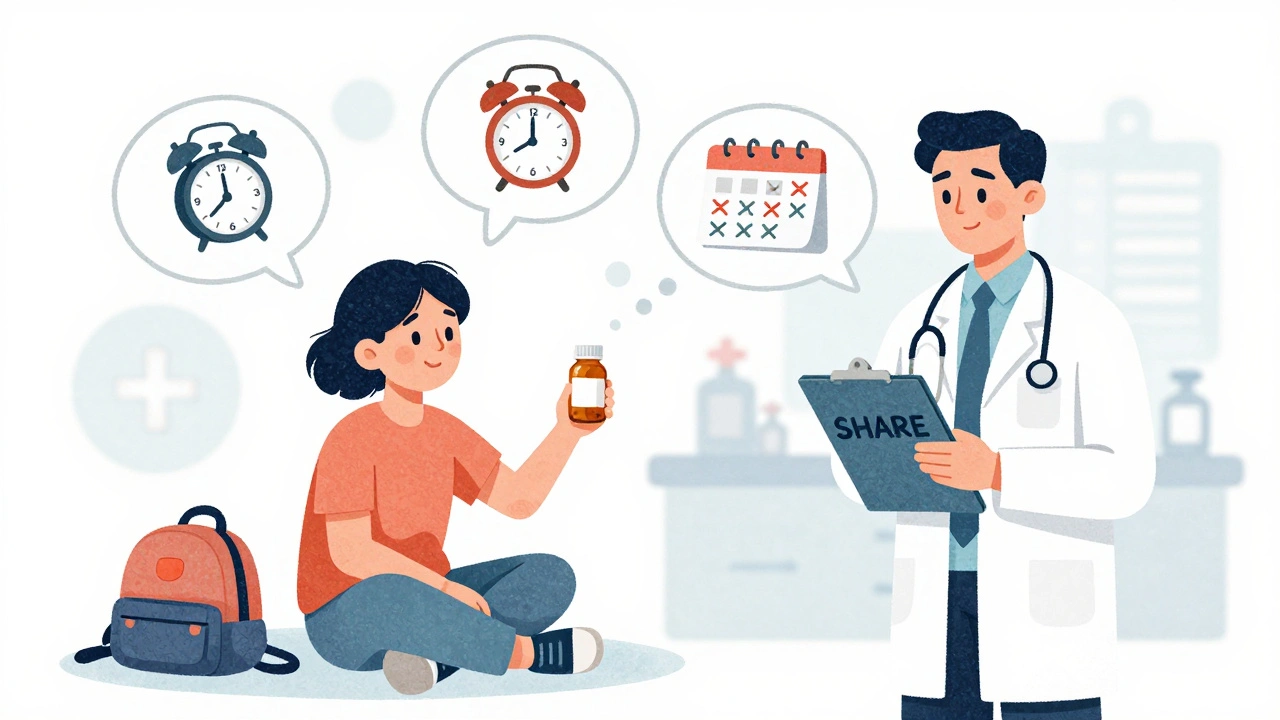
And it’s not just about physical symptoms. Treatment burden-the daily hassle of pills, blood tests, doctor visits-accounts for 42% of decision regret in chronic illness. One patient told me: “I didn’t mind the dry mouth. I minded having to take five pills at three different times a day and remembering to call the lab every week. That wore me out.”
That’s why effective scripts include a quick check: “How much extra work are you willing to take on for this treatment?”
When Scripts Go Wrong (And How to Fix It)
Not all SDM conversations work. Some patients feel like their doctor is reading from a checklist. Others say it felt robotic. Why? Because scripts aren’t meant to be scripts-they’re meant to be guides.
A 2022 study found that when clinicians use SDM tools without adapting them, patient satisfaction drops by 19%. The fix? Listen more than you speak. If a patient says, “I’m scared of weight gain,” don’t jump to statistics. Say: “Tell me more about why that worries you.”
Also, don’t force it. If someone’s in acute pain or just had bad news, they may not want to weigh options. Save SDM for when they’re ready. And if time is short? Use a quick version: “Here’s the main trade-off. What’s your priority-less pain, or fewer side effects?”
Tools That Help: Decision Aids and EHR Integration
Some clinics use visual aids-color-coded charts showing side effect probabilities. One hospital saw a 41% increase in patient satisfaction just by adding these. A simple bar chart with “1 in 10,” “1 in 4,” “1 in 100” makes abstract numbers real.
Electronic health records are catching up too. Epic Systems now includes SDM modules in 63% of U.S. hospitals using their platform. These tools prompt doctors with condition-specific questions: “For statin users, ask about muscle pain and willingness to take daily pills.”
And pre-visit materials help. A Kaiser Permanente program gave patients a 5-minute video explaining statin side effects before their appointment. Result? 33% fewer people stopped their medication because they knew what to expect.
Why This Isn’t Just a Trend-It’s the New Standard
Medicare now requires documentation of shared decision-making for high-risk drugs. Doctors can get reimbursed $45-$65 for these conversations. Insurance companies are pushing for it. Medical schools teach it. And patients? They’re asking for it.
On Reddit, a thread titled “How my doctor helped me choose between medications with difficult side effects” got over 140 upvotes. People wrote: “Finally, someone asked me what I could live with.” “I felt like a person, not a chart.”
This isn’t about being nice. It’s about getting better outcomes. Fewer hospital visits. Fewer dropped prescriptions. Fewer regrets. When patients are part of the decision, they’re more likely to stick with it-and that’s what matters most.
What You Can Do Right Now
If you’re a patient: Before starting a new medication, ask: “What are the top three side effects? How often do they happen? Which ones would make you stop?”
If you’re a clinician: Start with one script. Pick one common drug-like a statin or blood thinner-and use the SHARE steps in your next three visits. Track what changes. You’ll see it: patients ask better questions. They remember more. They trust more.
It’s not about doing more. It’s about doing it differently. And the data doesn’t lie-when side effects are discussed honestly, clearly, and personally, everyone wins.
What is shared decision-making in healthcare?
Shared decision-making is a process where patients and clinicians work together to choose the best treatment based on medical evidence and the patient’s personal values, goals, and concerns. It’s not about the doctor deciding alone-it’s about both parties understanding the risks, benefits, and trade-offs before choosing a path.
Why are side effect trade-offs so hard to discuss?
Side effects are often vague, poorly explained, or downplayed. Terms like “rare” or “common” mean different things to different people. Patients may also fear sounding ungrateful or challenging their doctor’s judgment. Structured scripts help by making risks concrete, normalizing concerns, and focusing on what matters most to the patient-not just what’s statistically likely.
What’s the difference between relative and absolute risk?
Relative risk sounds impressive but can be misleading. For example, “This drug cuts your stroke risk by 50%” sounds huge-but if your baseline risk was 2%, now it’s 1%. That’s a 1% absolute reduction. Absolute risk tells you the real change: “Out of 100 people, 2 have strokes without the drug. With it, only 1 does.” That’s clearer and less manipulative.
Can shared decision-making be used in emergencies?
In true emergencies-like a heart attack or severe trauma-there’s no time for full SDM. But even then, brief communication helps: “We need to give you this now to save your life. It may cause nausea or low blood pressure. We’ll monitor you closely.” For non-emergency situations, even urgent ones like new prescriptions for chronic conditions, SDM should be used.
How long does a shared decision-making conversation take?
A full SDM conversation for a medication with multiple side effects adds about 7-8 minutes to a typical visit. But using pre-visit materials like short videos can cut that time by 3 minutes. Many doctors find that the extra time pays off-fewer follow-up calls, fewer missed doses, and fewer patients quitting treatment.
Are there free tools I can use to prepare for a side effect discussion?
Yes. The Agency for Healthcare Research and Quality (AHRQ) offers free, downloadable decision aids and conversation scripts on their website for common conditions like high blood pressure, diabetes, and statin use. Many hospitals also offer printable or video-based tools through their patient portals. Ask your doctor if they have any.
What if I disagree with my doctor’s recommendation?
That’s exactly what shared decision-making is designed for. You don’t have to accept their first suggestion. Say: “I understand why you recommend this, but I’m worried about [side effect]. Is there another option that might be better for me?” Most doctors appreciate patients who ask thoughtful questions. If they push back or dismiss your concerns, it’s okay to seek a second opinion.
Katie Allan
December 5, 2025 AT 15:51Stephanie Bodde
December 6, 2025 AT 05:15Philip Kristy Wijaya
December 7, 2025 AT 10:19Jennifer Patrician
December 7, 2025 AT 12:25Mellissa Landrum
December 8, 2025 AT 19:17Mark Curry
December 10, 2025 AT 16:45Ada Maklagina
December 11, 2025 AT 17:52Harry Nguyen
December 13, 2025 AT 07:54Deborah Jacobs
December 13, 2025 AT 10:57aditya dixit
December 15, 2025 AT 00:32Lynette Myles
December 15, 2025 AT 09:18Mark Ziegenbein
December 16, 2025 AT 17:13