
Provider Education on Generics: Improving Clinician Knowledge to Boost Adherence and Cut Costs
 Feb, 24 2026
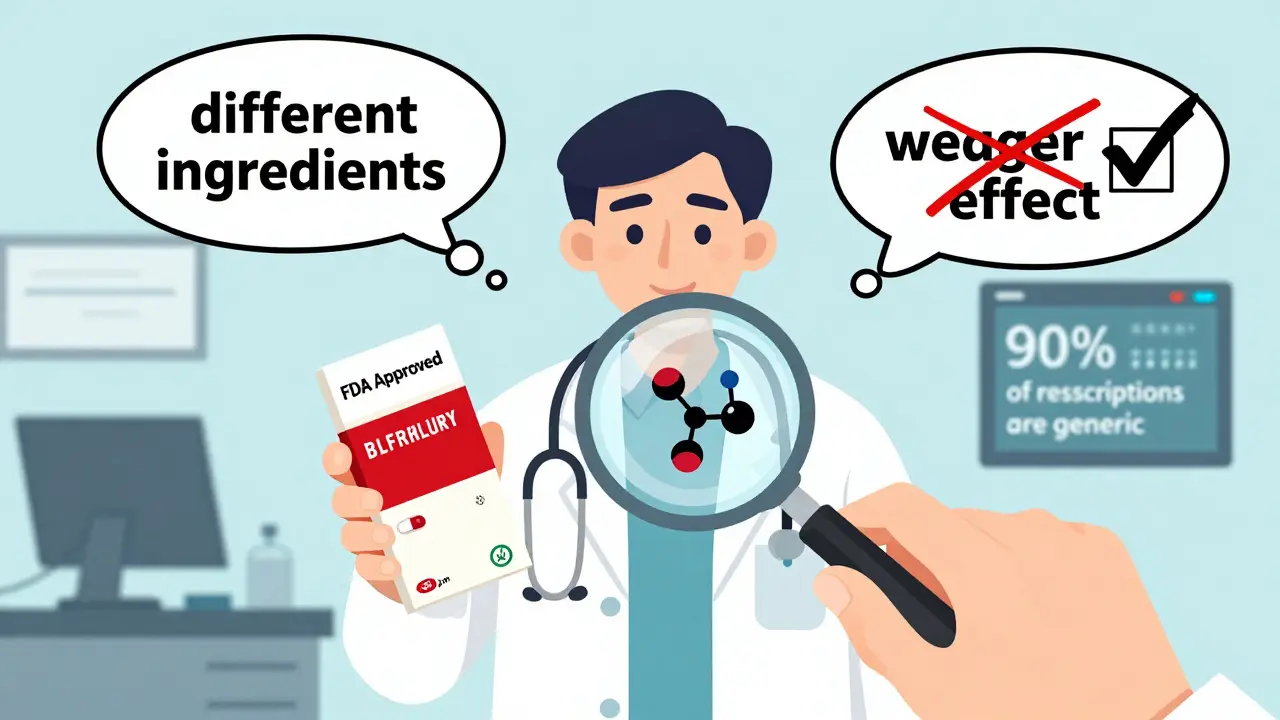
Generic drugs are used in 90% of all prescriptions in the U.S., yet many clinicians still hesitate to prescribe them. Why? Not because they’re less effective-but because they don’t fully understand how they work. A 2017 study found that 68% of physicians had at least some doubt about whether generics were truly equivalent to brand-name drugs. That’s a huge gap when you consider generics save patients and the system billions each year. The problem isn’t the drugs-it’s the education.
What Generic Drugs Really Are
Generic drugs aren’t copies. They’re exact replicas of brand-name drugs in every way that matters: same active ingredient, same strength, same dosage form, same route of delivery. The FDA requires them to meet the same strict manufacturing standards as brand-name drugs. The only differences? Inactive ingredients-like dyes or fillers-and the price. These inactive ingredients don’t affect how the drug works. But many clinicians think they do.
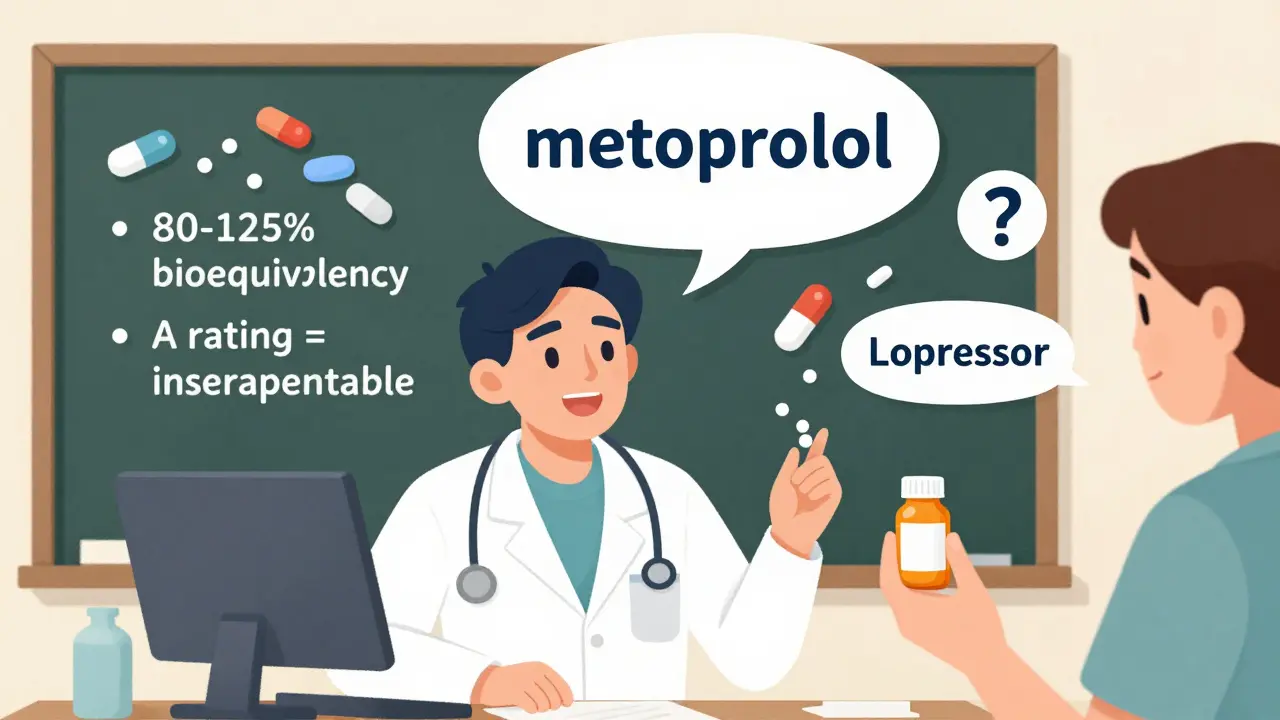
Here’s the hard truth: 45% of prescribers mistakenly believe generics must have identical inactive ingredients. 38% think manufacturing standards are looser for generics. And 27% wrongly think bioequivalence means generics can contain up to 20% less active ingredient. All of these are false. The FDA’s bioequivalence rule is clear: the 90% confidence interval for absorption (AUC and Cmax) must fall between 80% and 125% of the brand-name drug. That’s not a guess. It’s science.
The FDA’s Orange Book lists every approved generic and rates its therapeutic equivalence with a two-letter code. An ‘A’ rating means it’s interchangeable. A ‘B’ means it’s not. Most generics are ‘A’. But many doctors never check it.
Why Clinicians Still Prefer Brand Names
Even though generics are cheaper and just as effective, 62% of physicians still default to prescribing brand names. Why? It’s not laziness-it’s training. Medical students learn generic names in class. But in clinics, attending physicians say "Lopressor" instead of "metoprolol," "Zoloft" instead of "sertraline." Residents hear this daily. They leave school knowing the science, but they leave the hospital hearing brand names.
It gets worse. When a patient asks, "Is this the same as the blue pill I used to take?" and the doctor says, "It’s a generic," without adding, "It’s exactly the same," the patient hears "different." And that’s enough to make them skip doses or stop taking it altogether. Studies show patients are 35% more likely to start a medication when it’s a generic-if the provider endorses it. If they don’t? That number drops.
How Education Changes Behavior
One-size-fits-all education doesn’t work. A 2021 study in JAMA Internal Medicine compared two groups: one got a PDF handout. The other got interactive case-based sessions over six months. At six months, the interactive group had 42% higher knowledge retention. Simple fact sheets? Useless. Real conversations? Game-changer.
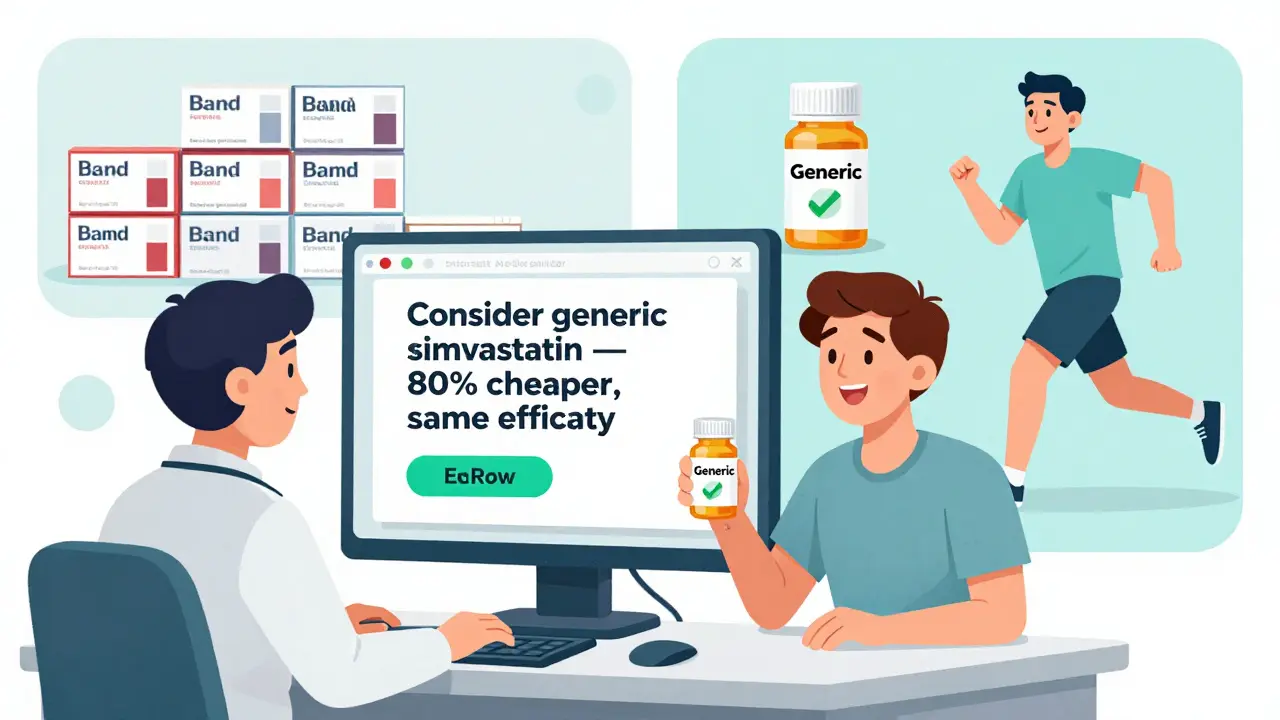
At UCSF Medical Center, they trained their prescribers on statins. They showed them data: generics work just as well. They role-played patient conversations. They embedded prompts in the EHR that popped up when a brand-name statin was selected: "Consider generic simvastatin-same efficacy, 80% cheaper." Within a year, brand-name statin prescriptions dropped by 37%.
Another win? Reducing nocebo effects. When patients believe a generic won’t work, they report more side effects-even when the drug is identical. Harvard research found that when providers explicitly said, "This generic is exactly the same as the brand," patient-reported side effects dropped by 18%. That’s not placebo. That’s trust.
Where Education Falls Short
Not all specialties are equal. Family doctors prescribe generics 89% of the time. Neurologists? Only 67%. Cardiologists and psychiatrists are the most hesitant. Why? Because they treat chronic conditions where patients are sensitive to change. A patient on levothyroxine might panic if their pill changes color-even if it’s the same drug. But here’s the twist: the data on levothyroxine generics is clear. The FDA says they’re equivalent. Some studies claim higher failure rates-but those studies are small, poorly controlled, and contradict the broader evidence.
Biosimilars are another mess. Only 28% of oncologists can correctly explain the difference between a generic small molecule and a biosimilar large molecule. Biosimilars aren’t generics. They’re complex biologics with minor structural differences. But many clinicians lump them together. That confusion leads to unnecessary brand-only prescribing.
And then there’s the time problem. In a 15-minute visit, talking about generics isn’t a priority. A 2020 ASPE study found only 35% of primary care doctors routinely discuss generics with patients. They’re overwhelmed. But the solution isn’t more meetings-it’s smarter integration.
What Works: Practical Steps for Better Education
Start with the FDA’s free tools. The Generic Drug Facts Handout (148KB PDF) is simple. The Generic Drugs and Health Equity Handout (958KB PDF) dives deeper. But here’s the kicker: only 22% of providers even know these exist.
Here’s what actually moves the needle:
- Spaced learning: Four 90-minute sessions over six months boost retention by 52% compared to a single lecture.
- EHR nudges: When a provider selects a brand-name drug, the system suggests a generic alternative with cost savings. One pilot increased generic use by 24%.
- Role-playing: Practice saying, "This generic is FDA-approved to work the same way. I’ve prescribed it to dozens of patients with the same results."
- Peer champions: Train one or two respected clinicians in each department to model and advocate for generics.
Some programs fail because they’re disconnected. A Tennessee Medicaid initiative spent $1.2 million on education-but didn’t link it to EHRs or pharmacy systems. Result? Only 8% improvement. Education must be embedded, not added on.
The Future Is Personalized
U.S. health systems are starting to use AI to target education. UnitedHealthcare’s 2024 pilot identifies doctors who prescribe few generics. Then it sends them tailored content: case studies, patient testimonials, cost data. The result? A 28% increase in generic prescribing.
In 2023, the FDA launched VR training modules that simulate patient conversations. Doctors wear headsets and practice responding to concerns like, "Will this really work?" or "My old pill was better." Early results show 41% improvement in communication confidence.
By 2025, Medicare’s Merit-based Incentive Payment System (MIPS) will include generic prescribing rates as a quality metric. Hospitals will be scored on how often they choose cost-effective generics. That’s not a punishment-it’s a signal: the system is betting on education to drive better outcomes.
What You Can Do Today
You don’t need a grant or a tech upgrade. Start small:
- Download the FDA’s Generic Drug Facts Handout. Read it. Share it.
- Next time you prescribe, say the generic name first. Then add: "This is the same as the brand, but cheaper."
- Ask your pharmacy: "What’s the generic equivalent of this drug?" Use their answer to teach residents.
- Push for an EHR alert that pops up when a brand-name drug is selected.
The data is clear: better education = better adherence = lower costs. Patients aren’t rejecting generics. They’re rejecting uncertainty. Your words-simple, confident, factual-can change that.
Are generic drugs really as effective as brand-name drugs?
Yes. The FDA requires generics to have the same active ingredient, strength, dosage form, and route of administration as the brand-name drug. They must also prove bioequivalence-meaning their absorption into the bloodstream must be within 80-125% of the brand. This isn’t theoretical. Millions of patients take generics daily with the same results. The FDA monitors adverse events for both brand and generic drugs and finds no meaningful difference in safety or effectiveness.
Why do some doctors still prescribe brand-name drugs over generics?
Several reasons: lack of education, habit, and patient perception. Many clinicians were trained to use brand names during residency. Others worry about patient backlash-even though studies show patients are more likely to adhere when generics are prescribed. Some also confuse biosimilars with generics or believe inactive ingredients affect efficacy, which isn’t supported by evidence. Time pressures in clinics mean conversations about alternatives often get skipped.
Can pharmacists substitute generics without the doctor’s permission?
It depends on the state. In 19 states, pharmacists can substitute a generic without notifying the prescriber. In 16 states, the prescriber must write "dispense as written" on the prescription to prevent substitution. In the rest, rules vary. Always check your state’s pharmacy laws. But even where substitution is allowed, the drug must have an ‘A’ rating in the FDA’s Orange Book to be interchangeable.
What’s the difference between a generic and a biosimilar?
Generics are chemically identical small-molecule drugs-like metformin or lisinopril. Biosimilars are complex biological products-like insulin or adalimumab-that are highly similar to, but not exact copies of, their reference product. They’re made from living cells, not chemicals. Because of this complexity, biosimilars require different approval pathways than generics. Many clinicians confuse the two, leading to unnecessary brand-only prescribing. Only 31% of providers can correctly explain the difference.
How can I learn more about generic drugs as a clinician?
Start with the FDA’s Generic Drugs Stakeholder Toolkit. It includes free handouts, fact sheets, and videos. The Generic Pharmaceutical Association (GPhA) offers online modules. Academic detailing programs through groups like ICER provide one-on-one education. For ongoing learning, look for CME courses on therapeutic equivalence. And don’t overlook your pharmacists-they’re trained in generics and can be valuable allies in patient education.
Anil bhardwaj
February 25, 2026 AT 09:25Been prescribing generics for years in India, and honestly? Patients don’t care what it’s called as long as it works. I’ve had folks come back saying, 'Sir, this cheaper pill did the same thing as the blue one.' No drama. No side effects. Just results. The real issue isn’t the science-it’s the noise.
Joanna Reyes
February 27, 2026 AT 08:36Let me just say this: the data in this post isn’t just convincing-it’s devastatingly clear. The fact that 38% of clinicians think manufacturing standards are looser for generics? That’s not ignorance. That’s systemic failure. We train doctors to memorize brand names in residency, then wonder why they default to them. And then we wonder why patients stop taking meds? It’s not the drugs. It’s the messaging. We need mandatory modules in med school that aren’t just about pharmacokinetics, but about patient psychology. Role-playing isn’t fluff-it’s survival. I’ve seen patients cry because they thought switching meant their disease was getting worse. That’s trauma we’re ignoring.
And don’t get me started on biosimilars. I had a cardiologist tell me last week, 'I won’t prescribe it because it’s not a true generic.' I had to pull up the FDA’s definition on my phone. He still looked skeptical. That’s the battle.
Stephen Archbold
February 28, 2026 AT 09:12OMG YES. I work in a rural clinic and we just started using EHR nudges last month. Like, when someone picks Lantus, it pops up: 'Insulin glargine: $15 vs $300.' First week? 12 switches. Second week? 21. I didn’t even have to say anything. The system did it. Also-my resident just asked me if 'generic' means 'fake.' I nearly fell out of my chair. We need to start this in med school. Like, day one. Not as an elective. As a core.
Also-can we PLEASE stop calling them 'generics'? Just say 'bioequivalent.' Sounds less sketchy. My patients trust 'bioequivalent' way more. Just a thought.
Nerina Devi
March 1, 2026 AT 10:52I’m from India, and I’ve watched my mother take the same generic for hypertension for 12 years. No issues. No hospital visits. Just steady BP. But here’s the thing: in the U.S., the brand-name drug feels like status. Like, 'I’m worth the expensive pill.' That’s not science. That’s culture. And until we address that, education alone won’t fix this. We need to reframe generics not as 'cheaper' but as 'equally powerful.' Language matters more than we admit.
Also-pharmacists are the real heroes here. They know this stuff inside out. Why aren’t they in the room during rounds? They’re the bridge. Train them. Empower them. Let them talk to patients. Not just the doctor.
Dinesh Dawn
March 3, 2026 AT 05:05This is such a good breakdown. I’ve been in primary care for 8 years and I still catch myself saying 'Zoloft' instead of 'sertraline.' It’s a habit. Like saying 'Kleenex' instead of tissue. But I started correcting myself last year. And I noticed something weird-patients started asking more questions. Like, 'So this is really the same?' And then I’d say yes, and they’d smile. It’s weird how simple that is. Just say the name. Then say it’s the same. That’s it.
Vanessa Drummond
March 4, 2026 AT 23:49Okay but let’s be real-this whole thing is a cost-cutting ploy disguised as science. Generics are cheaper because they’re cut corners. I’ve had patients come back with weird rashes, weird fatigue, weird sleep issues after switching. Coincidence? Maybe. But I’m not betting my patient’s health on a 20% absorption window. And don’t even get me started on how some generics look totally different-how is that not a psychological trigger? You think patients don’t notice? They do. And they’re not dumb.
Nick Hamby
March 5, 2026 AT 02:38There’s a deeper philosophical layer here that I think we’re overlooking. The assumption that knowledge alone drives behavior is a classic Enlightenment fallacy. We assume that if clinicians just knew the bioequivalence data, they’d change. But behavior is shaped by identity, habit, and social reinforcement-not just facts. The resident who hears 'Lopressor' daily doesn’t just learn a drug name-they learn a professional identity. To switch to 'metoprolol' isn’t just a change in terminology-it’s a shift in belonging. That’s why nudges and role-play work: they don’t just inform. They reframe.
And the fact that 28% of oncologists can’t distinguish generics from biosimilars? That’s not a knowledge gap. It’s a systems gap. We’ve created a taxonomy of confusion. We need to simplify the language, not just the education. The FDA’s 'A' and 'B' ratings? Brilliant. But if no one knows what they mean, they’re just hieroglyphs.
Haley Gumm
March 6, 2026 AT 03:48Wait-so you’re telling me that the 18% drop in side effects when providers say 'this is exactly the same' is because of trust? Not placebo? That’s wild. So the placebo effect is real, but the nocebo effect is realer? And we’re the ones creating it? That’s terrifying. I’m going to start saying 'this is FDA-approved identical' every time. No more 'it’s a generic.' That phrase is poison.
Gabrielle Conroy
March 7, 2026 AT 17:43YES YES YES!! I’ve been screaming this for years!! 🙌 I work in a hospital pharmacy and I literally have to chase down doctors to explain why their patient’s generic levothyroxine is fine. One guy said, 'But it’s a different color!' I said, 'So is your toothpaste.' 😅 We need a meme campaign. 'My generic thyroid pill is not a villain.' 🧪💙 Also-EHR alerts? Mandatory. Now. I’ve seen 3 patients stop meds because they thought the pill change meant their cancer came back. It’s heartbreaking. Let’s fix this.