
Pharmacist Authority in Medication Substitution: Legal Scope of Practice Across U.S. States
 Jan, 22 2026
When you pick up a prescription at the pharmacy, you might not realize the pharmacist is making a legal decision that could save you money-or even keep you safe. In most states, they can swap your brand-name drug for a cheaper generic. But what if they can switch you to a different drug entirely? That’s therapeutic substitution, and it’s not the same everywhere. One state might let a pharmacist change your blood pressure med without calling your doctor. Another might require a signed form, a 24-hour notice, or ban it completely. The rules aren’t just technical-they shape how and when you get care.
What Pharmacists Can Legally Substitute
Pharmacists have two main types of substitution authority: generic substitution and therapeutic substitution. Generic substitution means replacing a brand-name drug with an FDA-approved version that has the same active ingredient, strength, and dosage form. These generics must meet strict bioequivalence standards-within 80% to 125% of the brand’s absorption rate in the body. This isn’t guesswork. It’s science backed by the FDA’s Orange Book, which lists over 13,700 rated therapeutic equivalents as of early 2024.
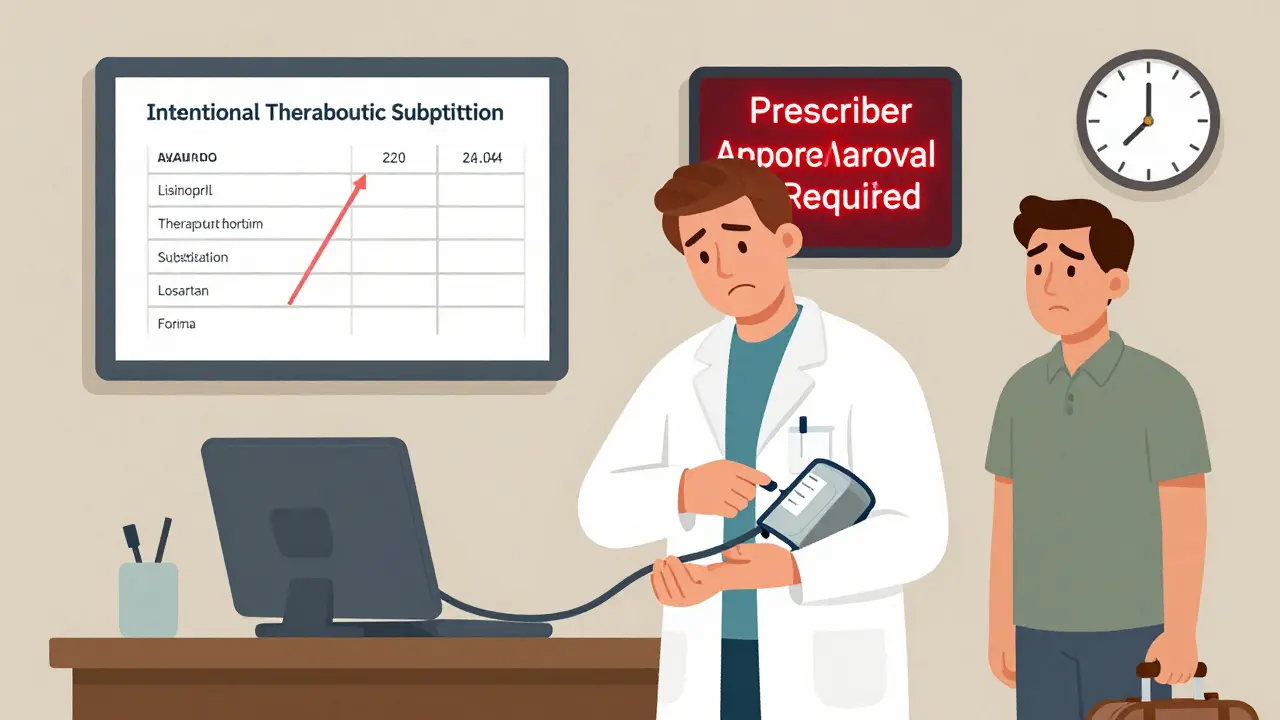
Therapeutic substitution is more complex. It means swapping one drug for another in the same class but with a different chemical structure. For example, switching from lisinopril to losartan for high blood pressure. This isn’t automatic. Only 27 states allow it, and each has its own rules. In Colorado, pharmacists must write “Intentional Therapeutic Drug Class Substitution” on the prescription. In California, it’s only allowed for insulin under very specific conditions. Some states require patient consent-written or verbal. Others don’t require any consent at all, just documentation.
State-by-State Differences Matter
The variation isn’t just paperwork-it’s life-changing. In New Mexico and Oregon, pharmacists can independently prescribe birth control, manage diabetes, and adjust pain meds under state-approved protocols. In Alabama, they can’t substitute a single pill without the prescriber’s direct approval. That means a patient traveling from Colorado to Alabama might get a different drug for the same condition, simply because of where they are.
Take insulin. In California, pharmacists can swap between types-like switching from Humalog to NovoLog-if the patient has a stable regimen and the prescriber has approved a general substitution plan. In Texas, they can’t do that unless they call the doctor first. That adds 15 to 20 minutes per prescription during busy hours. In Oklahoma, they can make the swap with just a note in the record. That’s not a minor difference-it affects how quickly someone gets their medicine, especially in rural areas where doctors are scarce.
Even vaccination authority varies. Forty-two states let pharmacists give shots. Sixteen let them do it without any doctor’s order. But in 23 states, they need a collaborative agreement-essentially a signed contract with a physician. That creates gaps in access, especially during flu season or when clinics are closed.
Federal Moves That Changed the Game
In July 2022, the FDA made a historic move: it allowed all licensed pharmacists in the U.S. to prescribe Paxlovid for eligible COVID-19 patients. This wasn’t a state law-it was federal. Pharmacists had to confirm the patient was 12 or older, weighed at least 40kg, had a positive test, and was at high risk for severe illness. They also had to check kidney and liver function records from the last 12 months or consult the prescriber directly.
This was a turning point. For the first time, pharmacists were given direct prescribing power for a specific, time-sensitive treatment. It wasn’t just substitution-it was clinical decision-making. And it worked. In the first six months, over 1.2 million Paxlovid prescriptions were filled by pharmacists, many in areas without easy access to doctors.
Since then, other states have followed suit. Maryland passed a law in October 2023 letting pharmacists prescribe birth control. By January 2024, they’d already written over 12,000 prescriptions. Maine, on the other hand, only lets pharmacists offer nicotine replacement therapy-and only after special training. The patchwork is real, and it’s growing.
Documentation: The Hidden Burden
Behind every substitution is paperwork. Thirty-two states require pharmacists to write a note directly on the prescription. Fourteen give them 72 hours to report the change. Nineteen states demand the prescriber be notified within 24 to 48 hours. That’s not just a formality-it’s time. A pharmacist in a chain store might handle 80 prescriptions a day. If 15 of those require calls or forms, that’s hours lost to bureaucracy instead of patient care.
Electronic systems don’t always help. Many pharmacy software platforms don’t talk to each other. A pharmacist moving from Colorado to Texas might need weeks of training just to learn how to document correctly in the new system. Chain pharmacies like Kroger Health have cut substitution errors by 37% by creating standardized templates and cross-state training. But independent pharmacies? They’re often on their own.
Patients don’t always understand what’s happening. A 2023 survey found that 78% of community pharmacy complaints came from people confused about why their medication changed. They thought the pharmacist was cutting corners. In reality, they were following state law. But without clear communication, trust erodes.
Why This Matters for Patients
These rules aren’t just about legal boundaries-they’re about access, cost, and safety. Generic substitution alone saves the U.S. healthcare system an estimated $197 billion a year. Over the last decade, that’s $1.97 trillion. Therapeutic substitution adds another layer. If pharmacists could routinely switch patients to more affordable, equally effective drugs for conditions like hypertension or depression, savings could reach $45 to $60 billion annually.
But it’s not just money. In rural areas, pharmacist-led substitution has reduced medication access gaps by 34%, compared to 19% in cities. When a patient can’t get a doctor’s appointment for weeks, a pharmacist who can adjust a statin or switch a pain med might prevent a hospital visit. A Colorado pharmacist told a Reddit community they helped 47 patients get birth control who otherwise would’ve waited over a month. That’s not just convenience-it’s reproductive autonomy.
On the flip side, experts warn about risks. Dr. David Fleming from the American College of Physicians says uncoordinated substitutions can fragment care, especially for patients on five or more medications. If a pharmacist changes a drug but the primary care doctor doesn’t know, it could lead to dangerous interactions. That’s why some states require documentation to be sent to the prescriber. But even then, many doctors never check the records.
What’s Changing in 2024
Change is accelerating. As of March 2024, 19 states are pushing new laws to expand pharmacist authority. Virginia and Illinois are expected to pass comprehensive reforms by the end of the year. The American Pharmacists Association is pushing for national competency standards for therapeutic substitution-something that doesn’t exist yet. They also want to expand authority to mental health medications, like antidepressants and anti-anxiety drugs, which are often underprescribed due to stigma and access issues.
But resistance remains. The American Medical Association still argues that pharmacists shouldn’t make these decisions without physician oversight. They’re not wrong-complex patients need coordinated care. But they’re also ignoring the reality: in many places, the pharmacist is the only accessible healthcare provider.
The future likely lies in hybrid models. States like Colorado show what’s possible: standardized protocols, clear documentation, and training that turns pharmacists into frontline care providers-not just pill dispensers. It’s not about replacing doctors. It’s about using every trained professional where they’re most effective.
What Pharmacists Need to Know
If you’re a pharmacist, your legal scope isn’t defined by your license alone-it’s defined by your state’s laws, your employer’s policies, and the systems you use. You need to know:
- Which substitutions are allowed in your state
- Whether consent is required and how it must be documented
- How long you have to notify the prescriber
- Which drugs are covered under therapeutic substitution rules
- How your pharmacy’s software handles substitution records
Training isn’t optional. States with expanded authority require 10 to 15 hours of extra education. Pharmacists working across state lines need up to 40 additional hours just to stay compliant. Ignoring this isn’t negligence-it’s a legal risk.
What Patients Should Ask
You don’t need to be an expert, but you should ask:
- “Is this a generic version of my usual drug?”
- “Is this a different medication altogether?”
- “Was this change approved by my doctor?”
- “Can I get the original drug if I prefer it?”
Most pharmacists will explain the change. But if they don’t, ask. You have the right to know what’s being swapped and why.
Can a pharmacist legally substitute my brand-name drug without my permission?
In most states, yes-for generic substitutions. Pharmacists can swap your brand-name drug for a cheaper generic without asking, as long as the prescription doesn’t say "Dispense as Written" or "Do Not Substitute." But for therapeutic substitution-switching to a different drug in the same class-the rules vary. Some states require written or verbal consent. Others only require documentation. Always check your state’s pharmacy board guidelines.
Why does my pharmacy in Colorado switch my blood pressure med, but my pharmacy in Alabama won’t?
Colorado allows pharmacists to perform therapeutic substitution under statewide protocols approved by the Board of Pharmacy. They can switch between drugs like lisinopril and losartan if it’s clinically appropriate and documented. Alabama, however, requires explicit prescriber authorization for any substitution beyond generics. It’s not about the pharmacist’s skill-it’s about state law. Two pharmacists with identical training can behave differently based on where they’re licensed.
Can pharmacists prescribe medications now?
Yes-but only in specific cases and only in certain states. Federal law allows pharmacists to prescribe Paxlovid for eligible COVID-19 patients nationwide. States like Maryland, New Mexico, and Oregon let pharmacists prescribe birth control. A few allow them to manage chronic conditions like diabetes or hypertension under formal protocols. But they can’t prescribe antibiotics, opioids, or psychiatric drugs without state-specific authorization. This is still evolving, and it’s not the same as full prescribing rights.
Do I have to pay more if my pharmacist substitutes my drug?
Usually, no. In fact, you usually pay less. Generic substitutions are almost always cheaper. Therapeutic substitutions may or may not reduce your cost-it depends on the drug and your insurance plan. But if your insurance covers the original drug and not the substitute, your out-of-pocket cost could go up. Always ask the pharmacist if the substitution affects your copay. If it does, you have the right to request the original medication.
What should I do if I’m not happy with a substitution?
Ask the pharmacist to explain why the change was made. If you’re uncomfortable, you can request the original drug-even if it costs more. You can also ask your prescriber to write "Dispense as Written" on future prescriptions. If you believe the substitution was illegal or unsafe, contact your state’s Board of Pharmacy. They investigate complaints and can take action against pharmacists who violate state law.
Final Thoughts
Pharmacist substitution authority isn’t about expanding power for its own sake. It’s about fixing gaps in a broken system. Millions of Americans can’t see a doctor when they need to. Pharmacists are the most accessible healthcare professionals-available without an appointment, often open on weekends, and trained to spot dangerous interactions. When the law lets them act, lives improve. When it holds them back, people go without care.
The real question isn’t whether pharmacists should have more authority. It’s whether we’re willing to let them use it.
Andrew Smirnykh
January 24, 2026 AT 09:32Interesting how the law varies so much between states. I’ve seen this firsthand-my mom got her blood pressure med switched in Colorado, then had to go through hell when she moved to Alabama. Same pill, different rules. It’s like crossing a border without a passport.
Pharmacists are the unsung heroes here. They’re the ones catching interactions, explaining options, and keeping people on track-especially in rural areas where doctors are a 2-hour drive away.
Why are we still treating them like glorified cashiers?
It’s not about replacing doctors. It’s about using the whole team.
Anna Pryde-Smith
January 25, 2026 AT 06:43THIS IS WHY WE CAN’T HAVE NICE THINGS.
Pharmacists are NOT doctors. Letting them swap out meds like they’re trading baseball cards is a disaster waiting to happen. What about drug interactions? What about patients on 7 different pills? You think some guy behind the counter with a 10-minute training module is qualified to make clinical decisions?
I’ve seen people get hospitalized because some ‘well-meaning’ pharmacist thought ‘losartan is close enough.’ It’s not. It’s not even close.
Stop giving power to people who didn’t go to med school. The AMA is right. This is a slippery slope to chaos.
Janet King
January 26, 2026 AT 14:35Generic substitution is safe and saves money. Therapeutic substitution is riskier and requires clear protocols. States that allow it must have mandatory documentation, patient notification, and prescriber alerts. Without these, errors increase.
According to the FDA, over 90% of generic substitutions are clinically equivalent. Therapeutic substitutions, however, require more oversight. Only 27 states permit them, and half of those have no consent requirement. That is concerning.
Pharmacists need standardized training, not state-by-state patchwork. National guidelines would reduce confusion and improve safety.
Patients should always be informed. Always.
Stacy Thomes
January 27, 2026 AT 01:04OMG YES. My pharmacist just switched my antidepressant last week and I didn’t even know until I got the bottle. I was FURIOUS. Then she sat down with me for 20 minutes, explained why it was a better fit, showed me the studies, and even called my doctor to confirm. Now I’m feeling better than ever.
Stop acting like pharmacists are just people who hand out pills. They’re trained clinicians. They know more about your meds than your doctor does sometimes.
Let them help. We need them. Especially in places where the nearest doctor is 80 miles away.
Stop the stigma. Trust the process.
Dawson Taylor
January 28, 2026 AT 21:34Authority without accountability is dangerous.
Pharmacists are gatekeepers, not decision-makers. The system works because checks exist.
Efficiency should not override safety.
One mistake can kill.
Standardization is necessary. But expansion without uniformity is reckless.
There is no such thing as a simple drug swap.
Complexity demands caution.
Laura Rice
January 29, 2026 AT 19:07okay so like… i just got back from the pharmacy and my blood pressure med was switched and i had no idea??
the girl behind the counter just handed me the bottle like it was normal. no explanation, no paper, no nothing. i had to ask twice. she said ‘oh yeah, it’s allowed here.’
but what if i’m allergic to the other one?? what if my doc didn’t know??
why is this even legal?? i feel like i just got a surprise upgrade to a car i didn’t ask for.
also i hate when people say ‘pharmacists are doctors’ no they’re not. they’re not. stop it.
Kerry Evans
January 29, 2026 AT 22:05Let’s be honest: this isn’t about patient care. It’s about cost-cutting. Insurance companies push this because generics are cheaper. Pharmacists comply because they’re under pressure to fill 100 prescriptions an hour.
Patients are being treated like data points. ‘Switch lisinopril to losartan-same class, 40% cheaper.’
But what about the patient who’s been stable on lisinopril for 12 years? What about the side effects no one talks about? What about the fact that 30% of patients report feeling worse after a therapeutic switch?
This isn’t innovation. It’s corporate convenience disguised as healthcare reform.
And don’t tell me ‘they’re trained.’ Training doesn’t replace clinical judgment.
Stop pretending this is progress.
Oladeji Omobolaji
January 30, 2026 AT 07:34Back home in Nigeria, pharmacists can’t even prescribe painkillers without a script. You walk in, hand over the paper, they give you the pill. No questions, no swaps, no drama.
But here? You’ve got pharmacists acting like mini-doctors, and half the time they don’t even know your full med list.
I get the idea-more access, less waiting. But if the system’s broken, why not fix the doctors first?
Not saying pharmacists aren’t smart. Just saying: don’t throw the whole system out because one part is slow.
Vanessa Barber
January 31, 2026 AT 09:41Actually, I think this is all overblown. Most people don’t even notice the switch. And if they do, they can always ask for the original. It’s not like the pharmacist is replacing your insulin with aspirin.
Also, if you’re so worried, write ‘dispense as written’ on your prescription. Done.
Stop making everything a crisis. The system works fine for 95% of people.
Also, why are we still using paper prescriptions in 2024? That’s the real problem.
dana torgersen
January 31, 2026 AT 13:19Okay, so… I just read this whole thing… and I’m… like… confused? Like, are pharmacists allowed to switch meds or not? Because it says 27 states allow it, but then it says some require consent, others don’t, and then it says California only allows it for insulin… and then it says Maryland lets them prescribe birth control… and I’m just… what??
Also, why is everyone so mad? It’s just a pill. People change their shampoo every month. Why is this a big deal?
Also, I think ‘therapeutic substitution’ sounds like a bad sci-fi movie title.
Also, I think I just had a stroke reading this.
Sallie Jane Barnes
February 2, 2026 AT 05:34Patients deserve transparency. Pharmacists deserve clarity. The system deserves standardization.
Every state should adopt a minimum framework: mandatory patient notification, electronic documentation shared with prescribers, and a 48-hour window for prescriber override.
Training should be nationally accredited. Software should be interoperable. Consent should be documented, not assumed.
This isn’t about power. It’s about responsibility.
And if we’re going to empower pharmacists, we must equip them-properly, consistently, and safely.
Otherwise, we’re not helping. We’re harming.
charley lopez
February 3, 2026 AT 15:53The current regulatory framework exhibits significant heterogeneity across jurisdictional boundaries, resulting in suboptimal clinical continuity and increased administrative burden on frontline providers.
Therapeutic substitution protocols, where permitted, lack harmonized criteria for clinical equivalence, patient risk stratification, and longitudinal outcome tracking.
Furthermore, electronic health record interoperability remains fragmented, impeding real-time prescriber notification and increasing the likelihood of medication reconciliation errors.
Until national standards are established-particularly regarding documentation, consent, and pharmacogenomic screening-the risk-benefit ratio remains unbalanced in favor of operational expediency over patient safety.
Susannah Green
February 5, 2026 AT 15:34My husband’s diabetes med got switched last month. I called the pharmacy, the pharmacist said, ‘It’s fine, same class.’ I said, ‘But his last A1C was 8.2.’ She said, ‘Oh, we didn’t know that.’
That’s the problem. They don’t have the full picture. And they shouldn’t be making decisions without it.
Yes, generics are great. Yes, pharmacists are smart. But they’re not magic. They don’t have access to labs, history, or the patient’s real story.
Let them help. Let them flag issues. Let them call the doctor.
But don’t let them swap without the full context.
And if you’re going to do this, at least make the software talk to each other.
And maybe-just maybe-train them on how to explain this to patients who are scared.
That’s the real gap.