
Metformin Side Effects: Gastrointestinal Issues and Lactic Acidosis Risk
 Mar, 3 2026
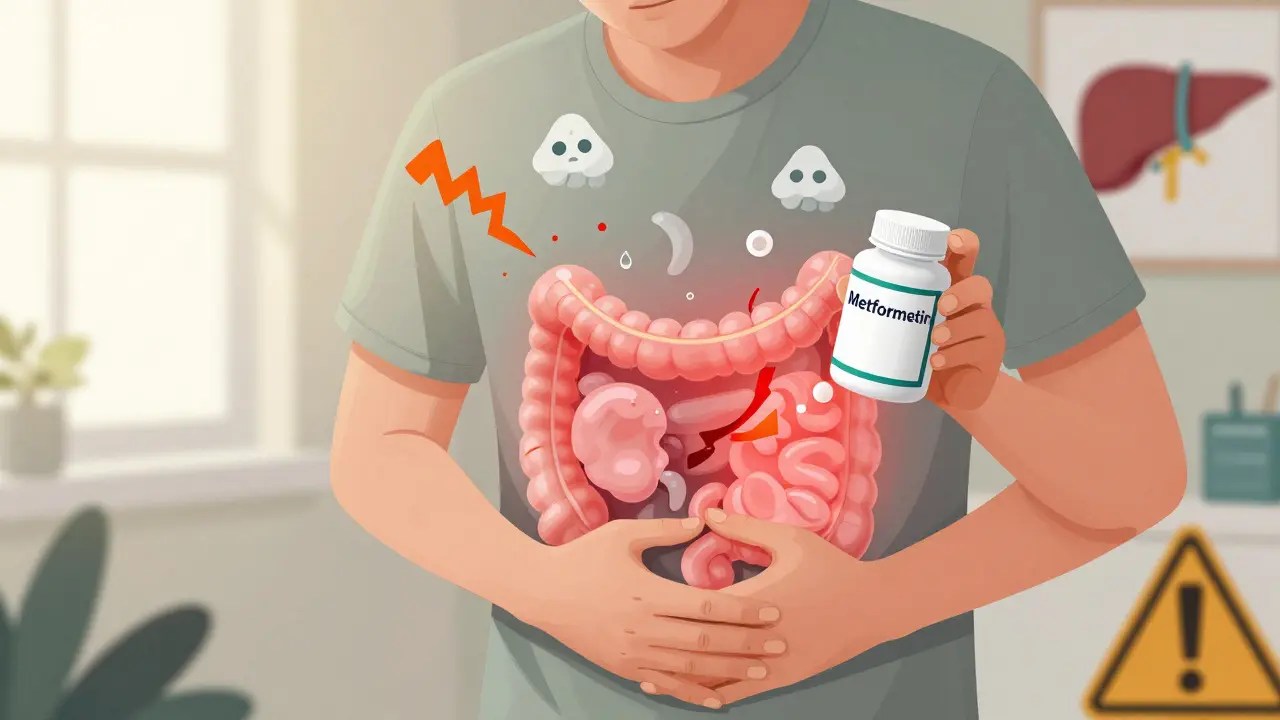
Metformin is the most prescribed diabetes drug in the world. Millions of people take it daily to keep their blood sugar under control. But for all its benefits, it comes with two real concerns that can’t be ignored: gastrointestinal issues and the rare but dangerous risk of lactic acidosis.
Why Metformin Causes Stomach Problems
If you’ve just started metformin, you’re not alone if you’re feeling nauseous, bloated, or having diarrhea. About 1 in 3 people experience these symptoms, especially in the first few weeks. A 2021 review of 39 clinical trials found that 53.2% of those with side effects had diarrhea, 27.5% felt nauseous, and over 20% had abdominal pain. These aren’t minor annoyances-they can make people quit the drug before it even has a chance to work.
The reason? Metformin doesn’t get absorbed in the stomach. It stays in the gut longer than most pills, irritating the lining and changing how water moves through the intestines. This can lead to loose stools, cramps, and even vomiting. The symptoms usually peak within the first 30 days, according to data from the UK Prospective Diabetes Study. But here’s the good news: 85% of people find their stomach settles down within 2 to 4 weeks.
Many patients don’t realize there are ways to reduce these effects. Switching to an extended-release (ER) formula helps. It releases the drug slowly, so less of it hits the gut all at once. One Reddit user with type 1 diabetes shared: “I started with 500mg ER at dinner. My diarrhea dropped from 4-5 times a day to just occasional cramping in 10 days.”
Dosing matters too. Starting low-like 500mg once a day with food-and slowly increasing helps the body adjust. Taking it with meals cuts irritation. Some people find skipping the morning dose and only taking it at night reduces symptoms. And if you’re still struggling, newer formulations like Metformin-ER-XR (approved by the FDA in May 2023) show 42.7% fewer GI issues in clinical trials.
Lactic Acidosis: The Rare but Deadly Risk
If gastrointestinal issues are common, lactic acidosis is rare-but serious. It’s the reason metformin carries a black box warning from the FDA, the strongest safety alert they issue. Between 1959 and 1996, 318 cases were reported, with 62 deaths. That led to the warning being added in 1998.
Today, the risk is much lower. Studies estimate only 1 to 9 cases per 100,000 patient-years. The FDA’s 2022 report found just 12 confirmed cases among 15.2 million users. That’s less than 1 in a million. But when it happens, it’s often fatal. Mortality rates range from 30% to 50%, according to a 2022 review in Diabetes Therapy.
Lactic acidosis isn’t caused by metformin alone. It’s triggered when the body can’t clear lactate, a natural byproduct of energy production. Metformin slows down how mitochondria use oxygen, which increases lactate. At the same time, if your kidneys or liver are failing, your body can’t remove it fast enough.
Two types exist: incidental (chronic buildup due to illness) and metformin-induced (acute overdose). The former makes up 92.7% of cases. That means most cases happen in people who are already critically ill-someone with a heart attack, severe infection, or kidney failure.
Symptoms don’t sneak up. They hit hard and fast:
- Extreme fatigue (94.7% of cases)
- Rapid, shallow breathing (88.3%)
- Nausea and vomiting (76.9%)
- Abdominal pain (63.2%)
- Muscle pain (52.4%)
- Hypothermia (38.7%)
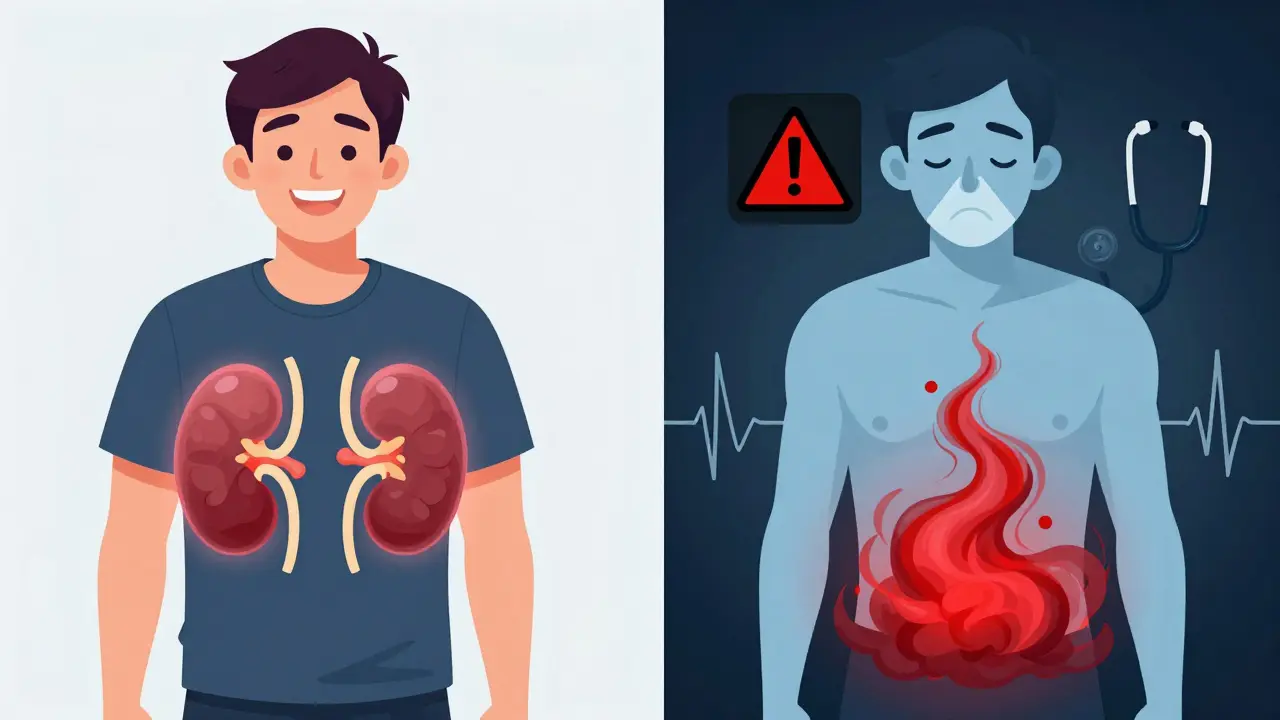
If you’re on metformin and suddenly feel like you’re dying-cold, breathless, nauseated, and weak-get to a hospital. No waiting. No “maybe it’ll pass.”
Who’s at Highest Risk?
Not everyone is equally at risk. The biggest danger comes from pre-existing conditions that affect how your body handles metformin.
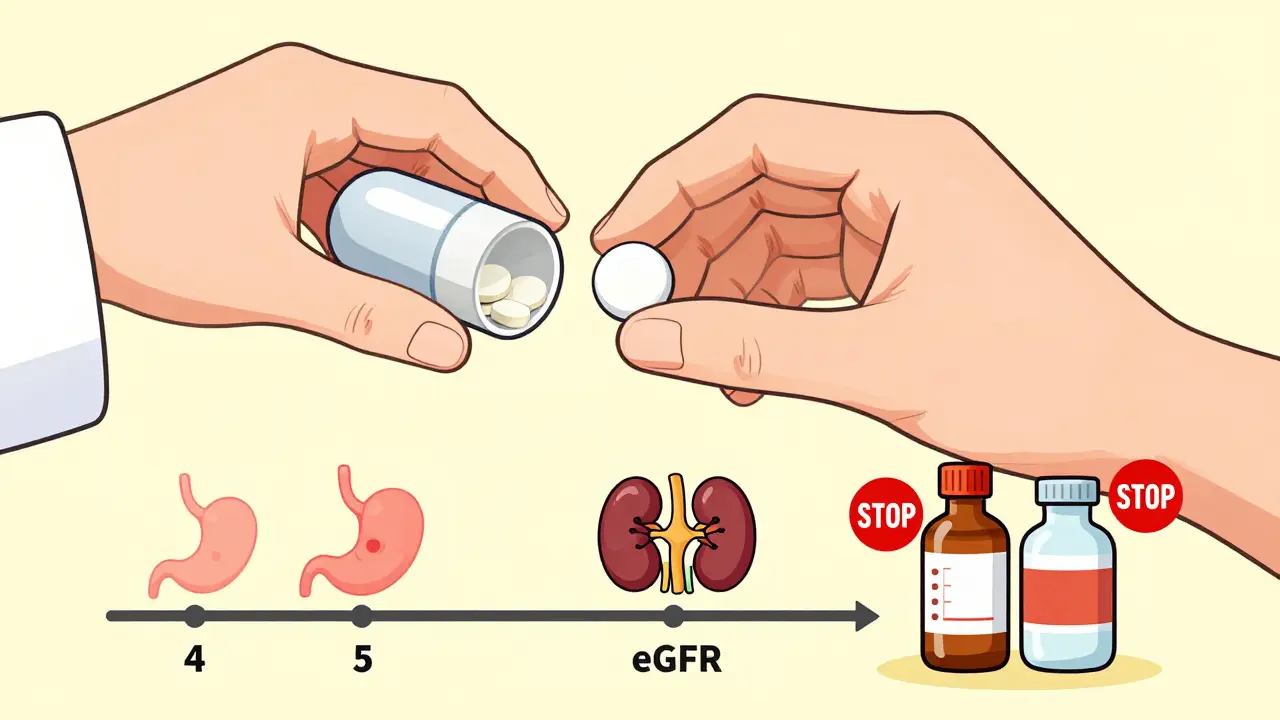
Kidney function is the biggest factor. Metformin is cleared by the kidneys. If your eGFR (a measure of kidney filtration) drops below 30 mL/min/1.73m², your risk jumps 18.7 times. A 2020 Kidney International study confirmed this. That’s why doctors test your kidney function every 3-6 months if your eGFR is between 45-59, and monthly if it’s below 45. The American Diabetes Association says stop metformin if eGFR falls below 30.
Acute kidney injury from dehydration, infection, or contrast dye can be deadly. If you’re getting a CT scan with contrast, guidelines from the American College of Radiology say you must stop metformin 48 hours before and after the procedure.
Liver disease raises risk 8.2 times. Age over 80 increases it nearly 5 times. Alcohol abuse (3+ drinks a day) multiplies risk by nearly 7 times. That’s why doctors ask about drinking habits during every checkup.
There are hard limits. The European Medicines Agency says metformin is absolutely contraindicated if serum creatinine is above 0.16 mmol/L in men or 0.13 mmol/L in women. These aren’t arbitrary numbers-they’re based on decades of data showing when the drug becomes unsafe.
Myths vs. Reality
There’s a lot of fear around metformin. Let’s clear up the noise.
Myth: Metformin damages your kidneys.
Truth: It doesn’t. A 10-year cohort study found no increased risk of kidney damage (HR=1.02). In fact, it may protect kidneys by improving blood sugar control.
Myth: Metformin causes dementia.
Truth: A 2021 Neurology study showed no link (OR=0.97). Some data even suggests it might lower dementia risk.
Myth: Metformin permanently steals your vitamin B12.
Truth: It can reduce B12 levels in about 7.2% of long-term users, but this is reversible. The AACE guidelines now require annual B12 testing and supplementation if needed. No permanent damage.
There’s still debate among experts. Professor Richard Kahn argues metformin doesn’t cause lactic acidosis-it just reveals it in people who are already critically ill. Dr. David Frankel says it directly blocks mitochondrial function, reducing lactate clearance by 25-35%. Both may be right. The key is context: if you’re healthy and your kidneys work, the risk is near zero.
What You Can Do
If you’re taking metformin and worried about side effects:
- Start low, go slow. 500mg once daily with food is the safest start.
- Switch to extended-release if GI issues persist. Many patients tolerate it better.
- Never skip kidney checks. Get your eGFR tested at least twice a year.
- Stop metformin before any imaging with contrast dye. Tell your radiologist you’re on it.
- Limit alcohol. Even moderate drinking can push you into danger if you have other risks.
- Watch for warning signs: unexplained fatigue, rapid breathing, nausea, cold skin. Act fast.
- Get your B12 checked yearly. Supplement if your doctor says so.
Metformin saves lives. It’s not perfect, but for most people, the benefits far outweigh the risks. The goal isn’t to avoid side effects at all costs-it’s to manage them smartly. Talk to your doctor. Don’t stop the drug on your own. And if something feels wrong, don’t wait. Get help.
Can metformin cause permanent damage to my kidneys?
No, metformin does not cause kidney damage. A 10-year study found no increased risk of kidney decline in people taking metformin (HR=1.02). In fact, better blood sugar control from metformin may help protect kidney function over time. The concern is the opposite: if your kidneys are already damaged, metformin can build up in your system and raise the risk of lactic acidosis. That’s why kidney function is monitored regularly.
Is lactic acidosis common with metformin?
No, it’s very rare. Studies estimate 1 to 9 cases per 100,000 patient-years. The FDA found only 12 confirmed cases among 15.2 million users in 2022. Most cases occur in people with severe illness-like sepsis, heart failure, or kidney failure-not in healthy individuals taking the drug as prescribed. The risk is low if you follow guidelines and avoid contraindications.
Should I stop metformin if I get diarrhea?
Not necessarily. Diarrhea is common in the first few weeks and usually goes away on its own. About 85% of people see improvement within 2-4 weeks. Try switching to an extended-release formula, taking it with meals, or lowering your dose. If symptoms are severe or last longer than a month, talk to your doctor. Don’t stop the medication without medical advice-you could lose blood sugar control.
Can I take metformin if I drink alcohol?
Occasional drinking is usually fine, but regular heavy drinking (3+ drinks per day) increases lactic acidosis risk by nearly 7 times. Alcohol stresses the liver and can cause dehydration, both of which interfere with how your body processes metformin. If you drink regularly, tell your doctor. You may need more frequent kidney checks or a different medication.
Do I need to stop metformin before surgery?
Yes, if it’s a major surgery or involves contrast dye. For procedures with contrast (like CT scans), guidelines say to stop metformin 48 hours before and not restart until 48 hours after, once kidney function is confirmed normal. For other surgeries, your doctor will decide based on your kidney health and risk of dehydration. Never stop it on your own-always follow your care team’s instructions.
Is there a better version of metformin with fewer side effects?
Yes. In May 2023, the FDA approved a new extended-release formulation called Metformin-ER-XR from GlySciences Inc. In phase 3 trials, it caused 42.7% fewer gastrointestinal side effects compared to older versions. It’s not yet widely available, but if you’re struggling with stomach issues, ask your doctor if this newer version is an option. In the meantime, switching to any extended-release formula can help significantly.
Justin Rodriguez
March 4, 2026 AT 15:41Been on metformin ER for 3 years now. Started with 500mg at dinner, stayed there. No GI issues at all. My doc said most people just need to let their gut adjust-like training a muscle. If you’re still struggling after a month, try splitting the dose: 250mg morning and 250mg night. Works better than jumping to 1000mg all at once. Also, don’t skip meals. Taking it with food? Non-negotiable.
Megan Nayak
March 4, 2026 AT 21:56Oh wow. Another ‘trust the science’ post. Let me guess-you’ve never had a single side effect? Or maybe you’re one of those people who thinks ‘rare’ means ‘impossible’? Lactic acidosis isn’t a myth-it’s a silent killer waiting for your kidney numbers to dip below 45. And yeah, 1 in a million sounds safe until it’s YOU on the ventilator. The FDA warning exists for a reason. Stop romanticizing drugs like they’re yoga.
Siri Elena
March 5, 2026 AT 23:52Oh honey. You’re telling me people are ‘surprised’ by diarrhea from a drug that literally sits in the gut like a brick? 🤡 I mean, did anyone read the label? Or just assumed it was ‘natural’ because it’s from a plant derivative? Also, ‘new formulation’? Honey, it’s 2023. We’ve had ER versions since the 90s. This is just marketing with a lab coat. Next you’ll tell me ‘organic sugar’ is healthier.
RacRac Rachel
March 6, 2026 AT 06:03Hey everyone-I’ve been on metformin for 8 years and I’m still here, happy, and my A1C is 5.4! 💪 I started with the regular stuff and had the worst cramps, but switching to ER and taking it with my biggest meal (dinner) changed everything. Also, I started taking a B12 supplement last year-my doc said it’s smart. No more tingling in my hands! 🙌 If you’re struggling, don’t give up. Tiny tweaks = huge results. You got this!!
Jane Ryan Ryder
March 6, 2026 AT 22:45So we’re giving out medals for not dying from a drug that’s basically a chemical grenade in your gut? Meanwhile, real people are dropping from lactic acidosis and you’re telling them to ‘wait it out’? This isn’t a wellness blog. This is a life-or-death medication. Stop pretending it’s just ‘mild discomfort.’
Levi Viloria
March 7, 2026 AT 23:35My uncle’s on metformin. He’s 82, has mild CKD, drinks one beer a night. Doc told him to keep taking it, monitor eGFR monthly. He’s fine. Not because he’s lucky, but because he listens. The key isn’t fear-it’s awareness. This drug isn’t magic. It’s a tool. Use it with knowledge, not anxiety or arrogance.
Dean Jones
March 9, 2026 AT 19:21Let’s talk about the epistemology of risk here. When we say ‘1 in 100,000’ we’re not talking about individual experience-we’re talking about statistical abstraction. The body doesn’t care about population-level probabilities. It cares about mitochondrial dysfunction, lactate accumulation, and renal clearance kinetics. The FDA’s 12 cases in 15 million? That’s a number. But behind each case is a human whose liver couldn’t compensate, whose kidneys were already compromised, whose body was already screaming for help-and metformin didn’t cause it, it merely revealed the fragility that was already there. The real tragedy isn’t the drug. It’s the system that lets people slip through the cracks until they’re in crisis. We need proactive monitoring, not reactive fear.
Darren Torpey
March 11, 2026 AT 16:31Metformin’s the OG diabetes hero. Yeah, it guts you at first-but that’s just your body throwing a tantrum. I went from chugging water like a camel to feeling like a normal human in 17 days. Switched to ER, took it with my burrito, and boom-no more midnight dash to the bathroom. And don’t even get me started on how it’s probably the reason I’m not in a nursing home at 58. This drug’s got more history than your grandma’s vinyl collection. Respect it. Don’t fear it.