
Melatonin and Sedatives: Understanding Additive Drowsiness and How to Stay Safe
 Dec, 1 2025
Melatonin-Sedative Interaction Risk Calculator
This tool calculates the increased risk of drowsiness when combining melatonin with sedative medications. The effects of combining these substances are multiplicative, not additive, meaning the risk increases significantly more than just adding percentages.
Important note: These calculations are based on clinical data but are not a substitute for professional medical advice. Always consult your doctor before combining medications.
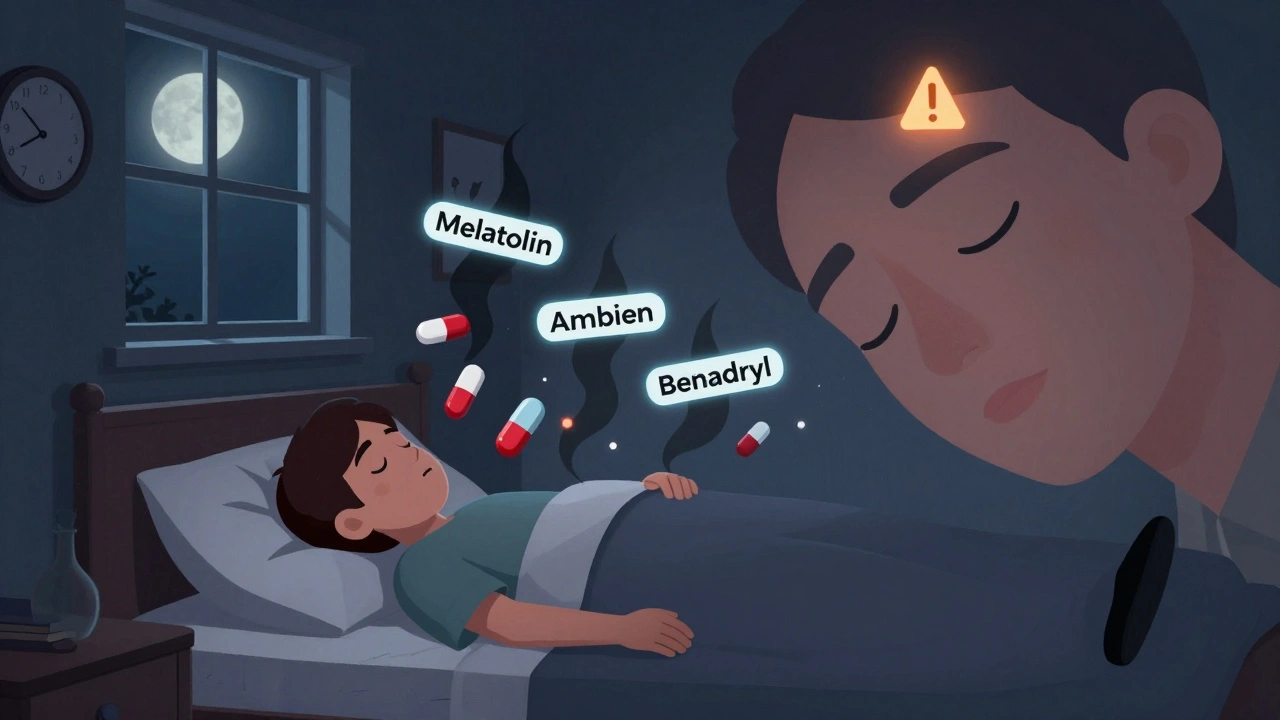
It’s easy to think of melatonin as just a gentle sleep aid-something natural, harmless, even safe to toss in with your nightly prescription sleep medication. But here’s the truth: combining melatonin with sedatives can turn a quiet night into a dangerous one. You might not feel it right away, but the drowsiness doesn’t just add up-it multiplies. And that’s not a theory. It’s happening in real lives.
Why Melatonin Isn’t Just a Vitamin
Melatonin is a hormone your body makes naturally to signal it’s time to sleep. When you take it as a supplement, you’re flooding your system with something that already controls your sleep-wake cycle. At low doses-like 0.3mg to 0.5mg-it can help reset your internal clock if you’re jet-lagged or working night shifts. But most people take way more: 3mg, 5mg, even 10mg. That’s not harmless. It’s pharmacologically active.Unlike caffeine or aspirin, melatonin doesn’t just make you sleepy. It binds to receptors in your brain that slow down neural activity. It also interacts with GABA-B and opioid receptors, which are the same targets for many sedative drugs. That’s why it doesn’t just add to the effects of benzodiazepines, zolpidem, or even antidepressants-it amplifies them.
What Counts as a Sedative?
When people say "sedatives," they often think of sleeping pills like Ambien or Xanax. But the list is longer than you think:- Benzodiazepines: diazepam (Valium), lorazepam (Ativan), alprazolam (Xanax)
- Non-benzodiazepine hypnotics: zolpidem (Ambien), eszopiclone (Lunesta), zaleplon (Sonata)
- Opioids: codeine, oxycodone, tramadol
- Antidepressants: trazodone, mirtazapine, doxepin
- Antipsychotics: quetiapine (Seroquel), olanzapine (Zyprexa)
- Antihistamines: diphenhydramine (Benadryl), doxylamine (Unisom)
- Alcohol
Even if you’re only taking one of these, adding melatonin can push you into dangerous territory. A 2020 study in the Journal of Clinical Sleep Medicine found that combining melatonin with benzodiazepines increased the risk of respiratory depression by 47%. That’s not a small bump-it’s a sharp rise in the chance your breathing could slow to a dangerous level while you sleep.
The Numbers Don’t Lie
Here’s what real data shows:
- People taking melatonin alone report drowsiness in about 8.7% of cases.
- When combined with sedatives, that jumps to 63%-over seven times higher.
- One in four people who take melatonin with a prescription sleep aid do it without telling their doctor.
- Four percent of those who combine them end up needing medical help because of oversedation.
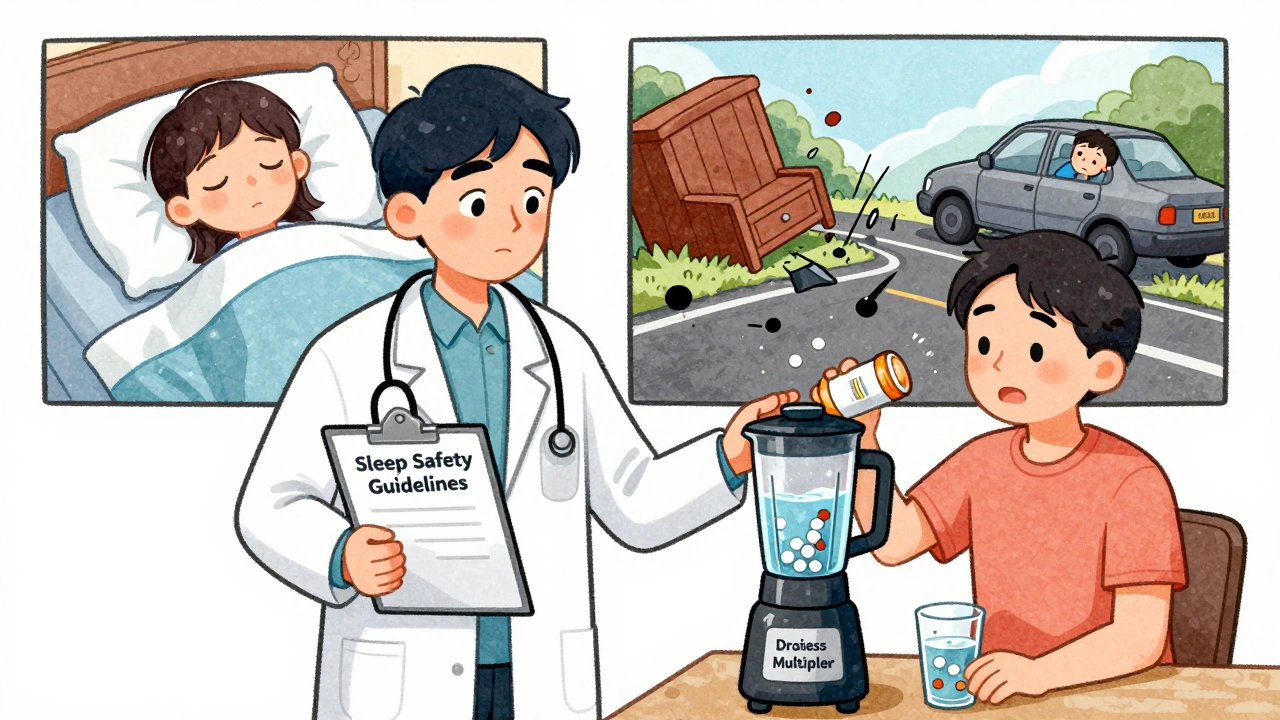
And it’s not just about feeling sleepy. People have woken up hours later with no memory of the night. Others have driven while drowsy and ended up in ditches. One Reddit user described taking 3mg of melatonin with 0.5mg of Xanax and waking up 14 hours later, confused and disoriented. That’s not a bad night’s sleep-that’s a near-accident waiting to happen.
Why This Isn’t Like Mixing Two Painkillers
People think: "If I take two mild things, it’s just a little more sleepy." But that’s not how it works. The effect isn’t linear-it’s multiplicative. Two mild sedatives together can feel like a strong one.
Dr. Neil Stanley, a UK sleep expert with over 35 years of research, put it plainly: "The additive effects aren’t linear-they’re multiplicative." That means if melatonin slows your brain by 20% and your sleeping pill by 30%, you’re not at 50%. You’re closer to 50% *plus* a dangerous synergy that affects your breathing, reflexes, and awareness.
And it’s worse for older adults. The American Geriatrics Society’s 2023 Beers Criteria warns that combining melatonin with benzodiazepines increases fall risk by 68%. That’s not just about tripping-it’s about broken hips, brain bleeds, and long-term disability.
What You Should Do Instead
If you’re already taking a sedative and thinking about adding melatonin, stop. Don’t guess. Don’t rely on forums or YouTube videos. Talk to your doctor or pharmacist. But here’s what you need to know before you go:
- Never mix them without medical supervision. Even if your doctor says it’s okay, they need to know exactly what you’re taking, how much, and when.
- If you’re approved to combine them, lower the dose. The American Academy of Sleep Medicine recommends reducing melatonin to 0.3-0.5mg and cutting your sedative dose by at least 25%.
- Wait at least five hours. The Mayo Clinic says to avoid driving or operating machinery for five hours after taking melatonin. With sedatives, extend that to eight hours. Sleep longer. Let your body clear it.
- Use prolonged-release melatonin. If you must use it, choose the slow-release version (like Circadin). Research shows it reduces interaction risks by 31% compared to fast-acting pills.
- Check your meds. Your doctor should screen for 14 classes of drugs before approving melatonin. Don’t assume they’ll ask. Bring a list.
What About Natural Alternatives?
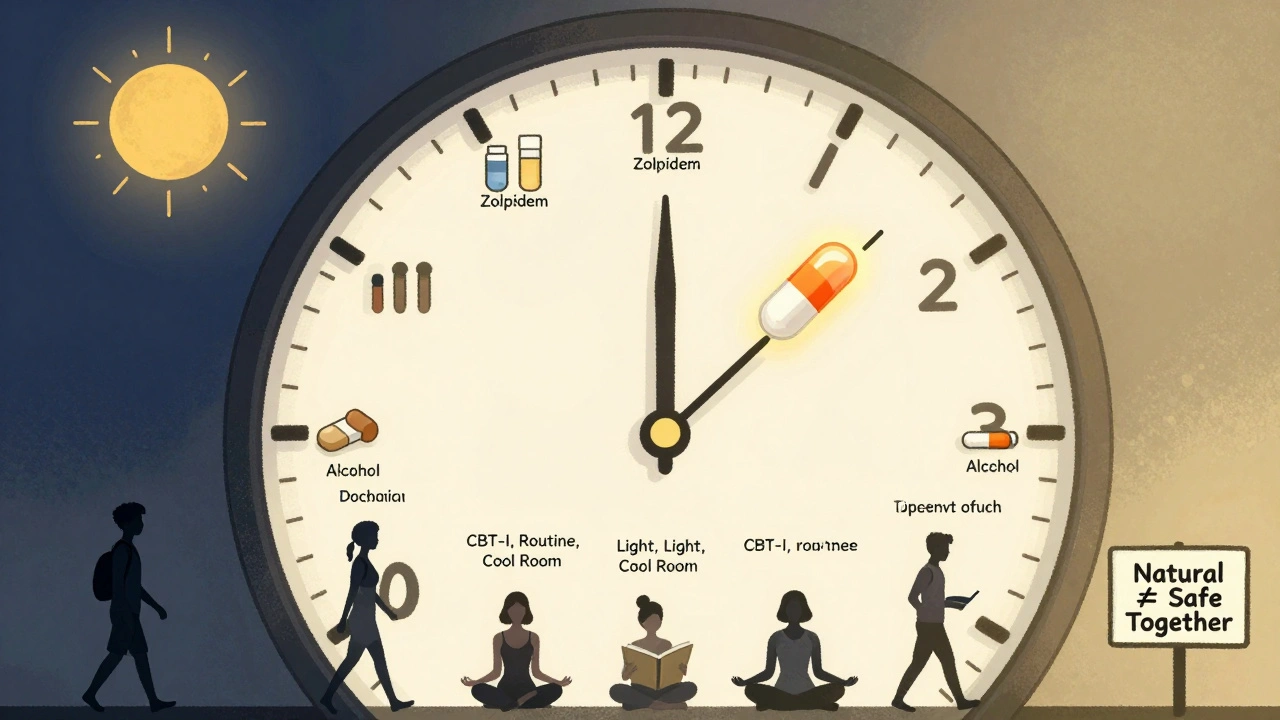
Instead of stacking supplements and pills, try what actually works for long-term sleep: cognitive behavioral therapy for insomnia, or CBT-I. It’s not a pill. It’s a structured program that teaches your brain to sleep better without drugs. The American College of Physicians now recommends CBT-I as the first-line treatment for chronic insomnia.
Other safe, non-drug options:
- Stick to a consistent bedtime-even on weekends
- Get bright light exposure in the morning
- Avoid screens 90 minutes before bed
- Keep your bedroom cool and dark
- Limit caffeine after 2 p.m.
These don’t come with warning labels. They don’t cause memory loss or falls. And they work better over time than any combination of pills.
What’s Changing Now?
The tide is turning. In 2023, the FDA started cracking down on melatonin manufacturers, issuing 12 warning letters for mislabeling and contamination. By mid-2024, all melatonin products sold in the U.S. will be required to include clear warnings about sedative interactions.
Europe already requires it. The European Medicines Agency mandates that all melatonin packaging say: "Do not combine with sedatives." And in the U.S., only 22% of primary care doctors now recommend combining melatonin with sedatives-down from 47% in 2018.
Meanwhile, melatonin sales are booming. The global market hit $743 million in 2022 and is expected to grow to over $1.4 billion by 2030. But the real story isn’t sales-it’s safety. More people are learning the hard way that "natural" doesn’t mean "safe with everything."
Final Rule: When in Doubt, Don’t Mix
You don’t need to take melatonin with a sedative to sleep better. In fact, you’re more likely to hurt yourself than help yourself. Melatonin works best for circadian rhythm issues-not for deep sleep problems caused by anxiety, chronic pain, or sleep apnea.
If your sleep is still bad after trying non-drug methods, talk to a sleep specialist. Don’t self-prescribe combinations that could put you in the hospital. Your body doesn’t need more chemicals. It needs better rhythm, better habits, and better support.
There’s no shortcut to restful sleep. But there are safe paths. Choose them.
Shubham Pandey
December 3, 2025 AT 11:33Been taking 5mg melatonin with my Xanax for years. Woke up fine. Probably just lucky.
Elizabeth Farrell
December 3, 2025 AT 19:23I really appreciate how clearly you laid this out. I used to think melatonin was just a vitamin, like you said-until my mom had that scary night after mixing it with her trazodone. She didn’t remember calling 911. Now she only takes 0.5mg, and only if she’s not on anything else. It’s scary how many people don’t know this. Thank you for being the voice that says ‘stop and ask your doctor’ instead of just googling it.
Sheryl Lynn
December 4, 2025 AT 21:35How quaint. The modern pharmacopeia has been reduced to a morality play about ‘natural’ substances. Melatonin is a neuropeptide modulator with affinity for MT1/MT2 receptors-its interaction with GABAergic systems is well-documented since the 90s. The fact that laypeople treat it like chamomile tea is less a tragedy than a symptom of epistemic decay. If you’re going to self-medicate, at least read the primary literature. Or better yet-don’t.
Paul Santos
December 5, 2025 AT 07:13Interesting. But let’s not forget the ontological paradox here: if melatonin is ‘natural,’ why does it bind to opioid receptors? Is nature itself just a slow-acting benzodiazepine? 🤔
Eddy Kimani
December 6, 2025 AT 22:30Can someone clarify the difference between additive vs. synergistic effects here? The post says multiplicative, but pharmacokinetics usually describe synergy as supra-additive, not linear. Is this just colloquial, or is there a real non-linear pharmacodynamic interaction? Asking because I’m trying to explain this to a patient who swears ‘it’s just melatonin.’
John Biesecker
December 8, 2025 AT 19:28my grandma took melatonin with her sleep meds for 8 years and never had a problem 😅 maybe it’s different for everyone? i think we should stop scaremongering… people need sleep, man
Genesis Rubi
December 9, 2025 AT 07:23Of course the FDA is cracking down-because Big Pharma doesn’t want you to have a cheap, natural alternative that doesn’t require a $500 co-pay. This is all a distraction. They’re scared people will realize they don’t need their pills.
Doug Hawk
December 11, 2025 AT 03:52the 47% increase in respiratory depression is from a 2020 study but the sample size was under 300 and most were elderly with comorbidities. i get the concern but this feels like overstating the risk for a general audience. also, i’ve seen people on 10mg melatonin + zolpidem wake up fine. maybe it’s about individual metabolism? i’m not saying it’s safe, just… maybe not everyone’s at risk
John Morrow
December 11, 2025 AT 15:48Let’s be honest: the entire supplement industry thrives on ignorance. Melatonin is unregulated, often contaminated with serotonin analogs, and marketed with cartoon bears on the bottle. People think they’re being ‘natural’ while ingesting untested compounds with unknown half-lives. This isn’t wellness-it’s pharmaceutical roulette with a side of pseudoscience. The fact that 25% of users don’t tell their doctors? That’s not negligence. That’s a systemic failure of medical education.
Kristen Yates
December 11, 2025 AT 21:49I’m from a country where melatonin is prescription-only. We don’t have it on shelves next to gummy vitamins. People here don’t even know what it is unless their doctor prescribes it. Maybe the problem isn’t melatonin-it’s how we treat sleep as something you can just buy.
Carolyn Woodard
December 13, 2025 AT 09:58I’ve been studying circadian biology for over a decade. The real issue isn’t just melatonin-sedative interactions-it’s the normalization of pharmacological sleep. We’ve turned a biological rhythm into a chemical problem. CBT-I isn’t just ‘an alternative’-it’s the only intervention that rewires the brain’s sleep architecture. The fact that we still default to pills says more about our culture than our physiology.
John Webber
December 13, 2025 AT 13:07THIS IS WHY WE CAN’T HAVE NICE THINGS!!! PEOPLE ARE DYING BECAUSE THEY THINK ‘NATURAL’ MEANS ‘SAFE’!!! THEY’RE PUTTING IT IN THEIR KIDS’ FOOD TOO!!! I SAW A VIDEO ON TIKTOK WHERE A MOM GAVE HER 8-YEAR-OLD 10MG FOR ‘ANXIETY’!!!
Chelsea Moore
December 14, 2025 AT 21:39My best friend almost died. She took melatonin with her Seroquel. Woke up in the ER. No memory. No pulse for 17 seconds. They said if her roommate hadn’t checked on her, she wouldn’t have made it. I’ve been screaming about this for two years. No one listens. Now I just don’t talk to people who take melatonin. It’s too painful.
alaa ismail
December 16, 2025 AT 11:26cool post. i used to mix stuff too but switched to just reading in bed with a dim lamp. no pills. no guilt. just quiet. sleep came slower but it stuck. weird how simple stuff works better than magic pills 😌
Sandi Allen
December 17, 2025 AT 23:25THEY’RE HIDING THE TRUTH!!! THE FDA IS IN BED WITH PHARMA!!! THEY WANT YOU DEPENDENT!!! THEY’RE LYING ABOUT THE 47% STAT BECAUSE THEY’RE PROFITING FROM YOUR SLEEP DISORDERS!!!