
Medication Safety for Non-English Speakers: How to Get Clear, Accurate Instructions
 Dec, 1 2025
Every year, thousands of people in the U.S. take the wrong dose of their medicine-not because they’re careless, but because they can’t read the label. For non-English speakers, pharmacy instructions written in English can be confusing, dangerous, or even deadly. A Vietnamese patient might think “daily” means “every day” instead of “once a day.” A Spanish-speaking elder might mix up pills because the label says “take with food” but doesn’t explain what counts as food. These aren’t rare mistakes. They’re systemic failures-and they’re preventable.
Why Language Barriers Put Lives at Risk
More than 25 million people in the U.S. have limited English proficiency. That’s one in eight Americans trying to manage prescriptions, side effects, and dosing schedules in a language they don’t fully understand. Studies show these patients are 1.5 to 3 times more likely to have a dangerous medication error than those who speak English fluently. The most common errors? Taking too much, taking too little, or taking the wrong drug entirely.
It’s not about intelligence or effort. It’s about access. Pharmacy labels use medical jargon like “SIG: one tablet PO q.d.”-even if you speak English, that’s hard to read. Now imagine trying to translate that into your native language without any training. Family members might help, but they often misunderstand terms like “intravenous” or “prn.” One Reddit post from a pharmacist described a Korean patient who took her blood thinner twice daily because the label said “daily,” and she didn’t know it meant once per day.
What Clear Instructions Actually Look Like
Good medication instructions don’t just translate words-they rebuild meaning. The ConcordantRx project, developed by researchers at the University of California, tested a new approach: simplify everything. Instead of “Take one tablet by mouth once daily,” they wrote: “Take one pill every morning with water.” They removed Latin abbreviations, avoided passive voice, and used short sentences. The result? 100% comprehension among tested patients who spoke Chinese, Korean, or Russian.
That’s not magic. It’s plain language. The FDA and ISO standards recommend writing at a 6th-grade reading level. That means:
- Use common words: “pill” instead of “tablet,” “take” instead of “administer.”
- Avoid abbreviations: Write “once a day,” not “q.d.”
- Include visuals: Icons showing a clock for timing, a plate for food, a trash can for disposal.
- Use color coding: Red for warnings, green for instructions.
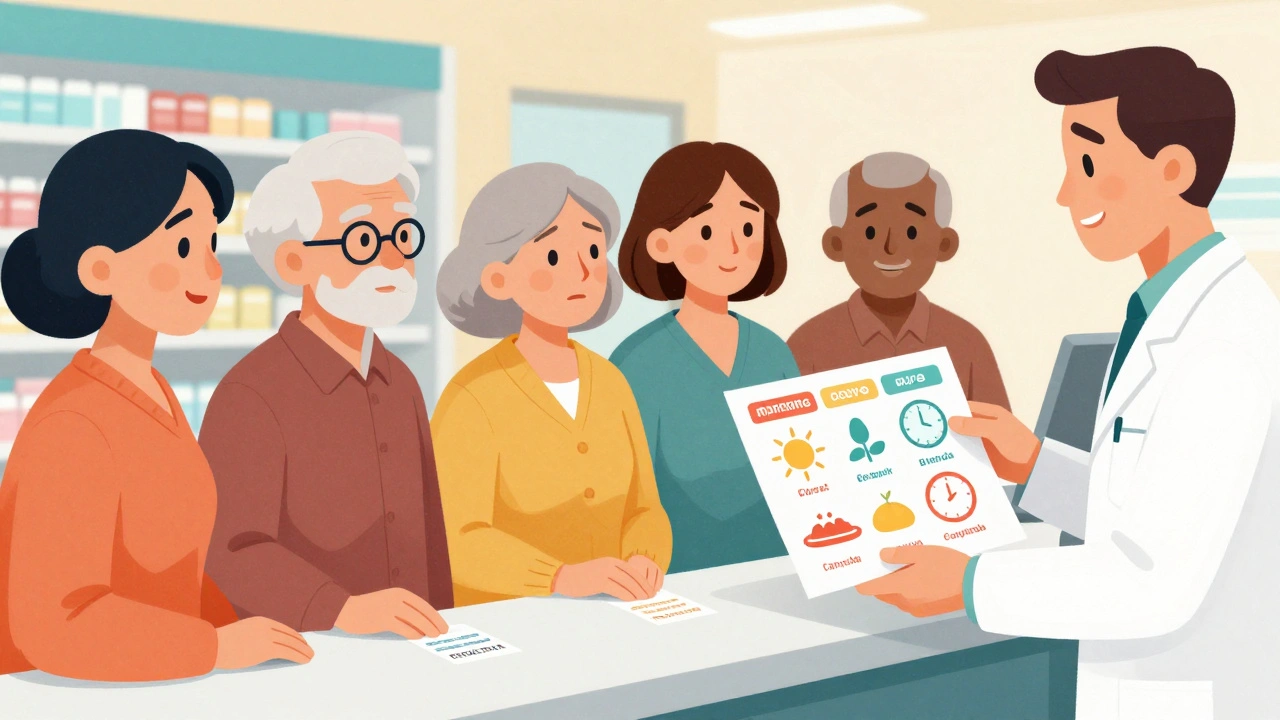
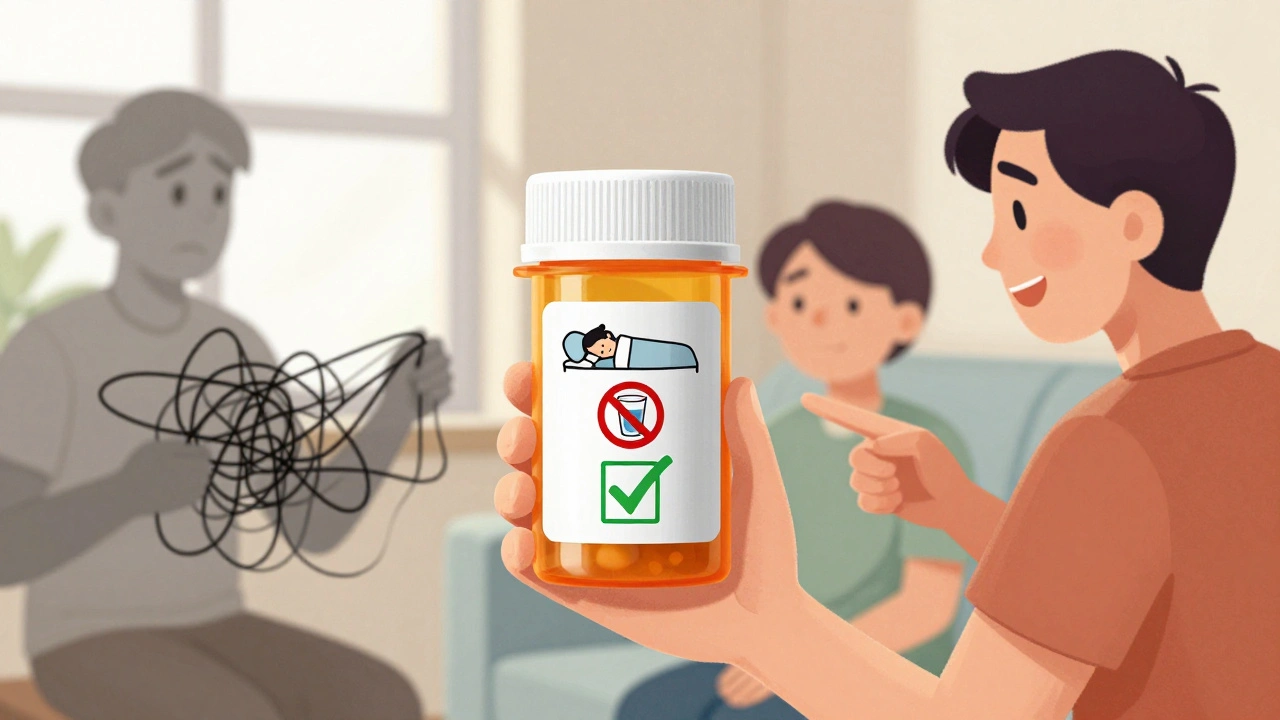
Some pharmacies now use pictograms approved by the FDA-like a crossed-out glass for “avoid alcohol” or a sleeping person for “take at bedtime.” These work better than words alone. A UK study found that when patients got labels with pictures and their native language, 89% understood their instructions. Without them, only 22% did.
Translation That Works vs. Translation That Fails
Not all translations are equal. There’s a huge difference between:
- Professional, medically reviewed translations (like those from RxTran or TransPerfect Healthcare): 95-100% accuracy, tested with real patients.
- Google Translate or AI tools: Up to 43% error rates, according to a 2023 FDA warning.
- Family members or bilingual staff without training: Only 42% comprehension, per a 2017 study.
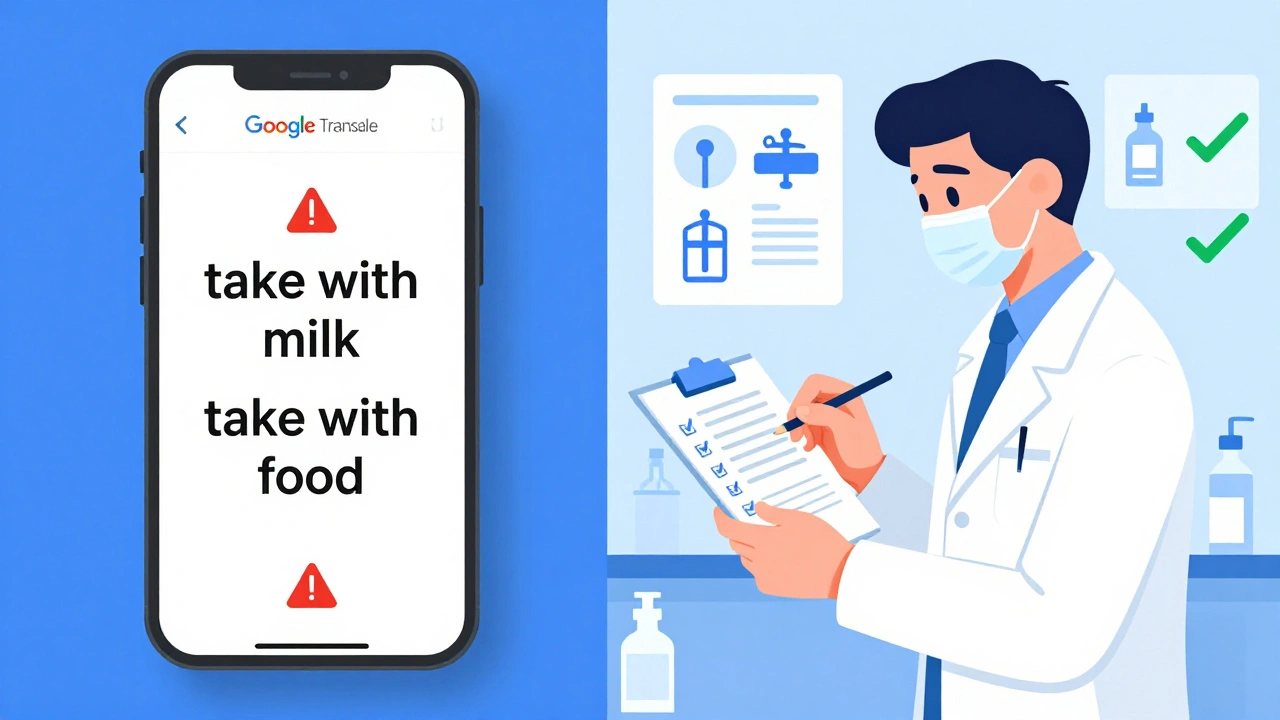
Automated tools get things dangerously wrong. One patient was told to “take with milk” because the AI translated “take with food” as “take with milk”-but the drug actually interacts with dairy. Another was instructed to “drink the solution” when the label meant to “spray into the nose.”
Professional services don’t just translate-they validate. They work with pharmacists and medical interpreters to make sure terms like “hypertension” become “high blood pressure,” and “adverse reaction” becomes “bad side effect.” They also check for cultural context: In some cultures, “take on an empty stomach” might mean “don’t eat anything all day,” which isn’t safe.
What Pharmacies Should Be Doing (But Often Aren’t)
Federal law says pharmacies must provide “meaningful access” to non-English speakers under Title VI of the Civil Rights Act. That means offering translation services. But here’s the problem: only 57% of community pharmacies give patients translated prescription labels, according to a 2021 survey.
Why? Cost. Professional translation adds $2.50 to $5 per prescription. Time. Training staff takes weeks. Technology. Many pharmacy systems like Rx30 or PioneerRx don’t plug into translation tools easily. And many pharmacies still rely on staff who speak a little Spanish or Mandarin-not enough to handle complex medical terms.
But the cost of not doing it is higher. Medication errors lead to ER visits, hospital stays, and even deaths. A 2019 University of Michigan study found that when pharmacies used professional translations and interpreter services:
- Medication errors dropped by 58%
- Patients took their meds correctly 37% more often
That’s not just safer-it’s cheaper for the system. Pharmacies that invest in language access report 22% higher patient satisfaction and 15% lower costs from avoidable errors.
How Patients Can Protect Themselves
You don’t have to wait for your pharmacy to catch up. Here’s what you can do right now:
- Ask for your language when you pick up your prescription. Say: “Can you give me this in [language]?”
- Request a live interpreter-not a family member. Many pharmacies have phone or video interpreters available at no cost.
- Check the label. If it’s only in English, ask for a bilingual version. If they say no, ask to speak to the pharmacist.
- Use visual aids. Ask if they have pictures or symbols that show when and how to take the medicine.
- Repeat it back. Say: “So I take this one pill every morning, right?” If they nod, great. If they hesitate, ask again.
One patient in California told her pharmacist she didn’t understand the label. He didn’t have a translation, so he drew a picture: a sun for morning, a moon for night. She took it home, showed it to her daughter, and never made a mistake again.
The Future Is Changing-But Slowly
Change is coming. California now requires pharmacies to certify their language services as of January 2024. New York City mandates translation for the top 10 languages. The federal government is pushing EHR systems to automatically flag language needs and trigger translations.
Still, gaps remain. For languages like Hmong, Navajo, or Amharic, there are fewer than 12 certified medical interpreters nationwide. AI tools are getting better, but they’re not ready for high-stakes medical use. And many pharmacies still don’t train staff on cultural differences-like how some patients avoid saying “no” to a provider, even if they don’t understand.
But progress is real. The market for pharmacy translation services is growing fast-projected to hit $490 million by 2027. More pharmacies are signing up with vendors like RxTran, which offers translations in 25 languages, including Somali, Tagalog, and Farsi.
It’s Not Just About Words-It’s About Trust
When a patient can read their label, understand their dose, and know what side effects to watch for, they feel safer. They trust the system. They take their meds. They stay out of the hospital.
Medication safety isn’t just about pills and prescriptions. It’s about dignity. It’s about being treated like a person who deserves to understand their own health. For non-English speakers, clear instructions aren’t a luxury-they’re a lifeline.
And it’s time every pharmacy made that lifeline available to everyone.
Fern Marder
December 1, 2025 AT 20:09OMG I can’t believe this is still a thing 😭 My abuela took her blood pressure med twice because the label said ‘daily’ and she thought it meant ‘every day’ like in Spanish… she ended up in the ER. This isn’t just inconvenient-it’s life or death. Pharmacies need to stop treating translation like an afterthought. 🙏💊
Carolyn Woodard
December 2, 2025 AT 03:41It’s interesting to consider the epistemological dissonance inherent in medical communication when linguistic frameworks are not aligned with clinical semantics. The hegemony of English in pharmaceutical labeling perpetuates a form of epistemic violence, particularly when lexical equivalence fails to capture pragmatic intent. One might argue that the very structure of medical jargon-rooted in Latin and Greek-is inherently exclusionary to non-native speakers, regardless of translation quality.
Allan maniero
December 3, 2025 AT 07:38Really well put. I’ve worked in a pharmacy in London and we had a lot of Somali and Urdu speakers coming in. We started using pictograms and simple icons-clock for time, plate for food, red X for ‘don’t take’-and the difference was night and day. People weren’t just reading labels anymore; they were understanding them. It’s not rocket science. Just common sense. And yeah, it costs a bit more, but so does a hospital bed for someone who took the wrong pill.
Anthony Breakspear
December 3, 2025 AT 17:28Let’s be real-pharmacies are running on fumes and $12/hour cashiers who barely speak English themselves. But here’s the kicker: if you slap a picture of a sun and a moon next to ‘take once daily,’ even my grandma gets it. No translation needed. No PhD required. Just human design. Stop overcomplicating it. The FDA already approved these pictos. Use ‘em. And stop acting like it’s a ‘cost center’-it’s a damn liability shield.
Zoe Bray
December 5, 2025 AT 02:19It is imperative to acknowledge that the provision of linguistically accessible pharmaceutical information constitutes a fundamental obligation under Title VI of the Civil Rights Act of 1964. The current state of non-compliance among community pharmacies represents a systemic failure in the delivery of equitable healthcare services. Formalized protocols, standardized translation protocols, and mandatory staff training in cultural competency are not optional-they are non-negotiable components of ethical pharmaceutical practice.
Girish Padia
December 6, 2025 AT 01:03People just need to learn English. Why should the whole system change just because someone doesn’t want to learn? I came here from India, I learned English, I understand my meds. It’s not that hard. Stop blaming pharmacies. Learn the language or stay home.
Elizabeth Farrell
December 6, 2025 AT 10:04There’s so much hope in the small things-like the California woman who drew a sun and moon for her label. That’s the kind of compassion that heals. We don’t need fancy tech or expensive systems. We need pharmacists who pause, listen, and draw a picture. That’s how trust is built. And trust? That’s the real medicine.
Sheryl Lynn
December 7, 2025 AT 22:14Oh, how quaint. We’re now reducing complex pharmacological regimens to emoji and stick figures? Next they’ll be handing out interpretive dance instructions for anticoagulants. The erosion of clinical precision in favor of performative accessibility is not progress-it’s infantilization. If patients can’t parse ‘q.d.’, perhaps they shouldn’t be managing polypharmacy. The system should elevate literacy-not lower standards.
Paul Santos
December 8, 2025 AT 19:15Ah yes, the classic ‘draw a sun’ solution. How poetic. I mean, I love the sentiment, but let’s not pretend that pictograms are a substitute for linguistic competence. It’s like giving a Shakespearean sonnet to someone who can’t read and saying, ‘Here, this little drawing of a book means “Hamlet.”’ It’s charming, but it’s not epistemologically sound. Also, I’ve seen those FDA pictos-they’re hilariously vague. Who’s to say the sleeping person means ‘bedtime’ and not ‘nap after lunch’?
Eddy Kimani
December 10, 2025 AT 14:36Interesting data point: the 100% comprehension rate in the ConcordantRx study was achieved with professional, culturally validated translations-not just simple words. The key isn’t just shortening sentences, it’s validating meaning with native speakers. AI tools can’t replicate that. Human nuance matters. We need more studies like this-and more funding. This isn’t charity. It’s precision medicine.
Chelsea Moore
December 11, 2025 AT 02:16THIS IS A NATIONAL EMERGENCY!!!!!!! WHY IS NO ONE TALKING ABOUT THIS?!?!?! My cousin’s mom died because she took her insulin at night instead of morning-label said “daily” and she thought it meant “every day” like in Tagalog!!! And the pharmacy just shrugged and said “we don’t have translators for that language”!!! THIS IS MURDER BY BUREAUCRACY!!!!!!! PEOPLE ARE DYING BECAUSE OF LABELS!!!!!!! #MedicationSafetyNow #JusticeForNonEnglishSpeakers