
How to Time Medication Doses to Reduce Infant Exposure During Breastfeeding
 Mar, 6 2026
Many mothers worry that taking medication while breastfeeding will harm their baby. The truth is, 98% of medications are safe to use during breastfeeding - if you time them right. It’s not about avoiding medicine altogether. It’s about using smart, science-backed timing to keep your baby’s exposure as low as possible while still treating your health.
Why Timing Matters More Than You Think
Medication doesn’t just disappear after you swallow it. It enters your bloodstream, then slowly moves into breast milk. The amount your baby gets depends on when you take the pill versus when they feed. If you take a dose right before nursing, your baby gets the highest concentration. But if you wait until after the longest stretch of sleep, you cut their exposure by up to 80%. This isn’t guesswork. It’s based on how drugs behave in your body - their peak concentration and half-life. Peak concentration is when the drug hits its highest level in your blood, usually within minutes to a few hours after taking it. Half-life is how long it takes for half the drug to leave your system. Shorter half-life = faster clearance = easier to time.The Simple Rule for Single Daily Doses
If you only take a medication once a day, give it right after your baby’s longest sleep period - usually right after the bedtime feeding. That way, the drug peaks while your baby is asleep and sleeping through the highest concentration. For most babies, this means dosing between 10 p.m. and midnight, after the last feed of the day. For example, if you’re taking hydrocodone for pain after delivery (peak at 0.5-2 hours, half-life 3-4 hours), taking it at 11 p.m. means your baby will get very little during the next 6-8 hours of sleep. Studies show this simple shift cuts infant exposure by over 70% compared to morning dosing.What to Do With Multiple Daily Doses
If you need to take a medication two or three times a day, the rule changes: breastfeed right before each dose. Why? Because your milk will have the lowest drug level right after a feeding. Your body starts absorbing the medication after you take it, but it takes time to reach peak levels. By nursing just before the pill, you’re using the natural gap between feeds to minimize transfer. This works best with short-acting drugs like oxycodone, ibuprofen, or amoxicillin. A 2022 survey of 157 lactation consultants found that 87% of mothers who followed this method saw no signs of sedation or fussiness in their babies.Medications That Need Special Care
Not all drugs are created equal. Some have long half-lives - meaning they stick around for days. For these, timing barely helps.- Diazepam (Valium): Half-life of 44-48 hours. Even with perfect timing, it builds up in milk over time. Many experts recommend avoiding it entirely if possible.
- Fluoxetine (Prozac): Half-life of 96 hours, with an active metabolite that lasts 260 hours. The American Academy of Family Physicians advises against it during breastfeeding.
- Alprazolam (Xanax): Immediate-release peaks at 1-2 hours (good for timing), but extended-release peaks at 9 hours (harder to control). Stick to immediate-release if you need it.
- Lorazepam (Ativan): RID (Relative Infant Dose) of only 2.6-2.9%. Safer than diazepam.
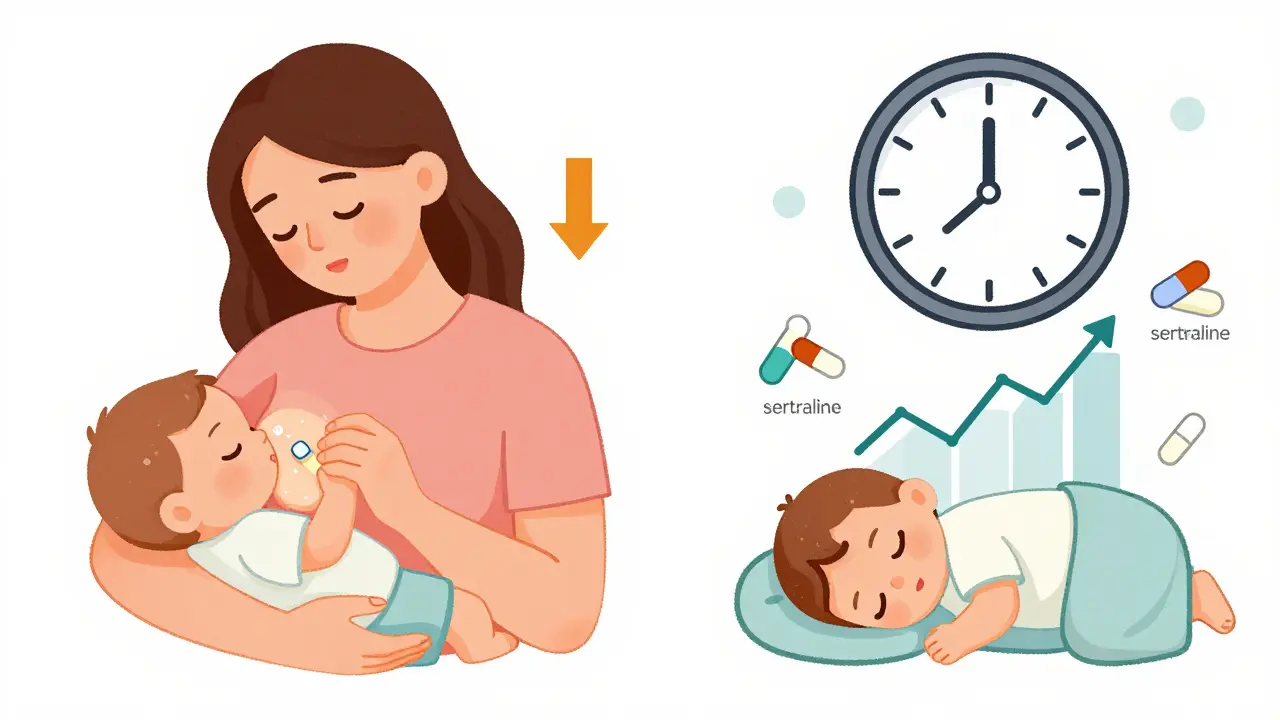
- Sertraline (Zoloft): Half-life of 26 hours. Preferred over fluoxetine for postpartum depression.
- Prednisone: At standard doses, very little passes into milk. Only delay feeding for 4 hours if you’re on a high dose (over 20 mg/day).
What About Newborns and Preemies?
Premature babies, newborns under 6 weeks, or infants with kidney or liver issues are more vulnerable. Their bodies can’t clear drugs as quickly as older babies. For them, timing isn’t just helpful - it’s critical. Mayo Clinic specialists warn that even low-dose medications can cause drowsiness, poor feeding, or breathing issues in these babies. If your child falls into this group, always:- Use the lowest effective dose
- Choose immediate-release over extended-release
- Time doses after the longest sleep period
- Watch for signs of sedation: limpness, weak suck, unusual sleepiness
Pumping and Storing: A Useful Backup
If you’re having surgery or need a one-time dose of a medication with a risky profile (like hydrocodone or codeine), pump and store milk ahead of time. This gives you a safe supply to use while the drug clears. One mother in Auckland shared: “I pumped 8 ounces before my dental surgery with hydrocodone. Fed that stored milk for 4 hours after. My 6-month-old had zero issues.” This strategy works best for short-term, high-risk situations. Don’t rely on it for daily medications - it’s not sustainable. But for a one-off, it’s a powerful tool.Tools That Help You Get It Right
You don’t have to memorize half-lives. There are trusted resources:- LactMed (by the National Library of Medicine): Updated monthly. Covers over 4,700 medications. Free online and as an app.
- Hale’s Medication and Mothers’ Milk (2020 edition): The gold standard reference. Uses RID values to rate safety.
- ABM Clinical Protocol #21 (2023): Lists exact peak times and half-lives for 23 common drugs.

What Your Provider Should Know
A 2021 study found only 58% of primary care doctors could correctly time common medications for breastfeeding mothers. That’s alarming. Don’t assume your doctor knows the details. Bring your own info. Say: “I’m breastfeeding and need to take [medication]. Can we check LactMed for the best timing?” For psychiatric medications, ask for sertraline or paroxetine instead of fluoxetine. For pain, use ibuprofen or acetaminophen - they’re safer and don’t need strict timing.What Doesn’t Work
Avoid these myths:- “Pump and dump” after every dose - It doesn’t reduce milk concentration. The drug leaves your body over time - not by pumping.
- “Wait 24 hours after a dose to nurse” - Only necessary for rare drugs like radioactive isotopes. Not for prescriptions.
- “All SSRIs are the same” - Fluoxetine is risky. Sertraline is not. Don’t generalize.
When to Seek Help
If your baby shows any of these after you start a new medication:- Excessive sleepiness or hard-to-wake episodes
- Refusing feeds or poor weight gain
- Unusual fussiness or jitteriness
- Changes in bowel movements or skin color
Most importantly - don’t stop breastfeeding because you’re scared. With the right timing, you can manage your health and keep giving your baby the best start.
Can I take painkillers while breastfeeding?
Yes. Ibuprofen and acetaminophen are considered safest. Take them right after a feeding to minimize exposure. Avoid opioids like codeine or hydrocodone unless absolutely necessary. If you must use them, take the lowest dose and time it right after your baby’s longest sleep. Never exceed 30 mg of hydrocodone per day.
Is it safe to take antidepressants while breastfeeding?
Many are. Sertraline and paroxetine are preferred because they transfer in very low amounts and have short half-lives. Fluoxetine should be avoided due to its 96-hour half-life and active metabolite. Always use the lowest effective dose and monitor your baby for irritability or sleep changes. Most mothers on SSRIs successfully continue breastfeeding with proper timing.
What if my baby is premature or has health issues?
Premature or ill babies are more sensitive to medications. Their livers and kidneys can’t clear drugs as quickly. In these cases, timing becomes even more critical. Use only medications with low transfer rates (like lorazepam instead of diazepam), avoid extended-release forms, and always consult a pediatric specialist. Monitor for signs of sedation - limpness, weak suck, or unusual sleepiness.
Should I pump and dump after taking medication?
No - not for routine medications. Pumping doesn’t speed up how fast the drug leaves your system. It only removes milk already in your breasts. The drug clears from your blood over time, not from your milk. Pump and dump is only useful for one-time exposures (like surgery) where you’ve stored milk ahead of time. Don’t waste time or milk on this unless it’s a specific, short-term situation.
How do I know if a medication is safe for breastfeeding?
Check LactMed (lactmed.nlm.nih.gov) - it’s free and updated monthly. Look for the Relative Infant Dose (RID). If it’s under 10%, it’s generally safe. Also check for warnings about long half-lives (over 24 hours) or active metabolites. Avoid drugs flagged as “not recommended” or “use with caution.” Always ask your provider to check the database with you.
Can I take hormonal birth control while breastfeeding?
Combination pills (estrogen + progestin) are not recommended in the first 3-4 weeks after birth because they can reduce milk supply and increase blood clot risk. Progestin-only pills (mini-pills) are safe and can be started as early as 3 weeks postpartum. Always choose progestin-only if you’re breastfeeding. Avoid hormonal IUDs or implants if you’re having trouble establishing milk supply.
Weston Potgieter
March 7, 2026 AT 18:39Also 'half-life'? Sounds like a chemistry class. Just nurse and move on.
Vikas Verma
March 7, 2026 AT 19:30Do not rely on anecdotal narratives. Consult a certified lactation pharmacist.
phyllis bourassa
March 9, 2026 AT 12:48Turns out I took hydrocodone at midnight like the article said. She didn't wake up for 10 hours.
Now I just pump and dump. Why make your baby a science experiment? I'm not a human IV drip.
Ferdinand Aton
March 11, 2026 AT 10:25Also, 'avoid fluoxetine' but 'use sertraline'-so now we're playing drug roulette?
What about the 40% of moms who can't afford to pump? This feels like rich mom advice.
William Minks
March 12, 2026 AT 05:13Also just found LactMed and it’s FREE?! Like, wow.
Thank you for making this feel less scary. You’re a lifesaver. 💕
Jeff Mirisola
March 13, 2026 AT 07:40But this timing strategy? It’s legit. I’ve used it with postpartum patients on pain meds and the difference in infant alertness is night and day.
Don’t fear the science. Use it. You’re doing great.
Susan Purney Mark
March 14, 2026 AT 08:47Some days you just need to feel human.
Timing helps, but your love? That’s what heals.
❤️
Joey Pearson
March 16, 2026 AT 02:29Trust your gut. You know your baby best.
Roland Silber
March 16, 2026 AT 17:59Timing works great if you have a 9-to-5 schedule and a partner who can hold the baby while you nap.
For the rest of us? We need options, not just protocols.
Can we talk about alternatives? Like non-pharm approaches? Or lower-dose patches?
Also-why isn't this in OB/GYN training? I had to Google this myself after my baby got fussy on sertraline.
It’s not that I don’t want to follow the rules. It’s that the rules don’t fit real life.
Can we make this more accessible? Less 'textbook' and more 'mom-to-mom'?