
How to Store Light-Sensitive Medications and Eye Drops Correctly
 Jan, 10 2026
Why Light Matters More Than You Think
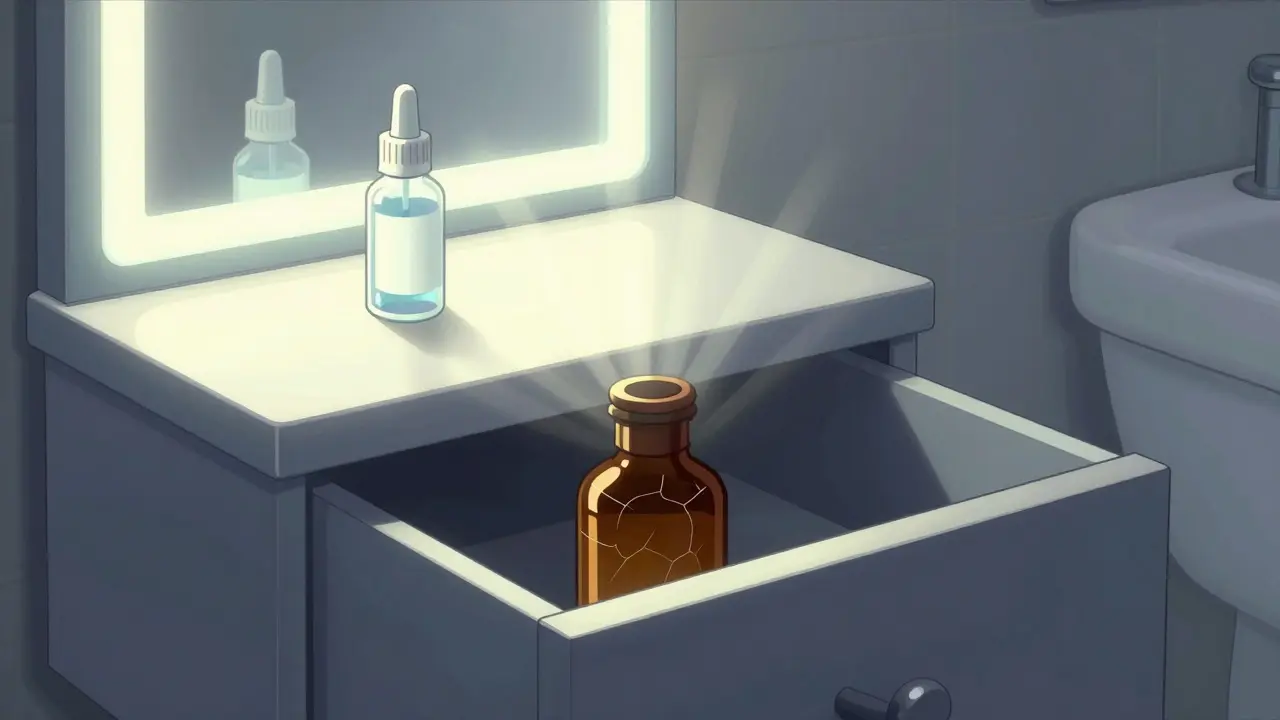
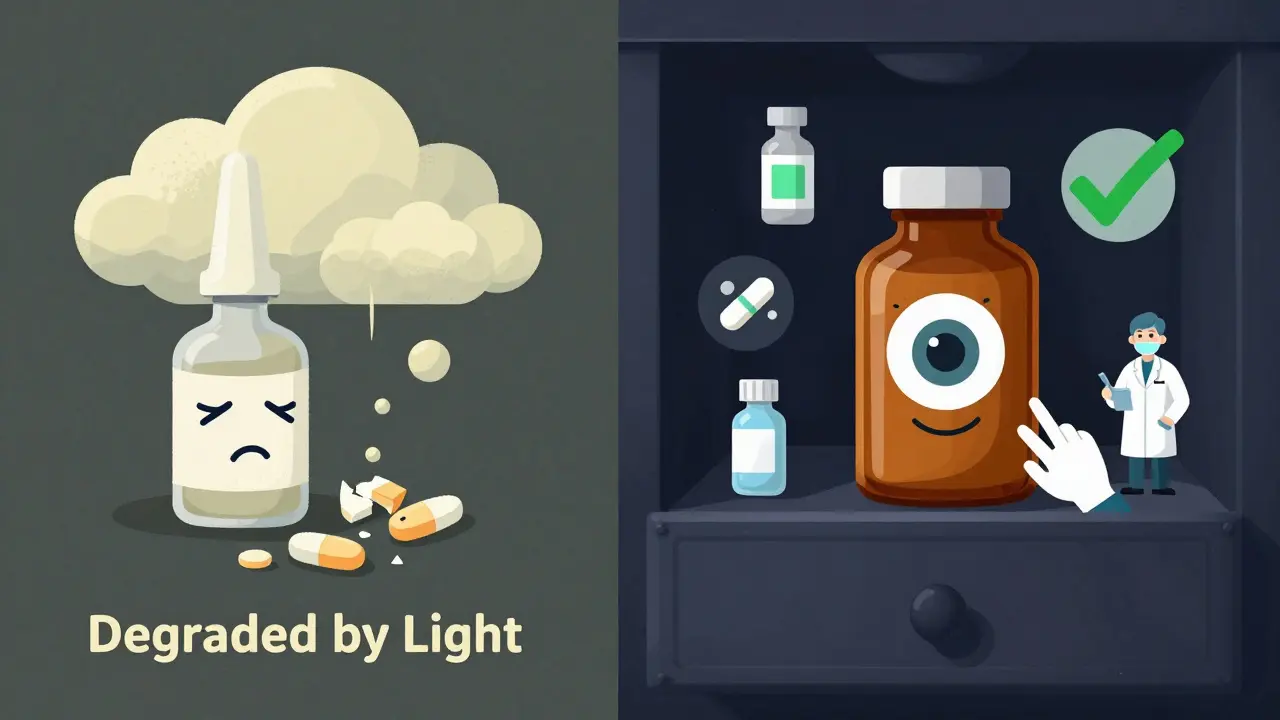
Most people store their medications in the bathroom cabinet, next to the sink, or on a windowsill. That’s a problem. If your medicine is light-sensitive, even a few hours of daylight can make it weaker-or worse, turn it into something unsafe. Eye drops, antibiotics, hormones, and even some vitamins can lose half their strength in just 30 days if they’re exposed to light. You won’t see it happening. No warning label flashes. No alarm sounds. But your body will feel the difference.
That’s why the light-sensitive medications you’re taking need more than just a dry place. They need darkness. Not just dim lighting-actual protection from UV and blue light. The pharmaceutical industry learned this the hard way in the 1900s when nitroglycerin and tetracycline started breaking down in clear bottles. Today, 470 injectable drugs require light protection, and nearly 80% of all light-sensitive medications come with a warning: Protect from Light. If you don’t see that label, assume it’s needed anyway.
What Counts as Light-Sensitive?
Not all medications are affected the same way. Some are more fragile than others. Eye drops are especially vulnerable because they’re liquid, exposed to air, and often used for long-term conditions like glaucoma. A 2021 study by Alcon found that when kept in clear containers, certain eye drops lost 35% of their potency in just two weeks. That’s not a small drop-it’s the difference between controlling your eye pressure and risking vision loss.
Other common light-sensitive medications include:
- Retinoids (like tretinoin cream-turns yellow when degraded)
- Chemotherapy drugs (some lose up to 50% potency)
- Birth control pills and hormone therapies
- Anti-seizure medications (like phenytoin)
- Antibiotics (tetracycline, doxycycline)
- Insulin (when unopened, needs cold and dark)
- Potassium iodide and certain tinctures
If you’ve ever noticed your cream changing color, your drops turning cloudy, or your pills smelling weird (aspirin smells like vinegar when broken down), that’s your body telling you the medication is failing. Don’t ignore it.
Amber Bottles Aren’t Just a Tradition-They’re Science
The brown or amber bottles your eye drops come in? That’s not for looks. That’s a UV shield. Amber glass blocks 98% of harmful light wavelengths below 470 nanometers. Opaque plastic blocks about 85%. That 13% gap matters. In a 2022 study published in the Journal of Ocular Pharmacology and Therapeutics, multi-dose eye drop containers with both amber glass and a UV-blocking coating lasted 25% longer than standard amber bottles.
Here’s the catch: not all amber bottles are created equal. The US Pharmacopeia (USP) requires that effective light protection block at least 90% of light in the 300-450 nm range. If your bottle looks clear inside, even if it’s brown on the outside, it’s not good enough. Always check the packaging for the USP-compliant label.
Some people try to save money by transferring eye drops to a clear dropper bottle. Don’t. That single act is linked to 18% of all eye drop efficacy issues, according to the American Academy of Ophthalmology. The original container is designed for a reason.
Where to Store Them (And Where Not To)
Temperature and light go hand in hand. Even if you’ve got the right bottle, storing it in the wrong place ruins everything.
Never store light-sensitive meds in:
- The bathroom-too humid, too warm, and full of light from the overhead bulb
- On a windowsill-even closed blinds let in enough UV to degrade drugs over time
- Inside the car-summer temps can hit 120°F, which breaks down most medications
- Next to the stove or microwave-heat accelerates chemical breakdown
Do store them in:
- A dark kitchen cabinet-away from the sink and stove
- A bedroom drawer-cool, dry, and out of direct sunlight
- A dedicated medication box with UV-blocking lining-ideal for travel
For eye drops, once opened, keep them between 40°F and 77°F (4°C-25°C). Refrigeration isn’t always needed, but if your doctor says to, do it. Just don’t freeze them. Insulin? Always refrigerated until opened. After that, it can stay at room temperature for up to 28 days-just keep it in the dark.
Traveling with Light-Sensitive Medications
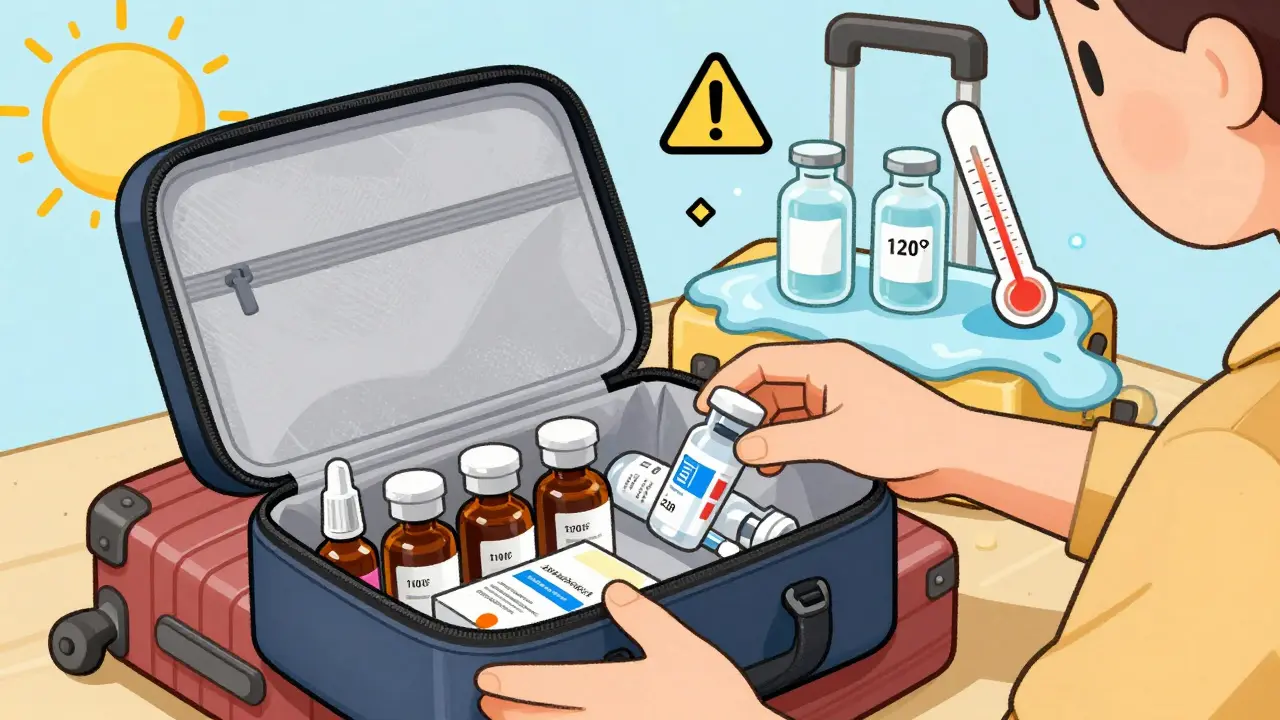
Traveling doesn’t mean you have to risk your health. The FDA-approved solution is an insulated medication bag with UV-blocking lining. These cost between $20 and $60, and they’re worth every dollar if you’re carrying insulin, chemotherapy drugs, or glaucoma drops.
Here’s how to pack safely:
- Keep meds in original amber containers
- Use a small insulated bag with a cold pack if refrigeration is needed
- Never check your meds in luggage-temperature swings in cargo holds can ruin them
- Carry a printed copy of the storage instructions from the pharmacy
Some new smart containers are in testing-like MedMinder’s UV-sensor bottles that alert your phone if light exposure gets too high. They’re not widely available yet, but they’re coming. For now, the old-school approach still works best: dark, cool, and untouched.
Signs Your Medication Has Gone Bad
You don’t need a lab test to tell if your medicine is still good. Your eyes can do it.
- Eye drops: Cloudy, discolored, or have floating particles
- Creams or ointments: Changed color (white to yellow or brown), separated, or smells off
- Tablets: Cracked, chipped, or have a strange odor (aspirin = vinegar smell)
- Insulin: Looks cloudy when it should be clear, or has clumps
If you see any of these, stop using it. The FDA recorded over 300 adverse events in 2022 directly tied to light exposure. You’re not being paranoid-you’re being smart.
What About Those UV-Blocking Storage Boxes?
Yes, they exist. And yes, they work. These are plastic boxes with internal UV filters, sometimes with temperature indicators. They’re great for people who take multiple light-sensitive drugs, or who live in hot climates. Amazon reviews show a 4.3/5 average from over 1,200 users. Common praises: “Keeps my insulin stable during summer,” “My vitamin D drops stopped turning cloudy.”
But they’re not perfect. The top complaints? “Hard to see how much is left” (18% of users) and “Child-resistant caps are too hard for arthritic hands” (23%). If you have trouble opening caps, ask your pharmacist for a bottle with an easy-open lid. Many pharmacies will swap them for free.
What to Do With Expired or Degraded Medications
Never flush eye drops or creams down the toilet. Never toss them in the regular trash where kids or pets might find them. The safest way is to use a drug take-back program. Most pharmacies in New Zealand and the U.S. have drop boxes for expired or damaged meds. If you can’t find one, mix the medicine with coffee grounds or cat litter, seal it in a plastic bag, and throw it in the trash. That makes it unappealing and unusable.
For eye drops, once opened, most are only good for 4-6 weeks. Write the opening date on the bottle with a marker. When in doubt, throw it out. A few dollars on a new bottle is cheaper than a trip to the ER.
Real Stories From People Who Got It Right (and Wrong)
One Reddit user, MedTechRN, threw away $120 worth of tretinoin cream after it turned yellow from being stored in the bathroom. She didn’t realize light was the culprit until she read about it online.
Another user, Eyesafe2022, switched to an amber storage box for his latanoprost eye drops. His drops lasted the full 6 weeks after opening instead of going bad at 4 weeks. His eye pressure stayed stable. No vision loss.
These aren’t anecdotes-they’re data points. The National Community Pharmacists Association found that 68% of people store meds in the bathroom. 42% of them saw visible changes in their meds. You don’t have to be one of them.
Final Rule: When in Doubt, Ask
Your pharmacist isn’t just there to fill prescriptions. They’re your best resource for storage questions. Call them. Ask: “Is this medication light-sensitive? What’s the best place to keep it?” Most will tell you without you even asking. And if you’re ever unsure whether your meds are still good-don’t guess. Get a new one.
Light doesn’t just fade photos. It fades medicine. Protecting your health isn’t about fancy gadgets. It’s about simple habits: keep it dark, keep it cool, and never trust a clear bottle.
Can I store eye drops in the fridge?
Yes, if the label says to. Most eye drops are fine at room temperature (40-77°F / 4-25°C) after opening. But if your doctor or the instructions say to refrigerate, do it. Never freeze them. Refrigeration helps slow bacterial growth and keeps the solution stable, especially in hot climates. Just make sure they’re still in their original amber bottle-even in the fridge, light can get in from the fridge light.
Do I need to keep all medications in the dark?
No. Only those labeled "Protect from Light" or those known to be sensitive-like eye drops, antibiotics, hormones, and some vitamins. If you’re not sure, check the package insert or ask your pharmacist. Most common pills (like ibuprofen or acetaminophen) are fine in a cabinet. But if you’re storing multiple meds together, keep the sensitive ones in a separate dark container to be safe.
What if my medication came in a clear bottle?
If it’s supposed to be light-sensitive and came in a clear bottle, that’s a red flag. Contact your pharmacy immediately. They should replace it with an amber or opaque container at no cost. The USP requires light-protective packaging for these drugs. If your pharmacy refuses, ask to speak to the pharmacist-in-charge. You have the right to safe, effective medication.
Can I use aluminum foil to wrap my meds?
Yes, but it’s not practical for daily use. Aluminum foil blocks 100% of light, which is great for long-term storage or travel. But you have to unwrap it every time you use the medicine, which increases the risk of contamination and makes it easy to forget. It’s better for backup storage or when you’re on the move. For daily use, stick with amber containers.
How do I know if my eye drops are still good after opening?
Check the expiration date on the bottle-it’s usually 4 to 6 weeks after opening. Write the opening date on the label with a marker. Then look at the liquid: if it’s cloudy, has particles, changed color, or smells strange, throw it out. Even if it’s before the 6-week mark, if it looks off, it’s not safe. Your vision isn’t worth the risk.
Christina Widodo
January 11, 2026 AT 13:21Alice Elanora Shepherd
January 11, 2026 AT 22:36Sona Chandra
January 12, 2026 AT 07:01Jennifer Phelps
January 12, 2026 AT 23:21Katherine Carlock
January 14, 2026 AT 10:18beth cordell
January 14, 2026 AT 12:39Lelia Battle
January 15, 2026 AT 03:48Rinky Tandon
January 16, 2026 AT 07:57Craig Wright
January 16, 2026 AT 23:16Prachi Chauhan
January 18, 2026 AT 05:29Lauren Warner
January 19, 2026 AT 00:00