
How to Set Achievable Adherence Goals and Track Progress
 Jul, 14 2026
Missing just one dose of your daily medication might not seem like a big deal. But for millions of people managing chronic conditions like diabetes or hypertension, those missed doses add up fast. The result? Higher blood sugar, uncontrolled blood pressure, and more hospital visits than necessary. It’s frustrating for patients and stressful for providers. The good news is that you don’t need perfect discipline to get better health outcomes. You just need a plan that actually works for your life.
The secret isn't trying harder; it's setting smarter goals. When we shift from vague intentions like "take my meds" to specific, trackable actions, adherence rates jump significantly. Research shows that structured goal-setting can improve adherence in chronic care programs by as much as 35%. This guide will walk you through exactly how to build these goals using proven frameworks and how to track your progress without getting overwhelmed by data.
Why Standard Advice Fails
We’ve all heard the standard advice: "Take your medicine every day." It sounds simple enough, but it ignores the messy reality of human behavior. Self-reporting alone suffers from a massive flaw-people tend to overestimate their adherence by 30-40% due to recall bias. You might think you took your pill with breakfast, but you were actually rushing out the door and left it on the counter. Without a concrete system, these small gaps become dangerous habits.
Traditional methods rely heavily on memory and willpower, which are finite resources. When life gets busy, stress hits, or routines change, willpower fades first. That’s why experts recommend moving away from abstract commands toward SMART goals, which are Specific, Measurable, Achievable, Relevant, and Time-bound objectives designed to create clear pathways for behavior change. By breaking down "adherence" into tiny, manageable steps, you remove the guesswork and make success visible.
The B-SMART Framework: Adding Barriers to the Mix
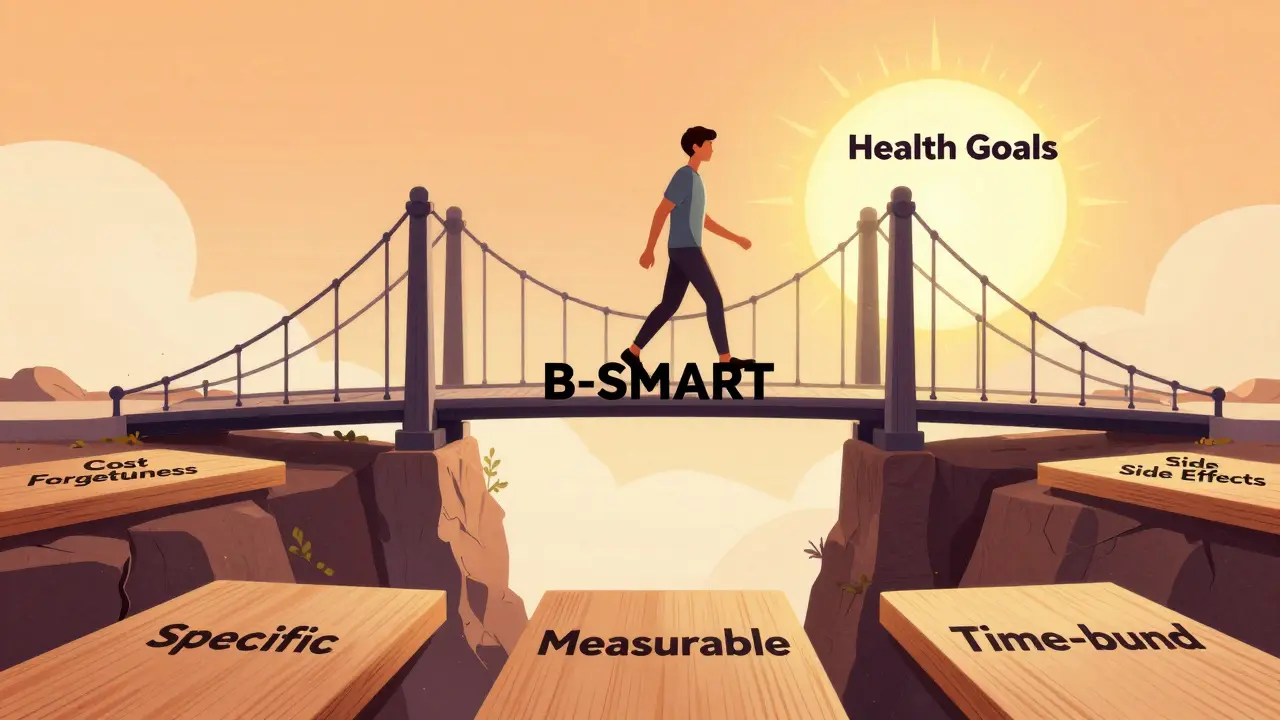
While the classic SMART framework is powerful, healthcare professionals have evolved it further. The National Community Pharmacists Association introduced the B-SMART framework, which adds 'Barriers' as the first critical step before setting any other criteria. Why start with barriers? Because if you ignore them, your goal will likely fail.
Before you write down your goal, ask yourself what stands in your way. Is it cost? Transportation to the pharmacy? Forgetfulness? Or perhaps the side effects make you hesitate? Identifying these obstacles upfront allows you to build solutions directly into your plan. For example, if cost is a barrier, part of your goal might be to switch to a generic version or use a mail-order service. If forgetfulness is the issue, your goal includes setting an alarm, not just "remembering to take the pill."
- B - Barriers: Identify what stops you (e.g., "I forget when I’m at work").
- S - Specific: Define exactly what you will do (e.g., "Take Metformin after lunch").
- M - Measurable: How will you know you did it? (e.g., "Check off on calendar").
- A - Achievable: Is this realistic right now? (e.g., "Yes, I always eat lunch at 1 PM").
- R - Relevant: Does this matter to your health? (e.g., "Controls my A1C levels").
- T - Time-bound: When is the deadline? (e.g., "Daily for the next 30 days").
Setting Goals That Stick: Practical Examples
Let’s look at how this translates to real life. Instead of saying "I want to manage my diabetes better," a B-SMART goal looks like this: "I will check my blood glucose twice a day (morning and evening) for the next two weeks to identify patterns, addressing my barrier of confusion about testing times by keeping my meter on the kitchen counter."
Notice the difference? The second statement gives you a clear action, a timeframe, and a solution to a potential obstacle. Studies show that patients who establish such specific diet and exercise goals during screenings achieve 65.5% adherence at follow-up. The key is making the goal so small and clear that saying "no" feels harder than doing it.
| Approach | Clarity | Accountability | Adherence Rate Impact |
|---|---|---|---|
| Vague Intentions | Low | Self-only | Minimal improvement |
| Standard SMART | High | Provider/Patient | Up to 35% increase |
| B-SMART + Digital Tracking | Very High | Automated Alerts | Significant long-term stability |
Tracking Progress Without the Stress
Setting the goal is only half the battle. You need to track it to see if it’s working. Fortunately, you don’t need to be a data scientist to do this. Modern digital health tools have made tracking effortless and highly accurate.
Electronic monitoring has come a long way. Smart pill bottles can detect openings with 98% accuracy, while e-injection pens record dosing history with 99.2% precision. These devices eliminate the "did I take it?" anxiety. If you prefer low-tech solutions, a simple calendar check-off system works well too, provided you review it weekly. The most important metric is consistency, not perfection. Missing one day doesn’t mean failure; it means you need to adjust your strategy.
Digital platforms like ThoroughCare or Medisafe integrate with electronic health records (EHRs) to pull Patient-Reported Outcome Measures (PROMs). This means your doctor sees your progress automatically. According to recent surveys, 78% of patients prefer visual progress charts over text-based updates. Seeing a streak of green checkmarks or a rising graph provides a dopamine hit that reinforces the habit. Wearable device users show 29% higher adherence when their goals are synced to their trackers, proving that visibility drives action.
Overcoming Common Hurdles
Even the best plans hit roadblocks. Here are three common hurdles and how to tackle them:
- Time Pressure: Many primary care providers report insufficient time to establish meaningful goals during short appointments. If you feel rushed, ask for a dedicated 15-minute goal-setting visit or use a pre-visit questionnaire to outline your barriers beforehand.
- Technology Fatigue: Older adults, in particular, may struggle with apps. One study found 52% of adults over 65 abandoned app-based tracking within 30 days. Solution: Use voice-activated assistants like Amazon Alexa or simple SMS reminders instead of complex apps.
- Cognitive Load: Patients with cognitive impairments may find structured approaches challenging. In these cases, simplify. Use color-coded pill organizers and involve a caregiver in the tracking process. Focus on one single goal at a time rather than multiple metrics.
Remember, the goal is to reduce friction, not add to it. If a tracking method feels burdensome, drop it and try something simpler. The best system is the one you actually use.

The Role of Providers and Support Systems
You shouldn’t have to do this alone. Effective adherence requires collaboration between you and your healthcare team. Dr. Jane Smith from Mayo Clinic notes that structured goal documentation reduces clinical note variability by 63%, leading to better care coordination. This means your provider should be actively involved in refining your goals.
Ask your doctor or pharmacist to help you identify the right metrics. For asthma, peak flow meters provide objective data. For diabetes, HbA1c reductions offer a long-term view. For hypertension, home blood pressure logs are essential. Your provider can also help interpret this data. If your numbers aren’t improving, it’s not necessarily because you’re failing-it might mean the dosage needs adjustment or the medication isn’t right for you.
Shared decision-making is crucial. When patients resist, it’s often because they don’t understand the "why." Ensure your goals align with your personal health priorities. If your main concern is energy levels rather than lab numbers, frame your goals around feeling better. This relevance boosts motivation significantly.
Future Trends: AI and Adaptive Goals
The landscape of adherence tracking is evolving rapidly. By 2025, AI-powered adaptive goal setting is becoming the new frontier. Algorithms can now modify targets based on real-time progress data. Imagine a system that notices you’ve been stressed and missing doses, then automatically suggests a simplified routine for the week. ThoroughCare’s analytics predict 89% of adherence failures 14 days in advance, allowing for proactive intervention.
Ingestible sensors and voice-activated tracking are also gaining traction. Proteus Digital Health’s systems verify adherence with 94% accuracy, removing doubt entirely. However, challenges remain regarding health equity. Patients in underserved areas still face lower completion rates due to social determinants of health. Future frameworks are focusing on "adaptable SMART" models that adjust goals based on local resource availability, ensuring everyone has a fair chance at success.
Next Steps for You
Start small today. Pick one medication or one health behavior. Identify the biggest barrier stopping you. Write down a B-SMART goal that addresses that barrier. Choose a tracking method that fits your lifestyle-whether it’s an app, a smart bottle, or a paper chart. Share this goal with your provider at your next visit. Consistency beats intensity. Small, sustainable wins lead to lasting health improvements.
What is the difference between SMART and B-SMART goals?
SMART goals focus on Specific, Measurable, Achievable, Relevant, and Time-bound criteria. B-SMART adds 'Barriers' as the first step, requiring you to identify potential obstacles like cost or forgetfulness before setting the goal. This makes B-SMART more practical for healthcare settings where external factors often derail plans.
How accurate are digital adherence trackers compared to self-reporting?
Self-reporting is notoriously unreliable, with patients overestimating adherence by 30-40% due to recall bias. Digital tools like smart pill bottles and e-pens offer 98-99% accuracy. Even simple calendar check-ins reviewed weekly reduce discrepancies to 8-12%, providing a much clearer picture of your actual habits.
Is it okay if I miss a day while tracking my progress?
Absolutely. Perfection is not the goal; consistency is. Missing a day is data, not failure. Use it to analyze what happened. Did you forget? Was the medication unavailable? Adjust your strategy accordingly. Celebrating small wins, like taking your med for 5 days in a row, builds momentum better than punishing yourself for slips.
Which digital tools are best for older adults?
Complex apps often lead to abandonment among adults over 65. Simpler solutions work best: large-button pill dispensers with alarms, voice-activated assistants like Alexa or Google Home for reminders, or traditional paper calendars with caregiver support. The key is minimizing steps and cognitive load.
How can I talk to my doctor about my adherence struggles?
Be honest and specific. Instead of saying "I forgot," say "I struggle to remember my morning dose because I rush to work." Ask for help identifying barriers and co-create a B-SMART goal. Most providers appreciate transparency and can adjust prescriptions or suggest tools that fit your lifestyle better.
Vineet Hawelia
July 16, 2026 AT 11:43The distinction between SMART and B-SMART frameworks is indeed quite significant when considering the practical application of adherence protocols. It is often overlooked that identifying barriers prior to setting objectives creates a more robust foundation for behavioral change. One must acknowledge that without addressing the root causes of non-adherence, such as cost or forgetfulness, the goals themselves remain theoretical rather than actionable. This approach aligns with established principles in health psychology where environmental factors are given equal weight to individual intent. It would be prudent for healthcare providers to adopt this methodology more widely in clinical settings.
Laura Odom
July 17, 2026 AT 00:48oh my god another article telling us how to behave like robots??
like seriously do we need an algorithm to tell us to swallow a pill?? its not rocket science its just taking care of yourself!! why does everything have to be so complicated with all these acronyms and tracking systems?? i mean come on people just take your meds and stop making it into a whole project management thing!! its exhausting just reading about all this 'data' and 'metrics' who has time for that?? life is messy and pills are hard enough without needing a smart bottle to judge you!!
Katie Caruthers
July 17, 2026 AT 13:44I simply cannot understand why anyone would struggle with this basic responsibility. It is truly heartbreaking to see how little effort some people put into their own well-being. If you cannot manage to take a small pill at the same time every day, what else in your life is out of control? It reflects a deeper moral failing in our society where convenience is valued over discipline. We should be ashamed of ourselves for needing apps and reminders to do what our ancestors did with sheer willpower. It is tragic really.
Megan Crossland
July 18, 2026 AT 19:09honestly the barrier part is key because ignoring obstacles is just delusional
i used to think i was just lazy but turns out my pharmacy was too far and the bus schedule sucked
once i switched to mail order my adherence went up instantly
it’s not about being better it’s about being smarter
stop beating yourself up and fix the system instead
Jairam Prasad
July 20, 2026 AT 12:07Ah yes, the modern obsession with quantifying every breath and heartbeat. How very Western of us to believe that if we can measure it, we can master it. In my culture, we trust the body's wisdom more than a graph on a screen. But I suppose one must play along with the digital age. The B-SMART framework is amusingly bureaucratic, isn't it? Adding 'Barriers' is like admitting that life is inherently difficult, which is a profound philosophical realization disguised as a healthcare tip. Perhaps we should start by acknowledging that existence itself is the ultimate barrier.
Gary Hull
July 21, 2026 AT 22:06look everyone here acting like these apps are going to save lives is totally missing the point
the real issue is that big pharma wants you dependent on their products so they sell you trackers too
its a scam plain and simple
just take your meds when you remember and dont let them turn you into a data point
im not buying into this tech bro health nonsense
Padraic Cepek
July 22, 2026 AT 01:11This is typical soft advice for weak people who cant handle basic discipline. Real Americans don't need fancy apps or smart bottles to take their medicine. We just do it because it's the right thing to do. All this talk about 'barriers' and 'stress' is just an excuse for laziness. If you want to get healthy, you stop whining and start following orders. Simple as that. No need for all this complicated stuff.
Mildred Fierce
July 22, 2026 AT 14:59I find it deeply unsettling how much privacy we are willing to sacrifice for the illusion of control. These companies are harvesting our biological data while we sit there thanking them for a green checkmark. It is a dystopian nightmare wrapped in a user-friendly interface. You think you are tracking your health but really you are being tracked by algorithms designed to keep you engaged and compliant. It is manipulative and cruel. Wake up people before you lose your autonomy entirely.
Trey Newkerk
July 22, 2026 AT 19:38You fools! You think a calendar or a beep from a phone will save you from the abyss? Adherence is a spiritual journey not a mechanical task! When you miss a dose you are rejecting the universe's gift of healing! Stop trying to hack your biology with these petty tricks! Embrace the chaos of forgetting and find enlightenment in the missed dose! Your doctors are liars and your apps are chains! Break free!