
How to Involve Grandparents and Caregivers in Pediatric Med Safety
 May, 8 2026
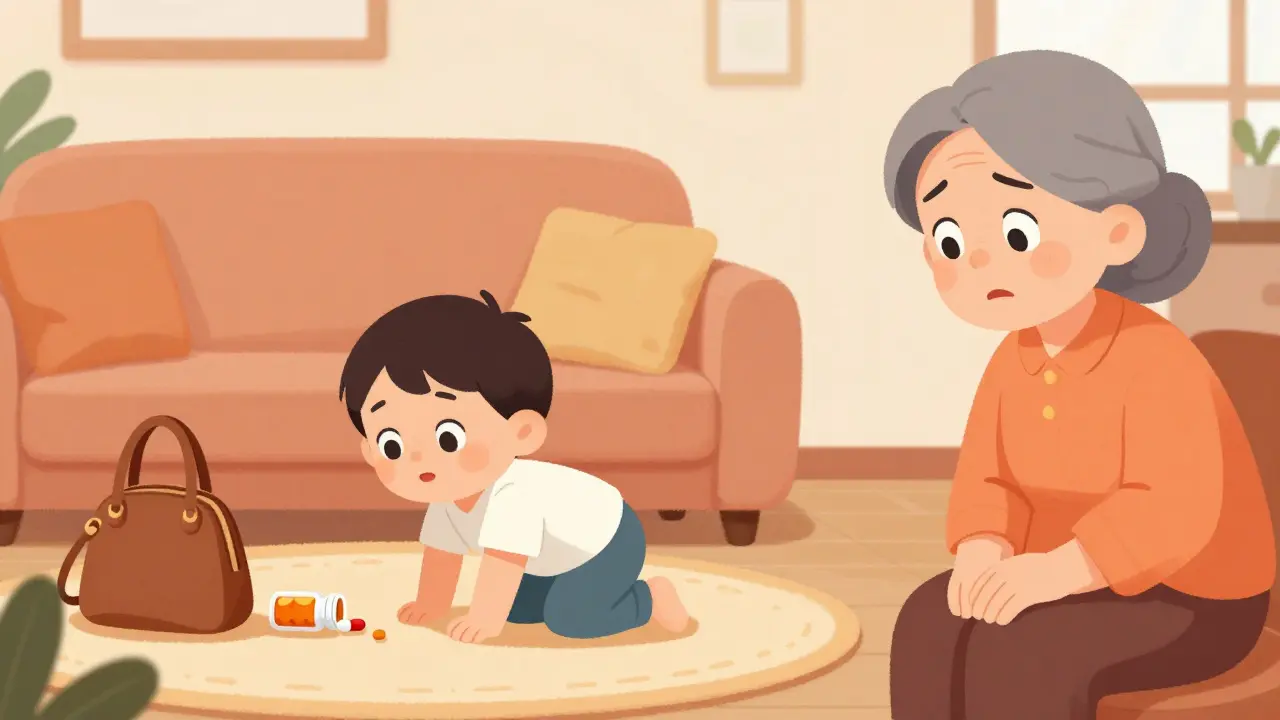
Imagine this: your three-year-old is playing on the floor while you’re in the kitchen making a snack. They crawl into your purse, find a small bottle of pills, and pop one into their mouth. It’s a nightmare scenario that happens far too often. In fact, nearly four out of ten pediatric medication poisonings involve a grandparent’s medicine. That’s not just a statistic; it’s a wake-up call for families everywhere.
We love our grandparents. They’re often the backbone of childcare, especially as more parents juggle work and family life. But here’s the tricky part: many older adults don’t realize how accessible their medications are to curious little hands. With over 7 million grandparents living with grandchildren in the U.S., and countless others providing regular care, we need to talk about pediatric medication safety. This isn’t about blaming anyone-it’s about protecting the kids we all cherish.
The Real Risk: Why Grandparents’ Medicine Cabinets Matter
You might think that keeping meds in a bathroom cabinet or on a nightstand is harmless after all, those containers have child-resistant caps, right? Wrong. Studies show that 30% of four-year-olds can open these "child-proof" lids in under five minutes. And when it comes to grandparents, the numbers are concerning. According to data from the National Poll on Healthy Aging, 12% of grandparents who care for kids daily keep prescription meds on bedroom dressers or nightstands. Another 29% transfer their pills into weekly organizers that aren’t child-safe at all.
Why does this happen? Well, older adults often take multiple medications an average of 4.7 per day compared to just 2.1 for younger parents. Managing so many bottles means some get moved around, repurposed, or left out for convenience. Plus, many grandparents grew up in an era where pill bottles didn’t even have safety caps. Their habits reflect that past reality, not today’s risks.
| Practice | Parents (Ages 30-49) | Grandparents (Ages 65+) |
|---|---|---|
| Daily Prescription Use | 42% | 74% |
| Proper Safe Storage | 68% | 52% |
| Use Locked Cabinets | 58% | 22% |
| Transfer to Non-Childproof Containers | 8% | 29% |
| Keep Meds in Purses/Bags | Low | 31% |
So, what can we do? The good news is that simple changes make a huge difference. Let’s break down exactly how you can help grandparents become safer caregivers without making them feel criticized.
Step-by-Step: Creating a Safer Home Environment
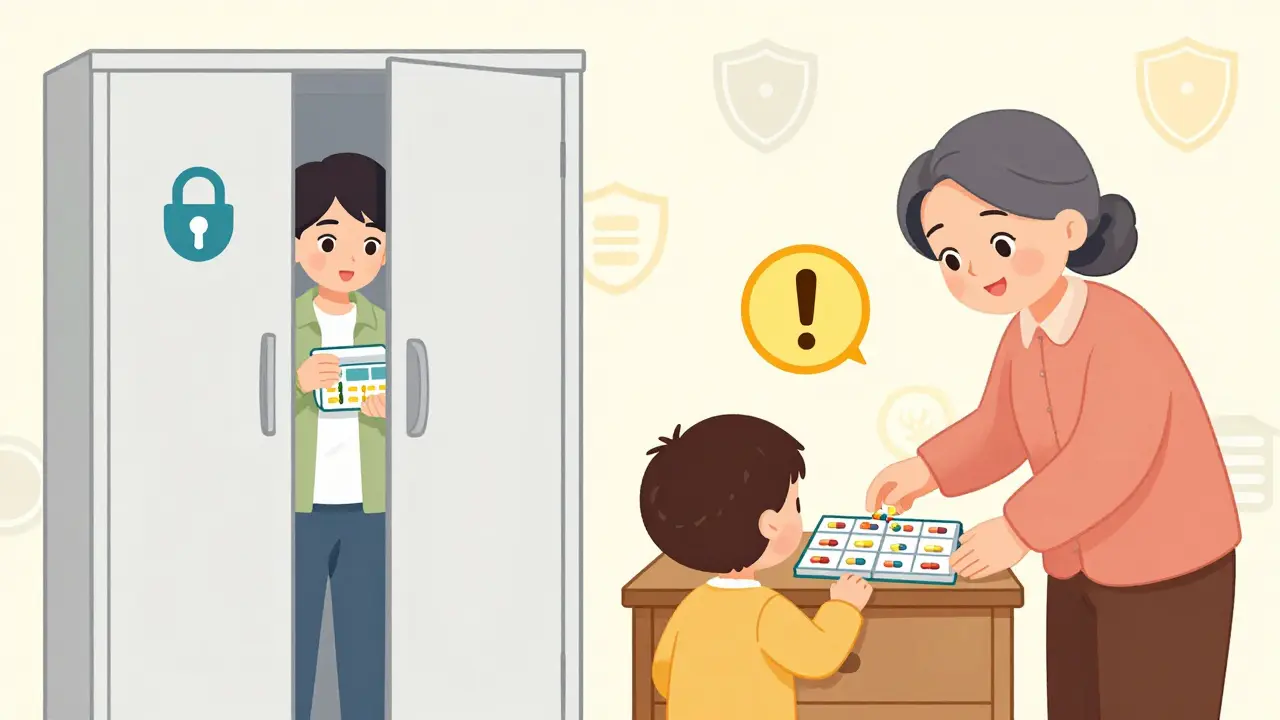
First things first: storage matters. The Centers for Disease Control and Prevention (CDC) recommends the "Up & Away and Out of Sight" approach. This means storing medications high up, locked away, and hidden from view. Here’s how to put that into practice:
- Choose the Right Location: Pick a cabinet that’s at least four feet off the ground. Ideally, it should require 15 pounds of force to open something most kids under five can’t manage. Avoid bathrooms and kitchens unless they’re locked.
- Invest in Lockboxes: If built-in cabinets aren’t an option, buy a sturdy lockbox. Keep it in a closet or drawer. Many pharmacies now offer free boxes to seniors ask during your next refill!
- Stick to Original Containers: Never pour pills into non-childproof containers like weekly planners or coffee tins. These lack security labels and safety features. If arthritis makes opening original bottles hard, look for easy-open caps designed specifically for seniors.
- Dispose of Expired Meds: Go through the stash every few months. Toss anything expired or unused. You can drop them off at local pharmacy take-back programs instead of flushing them down the drain.
A study published in PMC showed that just 15 minutes of education improved safe storage practices among grandparents from 39% to 78%. Imagine that! A short conversation could save lives.
Talking About Medicine Safety Without Causing Offense
Let’s face it: telling someone they’re doing something wrong rarely works. Instead, frame medication safety as teamwork. Use phrases like, "Let’s make sure our grandkids are super safe," rather than, "You’re putting them at risk." Empathy goes a long way.
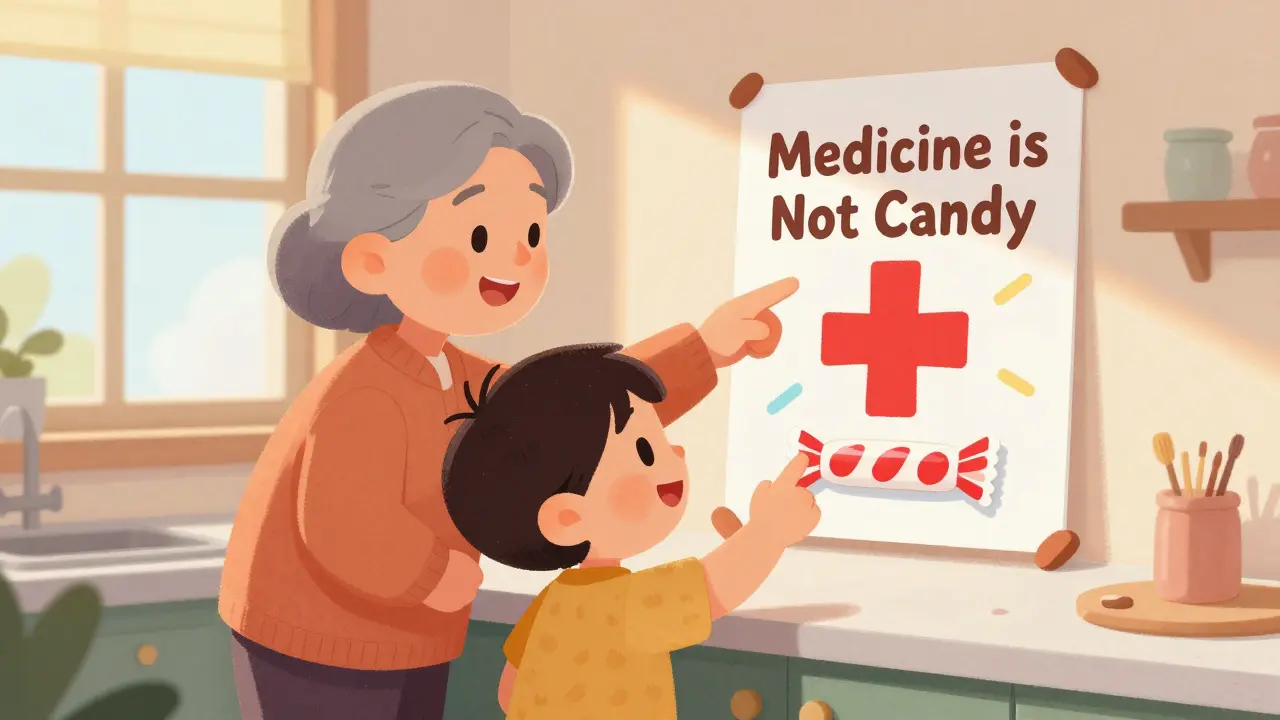
Here’s a tip: involve the kids themselves! Draw posters together labeled "Medicine Is Not Candy." Teach them the golden rule: if they find any pills, tell an adult immediately. Make it fun by turning it into a game. For example, play pretend where the child acts as the "medicine detective" reporting back to Grandma or Grandpa.
If resistance arises, remember why people push back. Some grandparents worry about being seen as careless or outdated. Reassure them that staying informed shows strength, not weakness. Share success stories too. Did you know 87% of grandparents express high concern about grandchild safety? They already care deeply; they just need guidance.
Leveraging Technology and Resources
Not everyone is tech-savvy, but there are tools tailored for older adults. The CDC recently launched the "Grandparent Guardian" digital toolkit featuring multilingual videos demonstrating proper storage techniques. Early results show 85% completion rates impressive considering the audience demographic.
For those who prefer traditional methods, printed materials still work wonders. Refrigerator magnets listing emergency contact numbers serve as constant reminders. Community health fairs also provide opportunities for hands-on training sessions. Look for workshops hosted by organizations like AARP or local senior centers.
Pharmacists play a crucial role here too. During pick-ups, ask questions like, "Do you have grandchildren visiting often?" Then suggest personalized safety assessments. Studies reveal 78% of participating grandparents modified their storage practices afterward. Small steps lead to big impacts.
Addressing Common Challenges Head-On
Arthritis, memory issues, and mobility limitations pose real barriers for some grandparents. Don’t ignore these concerns. Offer solutions such as automatic pill dispensers with alarms or voice-activated assistants reminding users to secure medications after use.
Another challenge? Misjudging children’s abilities. Sixty-two percent of grandparents believe kids couldn’t possibly open child-resistant packaging despite evidence proving otherwise. Show them demonstrations using actual products. Seeing is believing.
Finally, consider cultural differences. Materials should be available in multiple languages reflecting diverse communities. Visual aids help bridge communication gaps regardless of language proficiency.
Building Long-Term Habits Through Reinforcement
Change doesn’t stick overnight. Research indicates two to three reinforcement contacts yield best outcomes. Combine initial education with follow-up calls or visits checking progress. Celebrate successes along the way positive reinforcement motivates continued effort.
Establish clear communication protocols between parents and grandparents regarding medication locations and emergency procedures. Only 38% of families currently do this consistently according to AAP studies. Fill that gap by creating shared checklists posted visibly in homes.
Encourage annual reviews updating strategies based on evolving needs. As grandchildren grow older, adjust rules accordingly. Toddlers require different precautions than school-aged children.
What percentage of pediatric medication poisonings involve grandparents?
Approximately 38% of medication-related poisonings requiring emergency evaluation involve a grandparent's medicine, according to Consumer Product Safety Commission data analyzed in a 2017 study.
How effective is educating grandparents about medication safety?
Highly effective. An NIH-funded study demonstrated that a single 15-minute educational session improved safe medication storage practices from 39% baseline to 78% at follow-up among 223 grandparents.
Where should medications be stored safely?
Medications should be stored at eye level or higher, ideally in locked cabinets requiring 15+ pounds of force to open. Avoid leaving them in purses, on counters, or in easily accessible drawers.
Can child-resistant packaging truly protect young children?
While helpful, child-resistant packaging isn't foolproof. Testing shows 30% of four-year-olds can defeat these mechanisms within five minutes. Additional layers of protection like locks are essential.
Are there resources available for grandparents struggling with dexterity issues?
Yes, adaptive devices like easy-open caps designed for seniors and automatic pill dispensers with alarms address physical limitations. Consult pharmacists for recommendations suited to individual needs.
Why do some grandparents resist changing their medication habits?
Resistance often stems from fear of criticism or perceived loss of independence. Framing discussions positively emphasizes collaboration over blame, reducing defensiveness significantly.
How frequently should medications be reviewed and disposed of?
Experts recommend reviewing medications every few months. Discard expired or unused drugs via official take-back programs ensuring environmental safety alongside personal health considerations.
What role do pharmacists play in promoting medication safety?
Pharmacists serve as key educators offering personalized assessments during refills. Participating in initiatives like the Grandparent Pledge leads to substantial improvements in storage practices among seniors.
Guy Birtwhistle
May 10, 2026 AT 00:50Look, I get that we all love our grandparents and they mean well, but let’s not pretend that “child-resistant” caps are some kind of fortress. They’re basically a suggestion box for toddlers with opposable thumbs. My nephew figured out how to pop the lid on his grandma’s blood pressure meds before he could tie his shoes. It wasn’t impressive; it was terrifying. We need to stop relying on packaging that hasn’t been updated since the Reagan administration and start using actual locks. A simple magnetic cabinet lock costs five bucks and takes thirty seconds to install. If you’re still arguing that your three-year-old isn’t curious enough to find pills in a purse, you haven’t spent much time around children. They are little scientists whose hypothesis is “what happens if I eat this?” Spoiler alert: nothing good.
Kenny Pines
May 11, 2026 AT 21:12Oh boy, here we go again 🙄 The classic “grandma did it wrong” narrative. As if any of us parents are saints when it comes to leaving things lying around. I’ve left keys on the counter, phones on the couch, and yes, occasionally a bottle of ibuprofen within reach because I was tired and distracted. Does that make me a bad parent? No. It makes me human. And frankly, blaming grandparents for keeping their meds on the nightstand because they have arthritis and can’t bend down to a locked cabinet feels like kicking someone while they’re down. Maybe instead of shaming them, we should be installing better storage solutions together. Teamwork makes the dream work, right? Or at least keeps the ER visits to a minimum 😅
Liz and Nick
May 12, 2026 AT 22:32i mean honestly who has time for all this safety theater anyway. my grandkids are fine theyre just kids. sure maybe one ate a vitamin but hey look at him now running around healthy as a horse. all these rules and locks and educational sessions its just anxiety porn for people who cant relax. if a kid gets into something theyll learn from it or they wont. nature selects. also why do we always assume grandparents are the problem? what about the parents who leave the house unattended? seems like we should focus on that first. but no lets buy more plastic boxes and watch videos about how to store pills properly. sounds exhausting.
Brian Fibelkorn
May 14, 2026 AT 15:05The epistemological failure here is staggering. You cannot simply rely on heuristic assumptions regarding pediatric cognitive development and motor skills when dealing with pharmacological agents. The data presented clearly indicates a significant variance in storage practices between generational cohorts, specifically highlighting the lack of adherence to CDC guidelines among the geriatric population. This isn't about 'feelings' or 'tradition'; it's about risk mitigation protocols. When you transfer prescription medications into non-childproof containers, you are essentially engaging in negligent behavior that disregards established safety standards. The argument that 'it never happened to me' is a logical fallacy known as survivorship bias. We must enforce strict compliance with secure storage methodologies, including the use of tamper-evident seals and high-security locking mechanisms, to ensure the integrity of the domestic environment. Anything less is an abdication of duty of care.
David Rangkhal
May 16, 2026 AT 00:08Hey guys let’s keep it cool everyone is trying their best 👍 In India we often have multi-generational homes so this issue is huge there too. My dad used to keep his medicine in a drawer but after we showed him a demo of how easy it is for a toddler to open those child-proof caps he switched to a small lockbox. It didn’t cost much and now he feels safer knowing his stuff is secure. It’s not about blame it’s about helping each other adapt. Technology helps too like apps that remind you to put meds away. Let’s share tips instead of fighting. Peace and safety for all families 🌍💊
Chelsea Grdina
May 16, 2026 AT 23:54I think it’s really important to acknowledge that cultural contexts play a massive role in how we perceive safety and caregiving responsibilities, and while the statistics are indeed alarming, we must approach this conversation with a great deal of empathy and understanding rather than judgment, because many of our elders come from backgrounds where resources were scarce and safety features like child-resistant caps were simply nonexistent, meaning their habits are deeply ingrained responses to past realities rather than current negligence, so perhaps we can create community workshops that not only educate but also provide free safety kits to seniors, fostering a sense of shared responsibility and mutual support within our neighborhoods, which ultimately strengthens the bonds between generations while ensuring that our little ones are protected in a way that respects the dignity and autonomy of their caregivers.
Sarah Kwiatkowski
May 17, 2026 AT 12:42This is such a vital topic and I’m so glad we’re having this discussion! It’s amazing how much impact a simple conversation can have. I actually started doing ‘medicine detective’ games with my niece and nephew, and it’s turned into a fun routine where they proudly report any ‘finds’ to me immediately. It empowers them and keeps them safe without making them scared. Plus, involving the kids makes it less about policing the grandparents and more about family teamwork. Who knew safety could be so engaging? Let’s keep spreading these positive strategies!
Brian LeClercq
May 17, 2026 AT 21:44Absurdity. Pure absurdity. Here we are in America, the land of the free, being lectured by bureaucrats on how to store our own property. Grandparents know their homes better than any government agency ever will. These ‘child-resistant’ caps are a scam designed to sell more plastic waste, and now we’re expected to install locks on our cabinets like we’re guarding state secrets? Nonsense. Kids are resilient. If they eat a pill, they’ll likely vomit it up or survive just fine. Stop coddling them and stop invading the privacy of senior citizens. Let people live their lives without fear-mongering statistics from biased studies. Real freedom means taking calculated risks, not hiding every pill in a vault.
Frances Kendall
May 18, 2026 AT 23:24As a pharmacist, I see this daily. The resistance isn’t usually about stubbornness; it’s about accessibility. Arthritis, vision loss, and memory issues make original bottles a nightmare for many seniors. That’s why I always recommend specific adaptive devices during refills. We’ve seen a huge shift when we frame it as ‘making your life easier and safer’ rather than ‘you’re doing it wrong.’ Also, the ‘Grandparent Guardian’ toolkit mentioned is fantastic-I’ve handed out copies to dozens of patients, and the feedback has been overwhelmingly positive. It bridges the gap between medical advice and practical application. Let’s normalize asking pharmacists for help with storage solutions. It’s part of our job to ensure medication safety extends beyond the pharmacy doors.