
How to Check for Pharmacy-Level Recall Notifications: A Step-by-Step Guide for 2026
 Jan, 20 2026
When a drug gets recalled, it’s not just a notice on a website-it’s a race against time to keep patients safe. If your pharmacy dispenses a contaminated or mislabeled medication, the consequences can be deadly. That’s why knowing how to check for pharmacy-level recall notifications isn’t optional. It’s mandatory. And it’s not as simple as checking your email once a week.
Understand the Three Levels of Drug Recalls
Not all recalls are created equal. The FDA classifies them into three categories based on risk:- Class I: Highest risk. These involve products that could cause serious injury or death. Think contaminated antibiotics or pills with the wrong active ingredient. You have 24 hours to act.
- Class II: Moderate risk. These might cause temporary health problems or pose a minor threat. Examples include labeling errors or potency issues. You have 72 hours to respond.
- Class III: Lowest risk. These won’t hurt you but violate FDA regulations-like incorrect expiration dates or packaging defects. You have up to a week.
Class I recalls are the ones that keep pharmacists awake at night. In 2023, 4% of all drug recalls were Class I-and they required 100% patient notification under FDA rules. Missing one could mean a lawsuit, a loss of license, or worse.
Set Up Your Primary Notification Channels
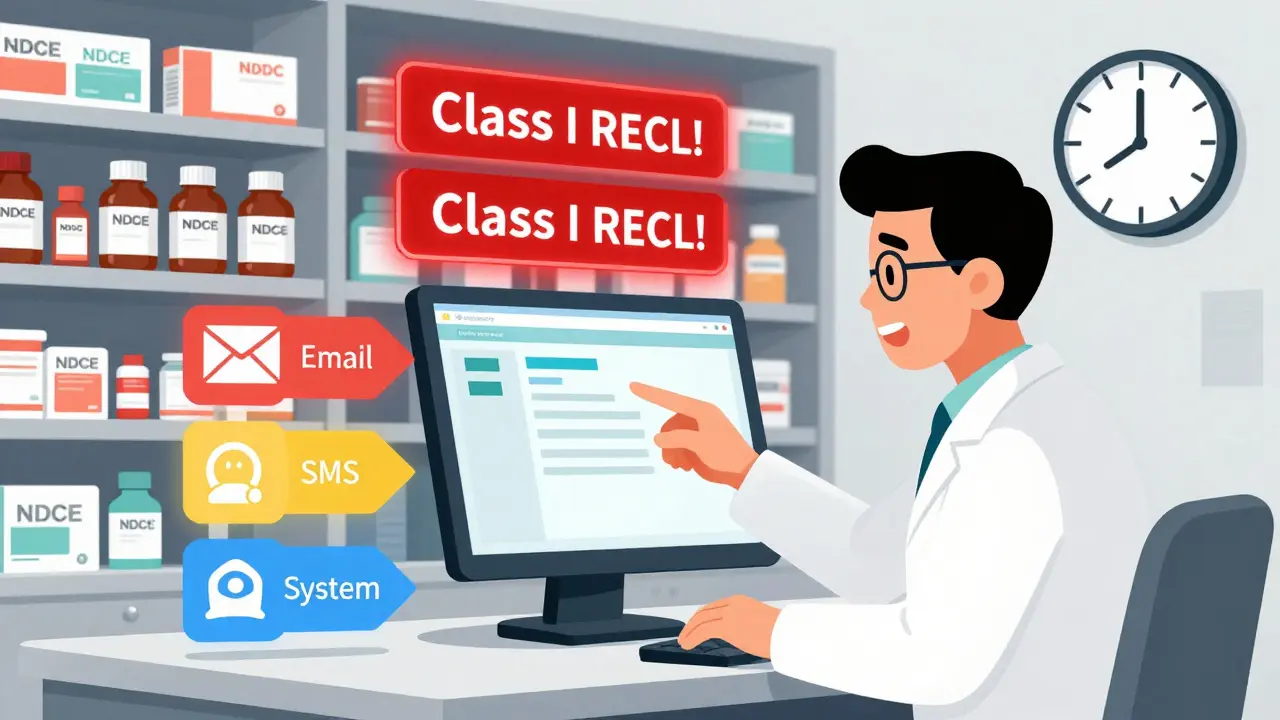
You can’t wait for a recall to happen to figure out how to respond. You need systems in place before the alert comes in. Here’s what every pharmacy must have:- FDA MedWatch Email Alerts: Free. Go to fda.gov/Safety/MedWatch/default.htm and sign up. You’ll get weekly summaries and urgent alerts. But don’t rely on this alone-only 62% of pharmacists acknowledge these in time.
- Your Wholesaler’s Recall System: Whether you buy from McKesson, Cardinal Health, or AmerisourceBergen, they all have automated recall feeds. These are mandatory under federal law. Most are free for contract pharmacies. Enable email and SMS alerts.
- Your Pharmacy Management System: This is non-negotiable. Systems like QS/1, PioneerRx, and FrameworkLTC pull FDA data hourly. They cross-reference your inventory by NDC and lot number. If your system doesn’t do this, you’re operating at high risk. In 2023, pharmacies using integrated systems cut recall response time from 7.2 hours to 1.4 hours.
Experts say you need at least three channels. One fails? You still have two backups. The FDA’s own 2022 report showed that pharmacies using only postal mail missed 28.6% of Class I recalls. That’s not negligence-it’s negligence with consequences.
Verify Recalls Within 4 Hours
Receiving a notice is step one. Verifying it is step two-and it’s where most pharmacies fail.Here’s the real-world process:
- Open the recall notice. Look for the National Drug Code (NDC) and the lot number. These are the keys to matching your inventory.
- Log into your pharmacy system. Run a search for that exact NDC and lot number. Don’t guess. Don’t assume. If your system doesn’t auto-flag it, manually check your dispensing logs.
- Check your physical inventory. Pull every bottle with that lot number. Even if you think you sold them all, you might have one sitting on a back shelf.
- Verify patient records. Did you dispense this drug to anyone in the last 30 days? For Class I recalls, you must contact every patient. For Class II, you need to reach 80%.
Time matters. CMS requires verification of Class I and Class II recalls within 4 hours. That’s not a suggestion. It’s a rule. And if you’re a Medicare-participating pharmacy, you’ll be audited on this starting in 2024.
Handle the Logistics: Quarantine, Notify, Document
Once you confirm a recall:- Quarantine all affected product immediately. Put it in a locked cabinet labeled “RECALL-DO NOT DISPENSE.”
- Notify patients. Call them. Don’t just mail a letter. For Class I recalls, the FDA requires direct contact. Use your pharmacy software to auto-generate call scripts. Many systems can even send SMS alerts.
- Document everything. Log the recall number, time received, who verified it, what was found, who was contacted, and when. The FDA requires you to keep these records for 3 years. Most pharmacies now use electronic audit trails-92% do, according to the 2023 Pharmacy Quality Alliance report.
One community pharmacy in Ohio missed a Class I recall in 2023 because they didn’t document their verification. They got fined $28,000. The recall had affected 14 patients. One had a seizure.
Why Your System Might Be Failing You
Even if you’re doing everything right, your tools might be letting you down. Here’s what’s broken in today’s system:- Lot number formats vary. One manufacturer uses “A123-BC456,” another uses “123456789012345.” Your system might not recognize them as the same.
- False positives. Wholesaler alerts often flag products you don’t carry. One pharmacy reported 18.7% of alerts were wrong. That’s wasted time.
- No after-hours access. Walgreens’ 2022 audit found 23% of verification failures happened because techs couldn’t access inventory systems after hours.
- Sync programs ignore recalls. If a patient gets a 90-day supply under a medication synchronization program, a recall notice might not reach them. That’s a blind spot 43% of pharmacies still miss.
The FDA is fixing this. By December 2024, all lot numbers must be 15 characters long and follow a standard format. By 2025, all Class I recalls must include patient-level risk data. But until then, you’re on your own.
What Independent Pharmacies Can Do on a Budget
If you’re a small shop, you might think integrated systems are too expensive. PioneerRx’s recall module costs $2,495 a year plus $495/month for data. That’s not feasible for a pharmacy doing only 2-3 recalls a year.Here’s a low-cost, high-reliability approach:
- Sign up for FDA MedWatch (free).
- Enroll in your wholesaler’s alert system (free).
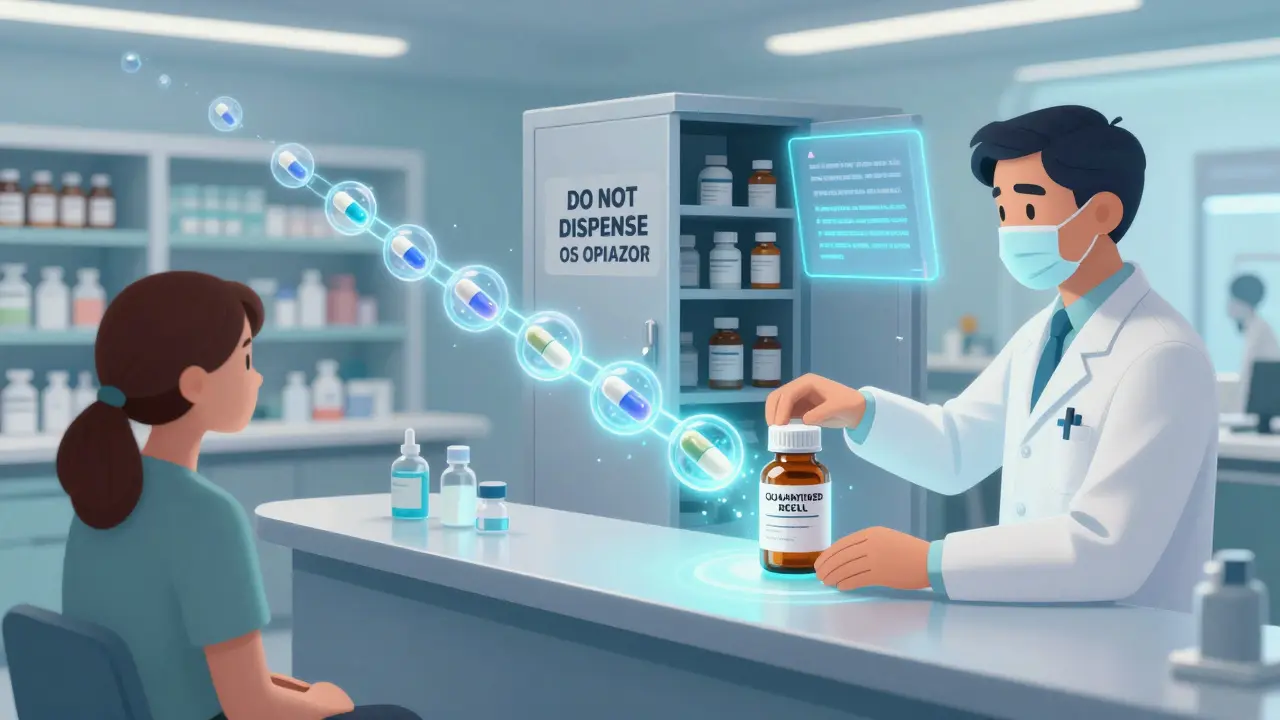
- Use a free Google Sheet to log every recall you get. Include: date received, NDC, lot number, inventory check status, patient contact status.
- Assign one person to check for recalls every morning and every evening.
- Keep a printed list of your top 10 most dispensed drugs and their NDCs. When a recall comes in, cross-check manually.
It’s not glamorous. But it’s legal. And it’s saved lives. One independent pharmacy in rural New Zealand used this method to catch a Class I recall on a blood pressure med-before a patient took it.
The Future: AI and Blockchain Are Coming
By 2025, 75% of pharmacies will use AI-powered recall verification. These systems will:- Auto-match NDCs and lot numbers across all vendors
- Identify patients on sync programs
- Send automated SMS alerts to patients
- Update inventory in real time
The FDA’s MediLedger Project is already testing blockchain for recall tracking. Imagine a system where every pill’s journey-from manufacturer to patient-is recorded and instantly searchable. That’s not sci-fi. It’s coming by 2027.
But until then? Your job is to be the human firewall. No software replaces vigilance. No automation replaces responsibility.
What Happens If You Don’t Act?
In 2022, a pharmacy in Texas missed a Class I recall on a diabetes med. The lot contained toxic impurities. Two patients went into diabetic ketoacidosis. One died. The pharmacy lost its license. The owner was charged with criminal negligence.This isn’t a hypothetical. It’s a pattern. The Patient Safety Movement Foundation ranks medication recalls as the seventh leading cause of preventable harm in outpatient care. And the number of recalls is rising-up 12.3% in 2022 alone, mostly from nitrosamine contamination in generics.
You can’t afford to be the one who missed the alert.
Kelly McRainey Moore
January 21, 2026 AT 00:35This is the kind of guide I wish I had when I started in community pharmacy. So many of us just wing it until something goes wrong.
Class I recalls are terrifying. I remember one last year where we almost missed a batch because the lot number was formatted weirdly.
Turns out the wholesaler’s system didn’t flag it right. We had to manually cross-check every bottle.
Thank god we caught it before the morning rush.
Now I print out the top 15 NDCs we dispense and keep them taped to my monitor.
Simple, dumb, but it works.
Also, don’t trust email alerts alone. I’ve had FDA alerts go to spam three times now.
Set up a separate inbox just for recalls. Trust me.
Amber Lane
January 22, 2026 AT 05:11One sentence: If you’re not verifying recalls within 4 hours, you’re already late.
Ashok Sakra
January 22, 2026 AT 08:45Y’all think this is bad? Wait till you find out the FDA’s secretly using AI to track your patients’ blood pressure meds and sell the data to Big Pharma.
They already know who’s on insulin and who’s not.
They’re watching you.
Every time you log in to your system, they’re smiling.
They’re coming for your pills.
And your patients.
And your soul.
Coral Bosley
January 23, 2026 AT 09:56I’ve been in this game 27 years and I’ve seen it all.
Back in the 90s we used to get recalls via fax machine. You’d print it out, hand it to the tech, and pray they didn’t misread the lot number.
Now we’ve got systems that auto-flag NDCs, send SMS alerts, even call patients.
But here’s the dirty secret - the most reliable tool is still the human who checks the shelf every damn morning.
Software glitches. Wholesalers mess up. Emails vanish.
But a person who cares? They don’t sleep on it.
I’ve got a 72-year-old tech who still writes down every recall in a leather-bound notebook.
She’s never missed one.
And she’s the reason we haven’t lost our license.
Technology helps. But heart? Heart doesn’t have an off button.
Steve Hesketh
January 24, 2026 AT 08:16Brothers and sisters, this is not just about compliance - this is about saving lives.
I come from a small town in Nigeria where medicine is scarce, and every pill matters.
When I saw this guide, I cried.
Because here in the U.S., you have systems, you have alerts, you have time.
But in many places, a single missed recall means someone dies alone in a village with no one to blame but silence.
So please - don’t take this lightly.
Check the lot number.
Call the patient.
Document it.
Even if no one sees it.
Even if no one thanks you.
Because someone’s life is in your hands.
And you’re the only one who can hold it.
Be the firewall.
Be the light.
Be the one who didn’t look away.
shubham rathee
January 26, 2026 AT 05:05Class I recalls are a scam
the FDA just wants you to buy more software
my wholesaler sends 20 alerts a day and 18 are wrong
they even flagged my ibuprofen once
the lot number was 123456789012345
and the recall was for 123456789012346
same digits different order
they call that precision
it’s just corporate laziness
you don’t need AI
you need a better spreadsheet
and maybe a nap
MAHENDRA MEGHWAL
January 27, 2026 AT 18:27It is with profound respect for the gravity of pharmaceutical responsibility that I acknowledge the meticulousness required in the verification and documentation of drug recalls.
The procedural rigor outlined herein reflects not merely regulatory compliance, but a moral imperative rooted in the Hippocratic tradition.
One must recognize that each National Drug Code corresponds not to an abstract inventory item, but to a human being who relies on the integrity of their medication.
Therefore, the act of cross-referencing lot numbers is not a task, but a covenant.
It is my sincere hope that all practitioners internalize this duty with the solemnity it deserves.
May we never be the cause of preventable harm.
Kevin Narvaes
January 28, 2026 AT 00:01so like… what if the recall is fake?
like what if the FDA just made it up to sell more pills?
or what if the wholesaler’s system is hacked by aliens?
i heard they use the lot numbers to track your dreams
and if you take the wrong pill you start seeing glitter
just saying
maybe we should all just stop taking meds
and go live in the woods
with goats
and a solar-powered pill organizer
that only works on tuesdays
Dee Monroe
January 28, 2026 AT 10:46There’s something deeply human about this whole process - the way we’re forced to slow down, to touch each bottle, to look into the eyes of a patient and say, ‘I’m sorry this happened.’
It’s not about the software. It’s not about the alerts. It’s about the moment when you realize that the NDC you’re typing isn’t just a string of numbers - it’s the name of someone’s mother, their child, their best friend.
And when you find that bottle on the shelf, you don’t just quarantine it.
You hold it.
You feel its weight.
You wonder what their life would have been like if you’d been five minutes slower.
That’s the real cost of a recall.
Not the fine.
Not the audit.
But the silence after you call the patient and they say, ‘Thank you for letting me know.’
Because that silence? That’s the sound of a life still breathing.
And that’s why we do this.
Not because we have to.
But because we choose to.
Jerry Rodrigues
January 28, 2026 AT 22:40Good guide. The Google Sheet tip is gold. I’ve been doing that for two years now.
Simple. No tech. No drama.
Just a list. Every morning. Every night.
And yeah, I still print the top 10 NDCs.
Works every time.
Jarrod Flesch
January 28, 2026 AT 23:57Just wanted to say this is the most useful thing I’ve read all year 🙌
Been using the wholesaler alerts + Google Sheet combo since last fall.
Found a Class II recall on a thyroid med last month - caught it before the 4-hour window.
Called the patient, she was 87 and lived alone.
She cried. Said she thought no one cared.
Turns out, we do.
Thanks for the reminder.
And yes, I still check the back shelf. Always.
Barbara Mahone
January 30, 2026 AT 15:46The blockchain mention is interesting, but I worry about accessibility.
Not every pharmacy can afford real-time tracking systems.
And in rural areas, internet is spotty.
What happens when the system goes down?
The low-tech methods described - the printed list, the manual log - are not outdated.
They’re resilient.
They’re human.
And in a world obsessed with automation, that’s the real innovation.
Andrew Rinaldi
February 1, 2026 AT 12:36I think we’re all trying to do the right thing.
Some of us have fancy systems.
Some of us have spreadsheets.
Some of us have a checklist taped to the wall.
But the goal is the same - keep people safe.
Maybe the real lesson here isn’t about the tools.
It’s about showing up.
Every day.
Even when you’re tired.
Even when it’s boring.
Even when no one’s watching.
That’s the work.
And it matters.
Gerard Jordan
February 2, 2026 AT 11:47Just saved this for my whole team 🙏
Also - if you’re not using a Google Sheet for recalls, you’re doing it wrong.
Here’s my template: Date | NDC | Lot # | Inventory Checked? | Patient Called? | Notes
We even color-code it: red = Class I, yellow = Class II, green = Class III
My techs love it. They’ve started adding emojis to the notes 😅
One wrote: ‘Bottle found. Patient called. She said ‘you’re the reason I still trust pharmacies.’
That’s the stuff that keeps me going.