
How to Ask for a 90-Day Supply of Medication to Cut Down Pharmacy Visits
 Jan, 9 2026
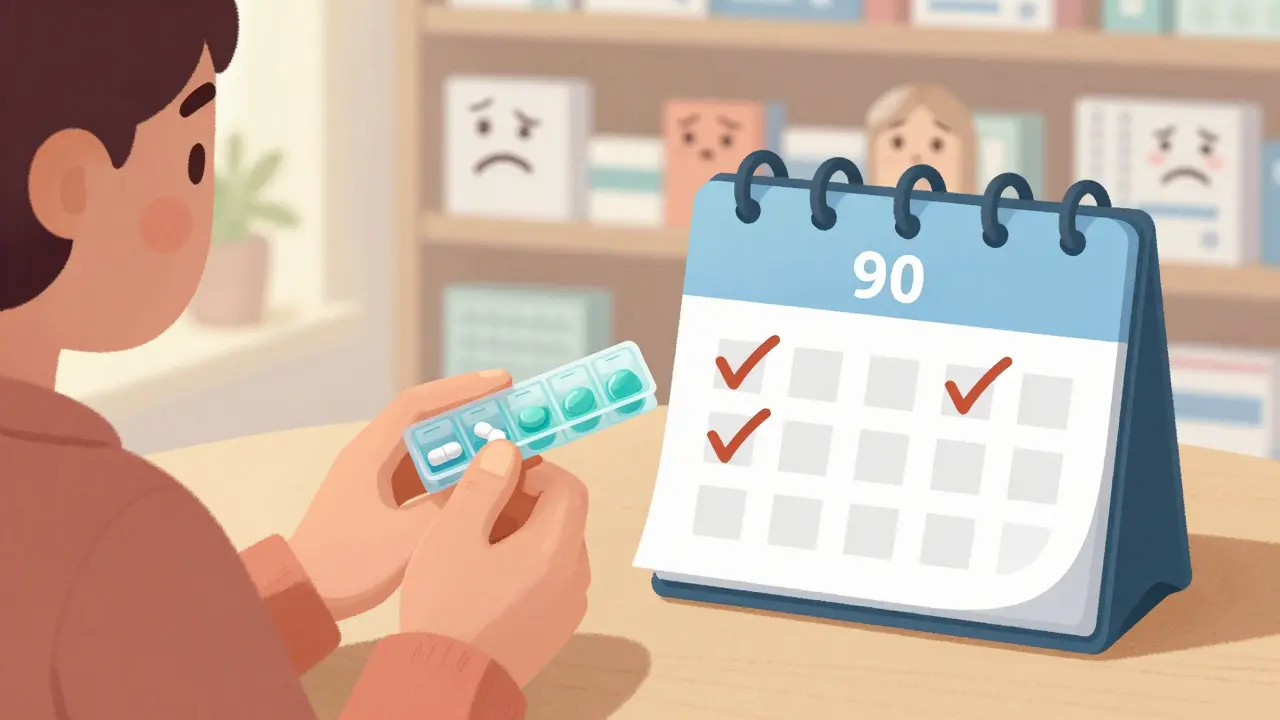
Every month, you drive to the pharmacy. Again. And again. For the same pills. Same time. Same line. Same frustration. If you’re taking medication for high blood pressure, diabetes, cholesterol, or depression, you’re not alone. Millions of people do this every single month. But what if you could cut that down to just four times a year? That’s the power of a 90-day prescription supply.
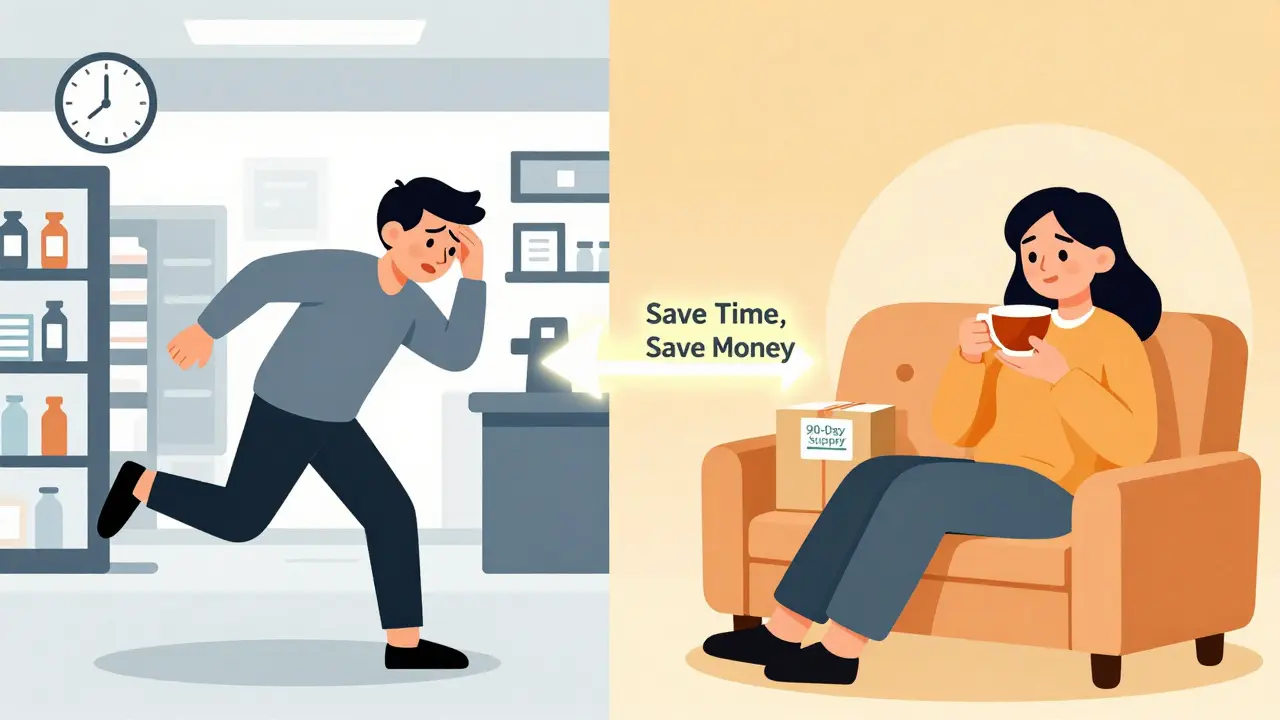
Getting a 90-day supply isn’t magic. It’s a benefit built into most insurance plans - and it’s designed to help you stick with your meds. Studies show people who get three months of medication at once are 27% more likely to take it as prescribed. They also spend 30% less out of pocket. And yes, you save time. No more rushing to the pharmacy during lunch breaks or calling in the middle of a workday because you’re out.
What Medications Qualify for a 90-Day Supply?
Not every drug can be filled for 90 days. These programs only work for maintenance medications - drugs you take every day for long-term conditions. Think:
- High blood pressure (lisinopril, amlodipine)
- Diabetes (metformin, glimepiride)
- High cholesterol (atorvastatin, rosuvastatin)
- Thyroid medication (levothyroxine)
- Depression or anxiety (sertraline, escitalopram)
Drugs you take for a week or two - like antibiotics, painkillers after surgery, or steroids - don’t qualify. Neither do specialty drugs like injectables for rheumatoid arthritis or multiple sclerosis, at least not at first. Most plans require you to fill a 30-day supply three times before switching to 90 days.
Check your plan’s list. CVS Caremark, Cigna, and Express Scripts all publish what’s eligible. If you’re unsure, call your insurer or check your member portal. Your doctor’s office can also tell you if your meds are on the list.
How to Get a 90-Day Prescription - Step by Step
It’s not as complicated as it sounds. Here’s how to do it:
- Call your doctor’s office. Say: “I’d like to switch my prescription for [medication name] to a 90-day supply. Is that possible?” Most doctors are happy to do this - it reduces missed doses and follow-up visits.
- Ask for an electronic prescription. Your doctor can send it directly to your pharmacy. If you’re using mail order, they’ll send it to the PBM’s pharmacy (like CVS Caremark Mail Service or Express Scripts).
- Choose your delivery method. You have two options: mail order or retail pharmacy.
Mail order is the easiest for most people. You sign up online through your insurer’s portal - like myCigna.com or Caremark.com. Then your meds are shipped to your door. Delivery usually takes 7-10 business days. You’ll get refill reminders by email or text. Some plans even include free shipping and safety checks for drug interactions.
Retail pharmacy works too - but only at certain stores. Cigna’s 90 Now program lets you get 90-day fills at select network pharmacies. Walmart offers 90-day generic prescriptions for $10. That’s a huge savings if you’re paying $40 or more for a 30-day supply elsewhere.
How Much Money Can You Save?
Let’s say you take metformin for diabetes. A 30-day supply costs $25 out of pocket. That’s $100 a month. Over a year? $1,200.
Now switch to a 90-day supply at Walmart: $10 for 90 days. That’s $3.33 per month. You save $96.67 per month. That’s over $1,160 a year - just by changing how you fill your prescription.
Even brand-name drugs get cheaper. Express Scripts charges $20 for a 90-day supply of a preferred brand. The same drug at 30-day intervals might cost $60 per month. That’s $180 a month down to $20. You’re not just saving money - you’re cutting your monthly medication bill by 89%.
Generic drugs are the biggest winners. Walmart, Kroger, and Target all offer $4 for 30-day and $10 for 90-day generics. If you take multiple generics, you could be saving hundreds a year.
What If Your Doctor Says No?
Sometimes, doctors don’t know about the program - or they’re used to writing 30-day scripts. If they hesitate, say this:
“I’ve read that getting a 90-day supply helps people take their meds more consistently. My insurance covers it, and I’d like to avoid running out. Can we try it?”
Most doctors will agree. If they still say no, ask if they can refer you to a pharmacist or check with your insurance. Many PBMs have tools that let pharmacists contact your doctor directly to request the change.
Some doctors worry about side effects or need to monitor you closely. That’s fine. You can still start with a 60-day supply as a middle ground. Then move to 90 days after your next checkup.
Where It Doesn’t Work - And Why
These programs are great - but they’re not universal.
- Some states block mail-order access. California, Texas, Minnesota, New Hampshire, and Washington have laws that make it harder to use mail-order pharmacies. You might still get 90-day fills at retail, but not by mail.
- Medicare Advantage plans sometimes offer 100-day supplies. That’s even better. Aetna and UnitedHealthcare members on Advantage plans can often get 100-day fills for maintenance meds.
- Specialty drugs are restricted. If you’re on a biologic for rheumatoid arthritis or multiple sclerosis, you’ll likely need to start with 30-day fills. After three refills, you may qualify for 90 days.
- Some drugs have odd limits. Oral contraceptives are often capped at 84 days (three packs), but that still counts as a 90-day supply under most plans.
Always check your plan’s guidelines. If you’re not sure, call the number on your insurance card. Ask: “Do I have access to 90-day supplies for my maintenance medications?”
How to Stay on Track
Once you switch, don’t forget to refill. Mail-order services usually send reminders - but you can’t rely on them alone.
- Set a calendar alert for 10 days before your supply runs out.
- Use your insurer’s app to refill with one tap.
- Keep a backup supply of 5-7 days in case your package is delayed.
Most people who switch never go back. One woman in Auckland told me she used to drive 20 minutes to the pharmacy every month. Now, her meds arrive on a Tuesday. She doesn’t think about it. She just takes them. And she hasn’t missed a dose in 18 months.
Final Tips
- Start with one medication. If it works, switch the rest.
- Use Walmart or Target for generics - they’re the cheapest.
- Never skip your doctor’s checkups. Your 90-day supply doesn’t replace monitoring.
- If you move, update your shipping address right away.
- Keep a list of all your meds and dosages. You’ll need it when switching pharmacies.
This isn’t about cutting corners. It’s about making your health easier. Fewer trips. Less stress. Lower costs. And most importantly - better results.
Can I get a 90-day supply if I’m on Medicare?
Yes, if you’re on Medicare Part D, you can get 90-day supplies through mail-order pharmacies or network retail pharmacies. Medicare Advantage (Part C) plans often offer 100-day supplies. Check your plan’s formulary or call Member Services to confirm.
Do I need a new prescription every time?
No. Your doctor writes one prescription for a 90-day supply with multiple refills - usually for three fills. That means you get 270 days of medication total. After that, your doctor will need to renew it.
What if my pharmacy doesn’t offer 90-day fills?
Ask if they’re part of your insurance’s network. If not, switch to a mail-order pharmacy like CVS Caremark or Express Scripts. Most insurers let you change your pharmacy online in minutes. You don’t need to switch your entire plan - just your pharmacy.
Are 90-day prescriptions safe?
Yes. Mail-order pharmacies are licensed and regulated. They do drug interaction checks, provide pharmacist consultations, and monitor for overuse. Many offer free delivery with tracking. The safety standards are the same as your local pharmacy - sometimes better.
Can I switch back to 30-day fills later?
Absolutely. If your medication changes, your condition improves, or you just prefer going to the pharmacy, you can always switch back. There’s no penalty. Your insurance won’t force you to stay on a 90-day plan.
Ian Cheung
January 10, 2026 AT 01:44Finally someone said it right
I used to hate going to the pharmacy every month like clockwork
Now my meds show up like magic on Tuesdays
No more lunchtime dashes
No more ‘oh crap I’m out’ panic calls
Walmart’s $10 for metformin changed my life
And I haven’t missed a dose in two years
Why did no one tell me this sooner
Michael Marchio
January 11, 2026 AT 16:57Let’s be real here - most people don’t take their meds consistently anyway, so giving them 90 days just gives them more time to let them sit in a drawer
And don’t get me started on mail-order pharmacies - they’re a black box
What if your package gets lost
What if they send the wrong dosage
What if you’re on a schedule and your meds arrive on a Friday and you need them Monday
It’s not about convenience, it’s about control
And if you’re that forgetful, maybe you need a pill organizer or a reminder app, not a bigger stash
Also, insurance companies push this because it saves them money, not because they care about you
Don’t be fooled by the ‘savings’ - they’re just shifting the burden
And yes, I’ve seen people hoard meds for months and then suddenly stop cold turkey - it’s dangerous
Doctors know this - that’s why they don’t always approve it
It’s not about being difficult - it’s about being responsible
Jake Kelly
January 13, 2026 AT 02:38I switched my blood pressure med to 90 days last year
Best decision I’ve made for my health
My doctor was surprised I even knew about it
Turns out, most patients don’t ask
It’s not magic, just smart
And yeah, I save like $80 a month on generics
Walmart’s $10 script is a gift
Don’t overthink it - if your doctor says yes, go for it
Ashlee Montgomery
January 14, 2026 AT 11:07It’s interesting how something so simple - extending a prescription - can have such a profound impact on adherence
Psychologically, reducing the frequency of a task lowers the cognitive load
Every trip to the pharmacy is a decision point
Every ‘I’ll pick it up tomorrow’ becomes a missed dose
By removing those friction points, we’re not just saving time
We’re removing barriers to self-care
And the financial savings are just the visible tip
The real win is consistency
Which leads to fewer hospitalizations
Which leads to a healthier system overall
It’s not about convenience - it’s about design
Healthcare should be designed to make the right choice the easiest choice
This is an example of that
Ritwik Bose
January 15, 2026 AT 15:51Thank you for this detailed guide
As someone from India, I find it fascinating how accessible and structured the U.S. healthcare system is for maintenance medications
In my country, even getting a 30-day supply is a challenge sometimes
Pharmacies often don’t have stock
Doctors are overworked
And insurance? Almost non-existent for most
Still, I hope this model spreads
It’s so simple, yet so powerful
Thank you for sharing this wisdom
🙏
Paul Bear
January 15, 2026 AT 21:01Let’s address the elephant in the room - the PBM cartel
Mail-order pharmacies are not altruistic
They’re profit engines disguised as patient advocates
Express Scripts, CVS Caremark - they’re owned by the same insurers who control your formulary
They push 90-day fills because they reduce administrative overhead
They reduce copay volume
They lock you into their network
And guess what? They’re not required to disclose their true pricing
That $10 metformin? The PBM paid $0.50 for it
They’re making 2000% margins
And you’re being told it’s a ‘savings’
It’s not - it’s a supply chain optimization for shareholders
Don’t be fooled
True savings come from generic manufacturers, not PBMs
And if you want real transparency - buy directly from a licensed online pharmacy that discloses cost
Otherwise, you’re just a cog in their machine
lisa Bajram
January 16, 2026 AT 00:02OMG YES
I switched my antidepressant to 90-day mail order and my life changed
No more crying in the pharmacy aisle because I was out
No more ‘I’ll just skip today’ because I was too tired
Now I get a text every time it ships
And my therapist said my adherence stats went from ‘concerning’ to ‘exemplary’
Walmart’s $10 for escitalopram? I’m basically getting therapy for free
Also - if your doctor says no, just ask for a 60-day trial
They’ll cave
And if you’re on Medicare - 100-day supplies are a GAME CHANGER
Stop overcomplicating it
Just. Do. It.
Jaqueline santos bau
January 17, 2026 AT 21:35Wait… so you’re telling me I’ve been wasting money and time for YEARS
I just found out my 90-day supply is cheaper than my coffee habit
And now I’m mad
Why didn’t anyone tell me this before
I spent $400 last year just on pharmacy trips
And I didn’t even realize I could get it mailed
Now I’m telling everyone
My mom’s on 5 meds - she’s gonna be so mad she didn’t know
Also - why do pharmacies still make you wait 20 minutes just to get a pill
It’s 2024
My phone orders my groceries
Why not my heart medicine
Someone needs to sue these guys
Kunal Majumder
January 19, 2026 AT 16:34This is brilliant
I’ve been taking metformin for 8 years
Never knew about the 90-day option
Just went to Walmart today
Got 90 days for $10
Worth every second of the 10-minute call to my doctor
Thanks for making this so easy to understand
Now I’m switching my cholesterol med too
Aurora Memo
January 21, 2026 AT 06:11I appreciate how practical this is
It’s not flashy
It’s not a miracle
It’s just a smarter way to manage something that’s already necessary
And that’s powerful
Healthcare doesn’t need to be complicated to be effective
Small changes - like this - can have ripple effects
Less stress
More consistency
More dignity
Thank you for writing this
neeraj maor
January 23, 2026 AT 01:44Have you considered that this is all part of a larger pharmaceutical control scheme
90-day prescriptions? They’re not for your benefit
They’re to ensure you stay dependent
Think about it - if you’re on a 30-day cycle, you have to interact with the system monthly
That means more visits
More labs
More opportunities to upsell
But with 90 days? You’re quiet for three months
And then suddenly - you get a ‘refill reminder’ from the PBM
Who owns that system
Who profits when you stay on the drug
And what if your condition improves
Do they want you to get better
Or do they want you to stay medicated
Ask yourself - who benefits
Not you
It’s all a trap
anthony martinez
January 24, 2026 AT 13:21So you’re telling me I could’ve saved $1,200 a year… and I didn’t even know
Wow
Guess I’ll be calling my doctor tomorrow
And then I’ll go cry in the parking lot
For wasting so much money
Jake Nunez
January 25, 2026 AT 07:01Just did this for my thyroid med
Mail order took 8 days
Perfect timing
Now I don’t even think about it
Just take it
Life’s too short for pharmacy lines
Christine Milne
January 27, 2026 AT 00:00This is a dangerous normalization of pharmaceutical dependency
It undermines personal responsibility
It encourages passive healthcare
It’s a product of American consumerism - where convenience overrides vigilance
And now you’re rewarding people for not engaging with their own health
Why not just inject them with a time-release capsule and call it a day
Where does it end
Next they’ll be mailing out insulin pumps
This isn’t progress
This is surrender