
How the FDA Monitors Generic Drug Safety After Approval
 Jan, 24 2026
When you pick up a generic pill at the pharmacy, you expect it to work just like the brand-name version. But how does the FDA make sure it’s safe after it’s on the shelf? Unlike brand-name drugs, which go through years of clinical trials before approval, generic drugs are approved based on proving they’re bioequivalent-meaning they deliver the same active ingredient at the same rate and amount. That’s it. No new clinical trials. So the real safety work happens after approval. And that’s where the FDA’s post-market surveillance system kicks in.
What Happens After a Generic Drug Hits the Market?
The FDA doesn’t just approve a generic drug and walk away. Once it’s sold, the agency starts watching it like a hawk. The Office of Generic Drugs (OGD), part of the Center for Drug Evaluation and Research (CDER), runs a dedicated team called the Clinical Safety Surveillance Staff (CSSS). This group of doctors, chemists, and data analysts tracks about 1.2 million adverse event reports every year. That’s not just random noise-it’s a targeted system built to catch problems that only show up when thousands or millions of people are using the drug.
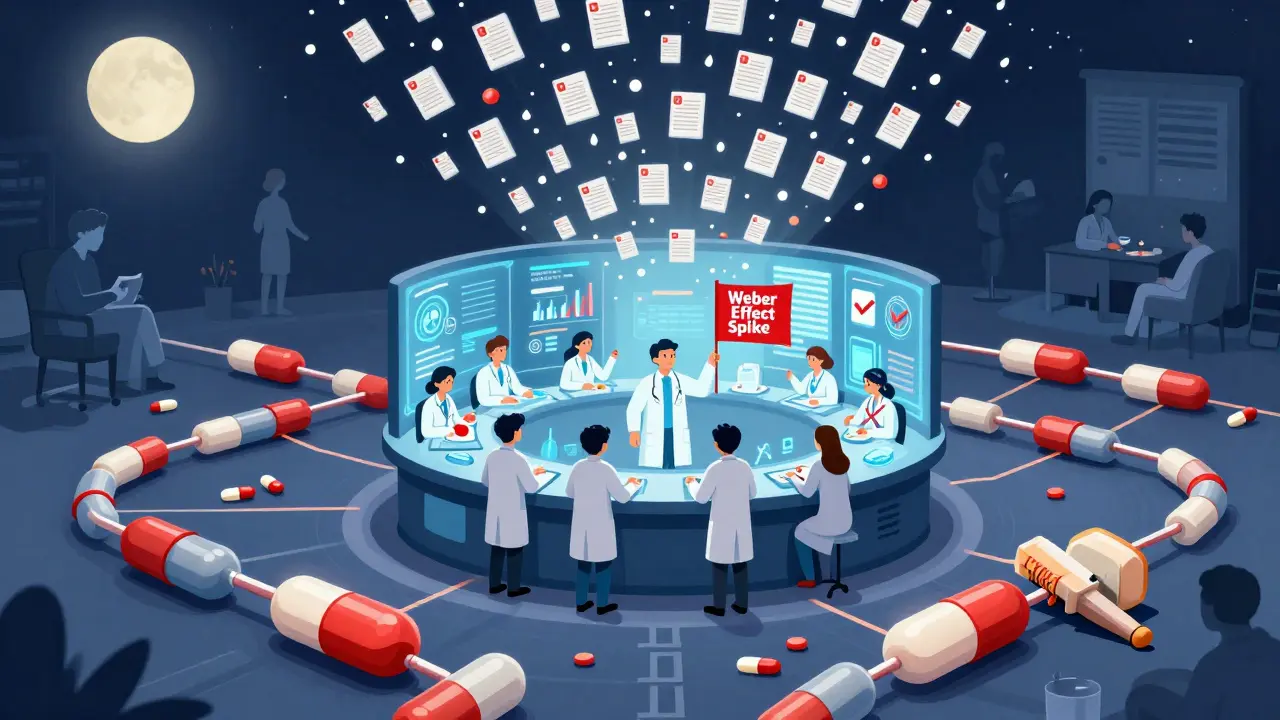
One of the biggest challenges they face is something called the Weber Effect. Right after a new generic drug launches, reports of side effects or problems spike by 300% to 400%. Why? Because everyone-doctors, pharmacists, patients-is paying attention. It’s not that the drug is suddenly dangerous. It’s that people are reporting more because they’re watching for issues. The FDA has to sort through that noise to find real signals.
The Data Pipeline: From Complaints to Signals
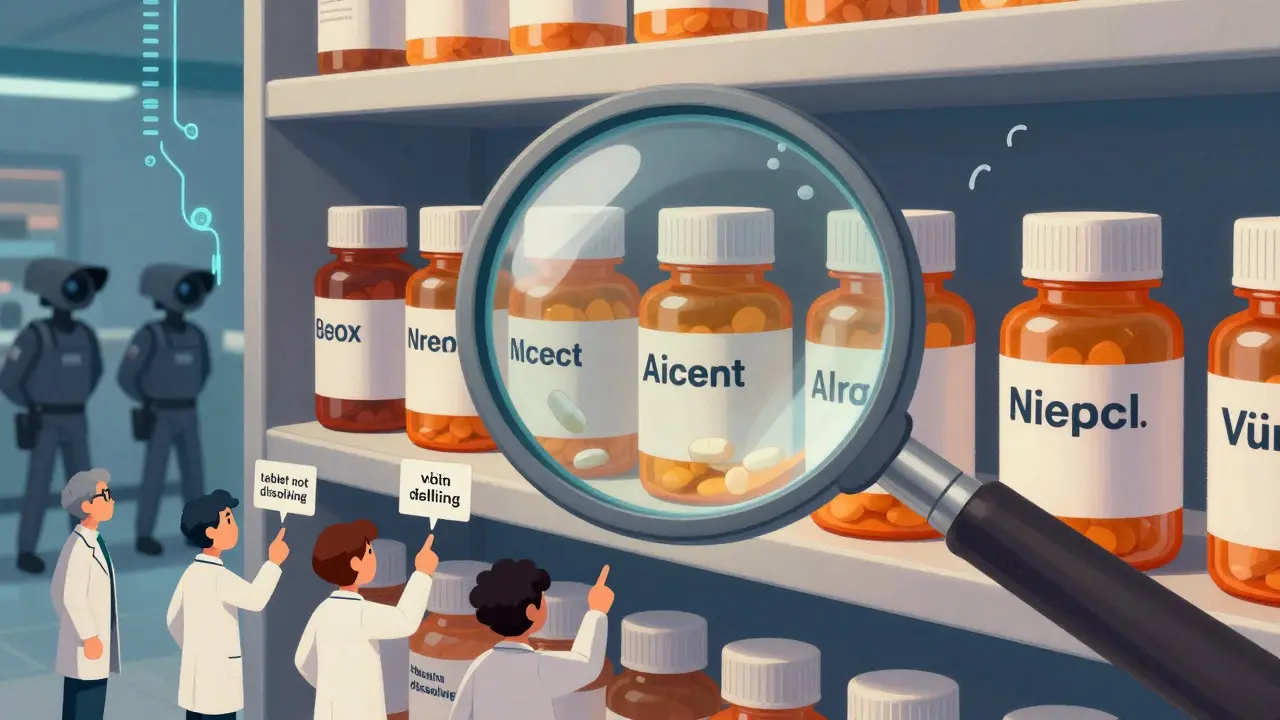
The FDA doesn’t rely on guesswork. They use a tightly controlled data system called the Drug Quality Reporting System (DQRS). Every year, they get 45,000 to 60,000 reports about drug quality-things like tablets that don’t dissolve, liquids with weird particles, or patches that fall off. These reports come from pharmacists, doctors, patients, and manufacturers.
Here’s how it works: Each report is entered into a system, then exported to Excel for sorting. From there, a custom SAS program analyzes the data for patterns. Is one manufacturer’s lot number showing up in 70% of complaints when they only control 30% of the market? That’s a red flag. Is a specific problem-like pills breaking apart-happening only with one company’s version? That’s not random. That’s a quality issue.
They don’t stop there. They also pull in prescription data from IMS Smart and Symphony to understand how many people are actually using each generic. That way, they can calculate whether a problem is happening more often than expected. If 100 people report a problem with a drug that’s taken by 10 million people, that’s one thing. If the same problem is reported 100 times for a drug taken by only 50,000 people? That’s a problem.
What Kind of Problems Are They Looking For?
The FDA isn’t looking for the same things as with brand-name drugs. With brand drugs, they watch for side effects tied to the active ingredient. With generics, they’re hunting for differences in how the drug is made.
- Tablets that don’t dissolve properly (17% of quality complaints)
- Medicines with visible particles or precipitates (12%)
- Patches that fall off too soon (9%)
- Extended-release pills that stop working after 12 hours instead of 24
These aren’t just annoyances. If a pill doesn’t dissolve, you’re not getting the full dose. If a patch falls off, your blood levels drop. That can be dangerous-especially for drugs with a narrow therapeutic index, like blood thinners, seizure meds, or thyroid hormone. A tiny change in how the drug is absorbed can mean the difference between control and crisis.
Complex delivery systems-like inhalers, injectables, and transdermal patches-are especially tricky. Between 2018 and 2022, 12% of all post-market safety issues came from these types of products. That’s why the FDA now prioritizes them in their watchlist.
The Decision-Making Machine
When a signal is found, it doesn’t go straight to a recall. It goes to the OGD Clinical Safety and Surveillance Committee. This group meets every month. It includes experts from safety, quality control, and epidemiology. They review every flagged issue and decide: Is this a one-off? Or is it a pattern?
They use a formal process called a Health Hazard Evaluation (HHE). Each case is rated on two scales: how likely the problem is to happen (remote, possible, probable), and how severe the outcome could be (mild, moderate, severe). Based on that, they decide whether to ask the manufacturer to fix it, issue a warning, or pull the product.
They complete 120 to 150 of these evaluations every year. And 85% to 90% of the committee’s monthly meetings are about generic drugs. That’s how seriously they take it.
Where the System Falls Short
Here’s the hard truth: the FDA’s system is excellent at catching manufacturing flaws. But it’s not great at catching subtle differences in how well a generic drug works.
Dr. Robert Temple, former FDA deputy director, said it plainly: “The system is excellent for detecting quality defects but less sensitive to subtle efficacy differences.”
Why? Because the FDA doesn’t require post-approval bioequivalence testing. Once a generic passes the initial test, they assume it stays the same. But pills can change over time. Manufacturing processes can drift. Excipients (inactive ingredients) can vary. And for drugs where the difference between a therapeutic dose and a toxic dose is tiny, even a small shift matters.
A 2021 Government Accountability Office report found that only 65% of potential therapeutic inequivalence signals were fully investigated. Why? Lack of resources. The FDA has to choose where to focus. And right now, they’re prioritizing clear safety risks over uncertain efficacy issues.
Patients notice this. In MedWatch reports, only 28% of people who reported problems felt like they got a follow-up. And doctors? A 2018 survey found 63% believed the FDA does routine post-approval bioequivalence testing. They don’t. That’s a dangerous misunderstanding.
What’s Changing Now?
The FDA knows the system has gaps-and they’re fixing them.
- AI-powered tools launched in 2023 cut false alarms by 27% by better spotting real patterns in the noise.
- Real-time pharmacy claims data will be integrated by Q3 2024, letting them track usage and side effects as they happen.
- Mandatory bioequivalence testing for narrow therapeutic index drugs is expected to become a rule in Q2 2025.
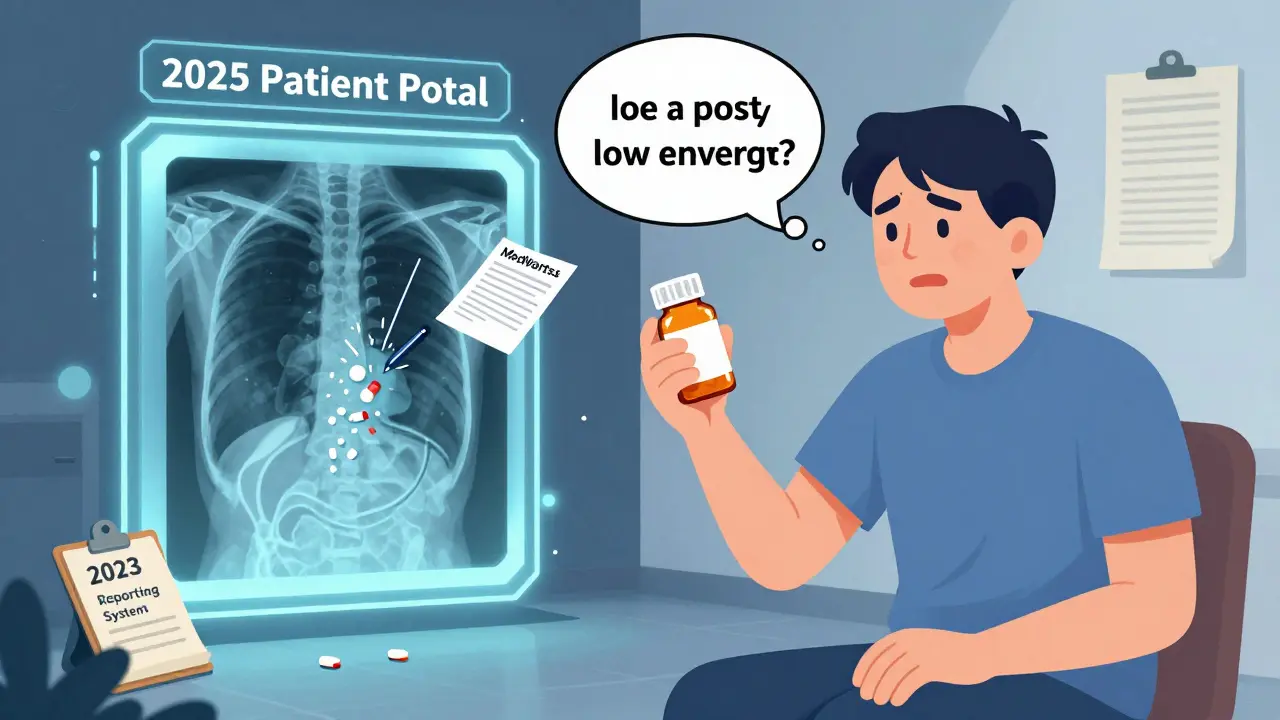
- A patient-facing portal for reporting therapeutic issues will launch in beta in Q1 2025. This is huge-patients will finally have a direct line to report when a generic just doesn’t work like it used to.
These changes are expensive. The FDA’s GDUFA III program (2022-2027) allocates $220.5 million specifically for safety monitoring. But experts say they’ll need $120 million more per year to keep up with complex generics and rising demand.
Who’s Reporting-and Why It Matters
Most reports come from healthcare professionals: 68% of MedWatch submissions. Pharmacists are the biggest group among them, making up 42% of professional reporters. That makes sense-they’re the ones filling prescriptions and seeing what patients say.
But patients are reporting more. Reddit threads, Facebook groups, and online forums are full of stories: “My generic metformin stopped working.” “My thyroid meds made me jittery.” “My blood pressure spiked after switching.”
One 2023 Reddit post described 15 patients in three months whose extended-release metformin stopped lasting 24 hours. That’s exactly the kind of pattern the FDA is trying to catch. But it takes time. And until the new systems are fully in place, many of these stories go unheard-or ignored.
What You Can Do
If you notice your generic drug isn’t working the same way, don’t brush it off. Write it down. Note the manufacturer name, lot number (on the bottle), and what changed. Then report it.
Go to MedWatch and file a report. Even if you’re not a doctor, your experience matters. The FDA needs real-world data to catch problems early.
And if you’re a pharmacist or prescriber: when a patient says their generic isn’t working, don’t assume it’s all in their head. Ask which manufacturer they’re using. That detail could be the key to catching a batch-wide issue before it spreads.
The system isn’t perfect. But it’s working. And it’s getting better. The FDA doesn’t have a crystal ball. But with data, teamwork, and public help, they’re slowly closing the gaps-and keeping millions of people safe every day.
Does the FDA test generic drugs after they’re approved?
The FDA doesn’t routinely retest generic drugs for bioequivalence after approval. Instead, they rely on post-market surveillance to catch problems. This includes analyzing adverse event reports, quality complaints, and manufacturing data. If a pattern emerges-like a specific lot failing to dissolve or causing unexpected side effects-they investigate further. Mandatory post-approval bioequivalence testing is only required for drugs with a narrow therapeutic index, and that rule is expected to expand in 2025.
Can a generic drug be less effective than the brand name?
Legally, generics must be bioequivalent to the brand-name drug, meaning they deliver the same active ingredient at the same rate and amount. In most cases, they work just as well. But for drugs with a narrow therapeutic index-like warfarin, levothyroxine, or seizure medications-even small differences in absorption can matter. There have been documented cases where patients experienced therapeutic failure after switching generics, often due to changes in inactive ingredients or manufacturing processes. The FDA is working to improve detection of these issues, but gaps remain.
What should I do if my generic medication isn’t working?
First, check the manufacturer name and lot number on the bottle. Then, talk to your doctor or pharmacist. Don’t assume it’s all in your head-many patients have reported real changes in how their medication works after switching generics. If the problem persists, file a report with the FDA through MedWatch. Your report helps the agency identify patterns that might signal a manufacturing issue. If multiple people report the same problem with the same lot, the FDA can trigger an investigation.
Are generic drugs from foreign manufacturers less safe?
The FDA inspects all manufacturing facilities-domestic and foreign-that supply drugs to the U.S. market. In fact, over 80% of generic drug manufacturing happens overseas, and the FDA conducts thousands of inspections each year. There’s no evidence that foreign-made generics are inherently less safe. However, smaller manufacturers, especially those with limited resources, are more likely to have delays in addressing safety signals. The FDA prioritizes inspections and monitoring based on risk, not origin.
How long does it take the FDA to act on a safety concern?
It varies. For clear, acute quality issues-like tablets that crumble or liquids with particles-the FDA can act within weeks. For subtle therapeutic inequivalence, the process can take 6 to 9 months or longer. That’s because they need enough reports to confirm a pattern, rule out other causes, and assess whether the issue is isolated or widespread. The new AI tools and real-time data systems being rolled out in 2024-2025 aim to cut this lag time significantly.
Peter Sharplin
January 25, 2026 AT 02:03I’ve been a pharmacist for 18 years, and I’ve seen the same generic metformin work wonders for one patient and do absolutely nothing for another. It’s not placebo-it’s the excipients. One batch has corn starch, another has lactose. For some people, that tiny change messes with absorption. The FDA’s system catches the big stuff, but the quiet failures? Those slip through. Patients don’t know to report it. Doctors don’t ask. And manufacturers? They don’t care until the numbers go red.
Kipper Pickens
January 25, 2026 AT 14:32Post-market pharmacovigilance for generics operates under a risk-based signal detection paradigm, leveraging adverse event reporting systems (AERS) and real-world evidence (RWE) derived from structured electronic health records and pharmacy claims databases. The Weber effect introduces a confounding bias in early-phase reporting, necessitating Bayesian signal refinement algorithms to distinguish true pharmacodynamic anomalies from surveillance noise. The current DQRS infrastructure, while robust, lacks real-time temporal resolution, which is why the integration of IMS Smart data streams represents a critical evolution in dynamic risk stratification.
rasna saha
January 27, 2026 AT 05:57My mom switched to a new generic thyroid med last year and started feeling dizzy and exhausted. We didn’t think much of it until she mentioned the bottle had a different logo. We switched back to the old one and she was fine. I didn’t know you could report that. Now I do. Thanks for explaining how the system works-it’s scary how much we don’t know about what’s in those little pills.
Skye Kooyman
January 28, 2026 AT 16:15shivam utkresth
January 29, 2026 AT 05:34Bro, the FDA’s doing the best they can with peanuts. Imagine trying to monitor 1.2 million reports with a team that’s half the size of a Starbucks in Mumbai. Meanwhile, some generic manufacturer in Hyderabad is making 500 million tablets a month with a machine that’s older than my dad’s scooter. The system ain’t broken-it’s just running on a 1998 Dell with Windows XP. And now they’re throwing AI at it? Cute. But if they don’t fund inspections, it’s all just digital glitter.
John Wippler
January 30, 2026 AT 19:00Think about it-every time you pop a pill, you’re trusting a factory you’ve never seen, with people you’ll never meet, making something that’s supposed to keep you alive. And the system? It’s not magic. It’s math. It’s data. It’s a bunch of tired analysts in Bethesda squinting at Excel sheets trying to find the one batch that’s off. We act like drugs are like cars-same model, same parts. But the body’s not a transmission. It’s a living, breathing, finicky thing. The FDA’s not perfect. But they’re trying. And if we stop reporting, if we stop caring, then the only thing that changes is the silence.
Aurelie L.
February 1, 2026 AT 08:16Joanna Domżalska
February 1, 2026 AT 22:02James Nicoll
February 1, 2026 AT 23:51So the FDA spends $220 million to watch pills and we’re supposed to be grateful? Meanwhile, the same agency approves a new opioid painkiller in 6 months. The priorities are clear. We’re not a country that values health-we value cost savings. And generics? They’re the sacrificial lambs. The FDA doesn’t protect patients. They protect the bottom line. And we’re all just along for the ride.
Uche Okoro
February 2, 2026 AT 03:28It is imperative to underscore that the current post-market surveillance architecture exhibits structural deficiencies in its capacity to detect subtherapeutic bioequivalence deviations, particularly in the context of pharmacokinetic variability induced by excipient heterogeneity. The absence of mandatory bioequivalence retesting constitutes a critical governance gap, which, in conjunction with under-resourced inspectional capacity, renders the system inherently vulnerable to systemic drift. Empirical data from GAO 2021 corroborates this assertion, indicating that over one-third of potential therapeutic inequivalence signals remain uninvestigated due to resource constraints.
Ashley Porter
February 3, 2026 AT 08:53Did you know that 80% of generic drugs are made overseas? The FDA inspects maybe 10% of those factories every year. So they’re trusting the rest on paper. And then they wonder why people report weird side effects. It’s not that the drug doesn’t work-it’s that the tablet was made in a warehouse with no AC, on a machine that’s been running 24/7 for 8 years. The FDA doesn’t need more AI. They need more boots on the ground.
Faisal Mohamed
February 5, 2026 AT 04:25AI tools? Real-time data? 🤖📈 That’s cute. But here’s the real problem: no one’s asking why patients are so afraid to speak up. If you say your generic doesn’t work, doctors call you a hypochondriac. Pharmacists say, "It’s the same chemical." But the body doesn’t read chemical formulas-it reads experience. And if your body says "no," who are we to say it’s wrong? The FDA needs to listen more. Not just to data. To people.
😔