
Generic Price Transparency: Tools to Find the Best Price for Prescription Medications
 Dec, 24 2025
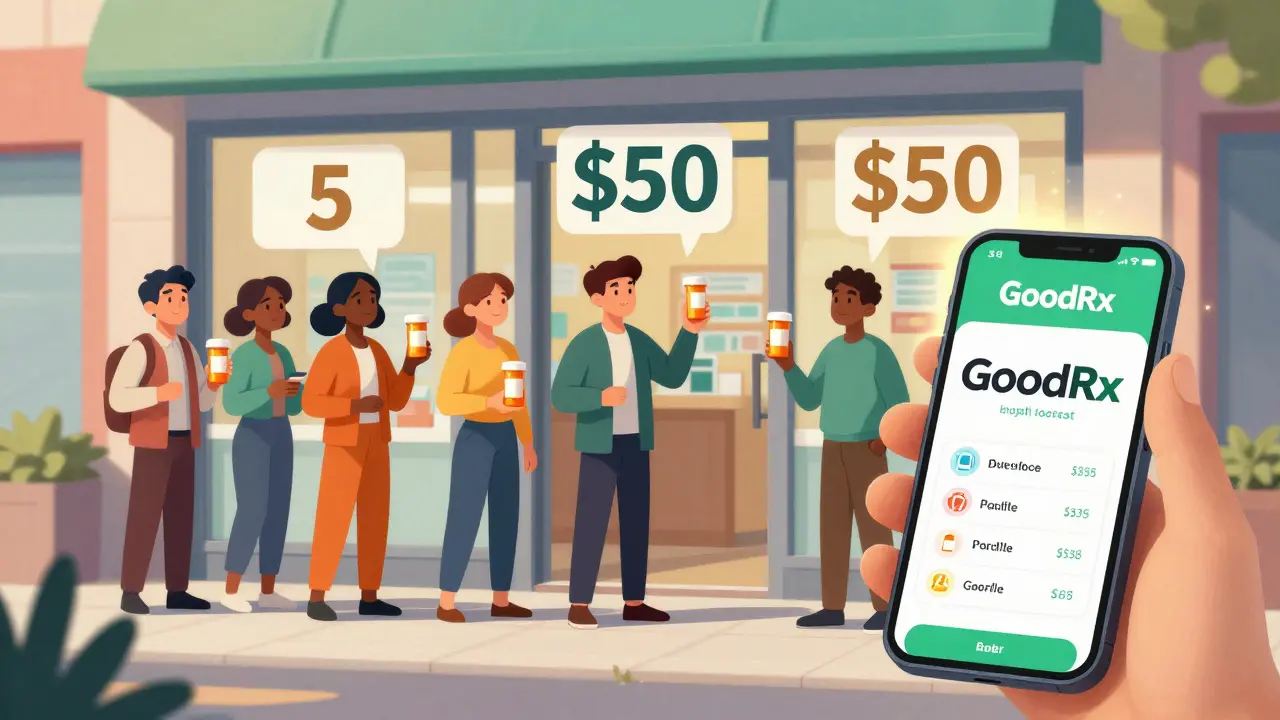
How much should you really pay for a generic pill? If you’ve ever been handed a prescription and seen a price that made you gasp - $40 for a 30-day supply of metformin, $120 for lisinopril - you’re not alone. The truth is, the same generic drug can cost $5 at one pharmacy and $50 at another, just down the street. And no one tells you that until you’re at the counter, card in hand, hoping your insurance will cover it. This isn’t a glitch. It’s the system. But there are tools now that let you see the real price before you even walk in. You just have to know where to look.
Why Generic Drug Prices Vary So Much
Generic drugs are supposed to be cheaper. They’re chemically identical to brand-name pills, but they don’t carry the marketing costs or patent protection. So why does one pharmacy charge $7 for atorvastatin and another charge $28? The answer lies in a tangled web of middlemen: manufacturers, pharmacy benefit managers (PBMs), insurers, and pharmacies. Each one negotiates their own deal, often behind closed doors.
The price you see on a receipt isn’t the list price. It’s the net price - what’s left after rebates, discounts, and contract deals. But here’s the catch: those rebates are secret. Your insurer gets money back from the drugmaker, but you never see it. All you know is the final number on your bill.
That’s where transparency tools come in. They don’t fix the system. But they cut through the noise and show you what you actually have to pay right now - at that pharmacy, with your insurance, today.
Real-Time Benefit Tools (RTBTs) for Prescribers
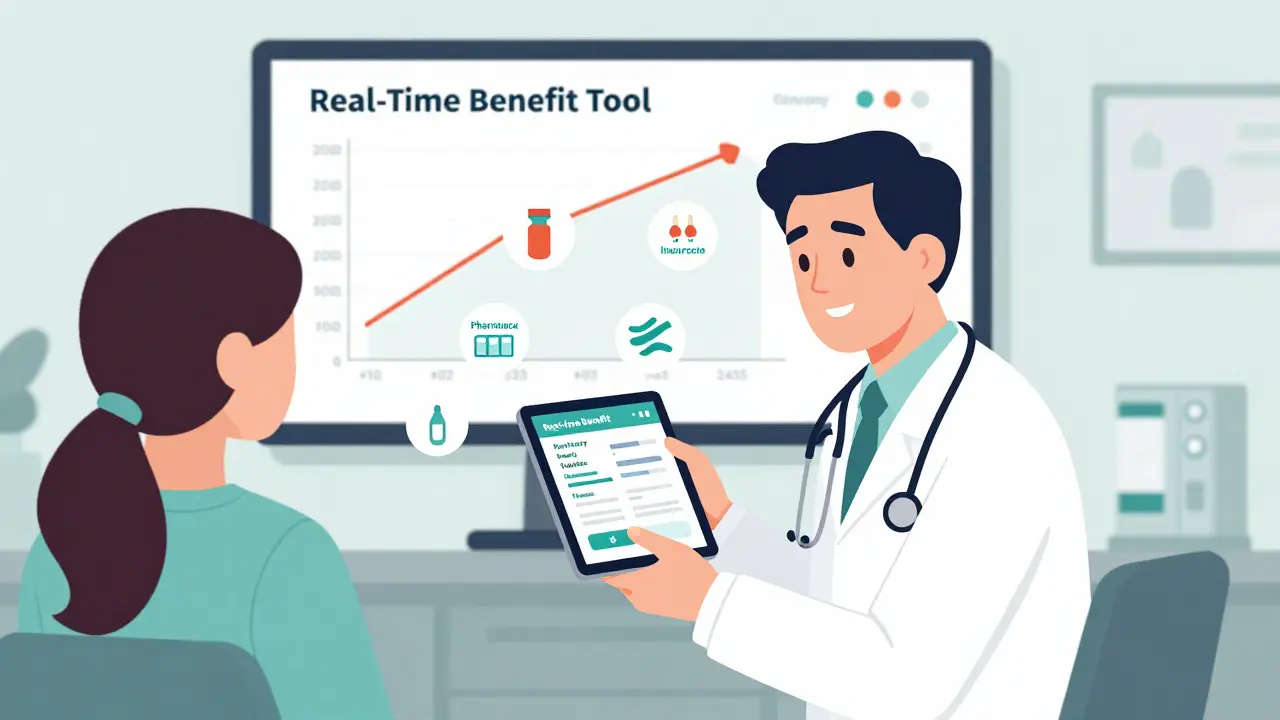
Doctors and pharmacists are using tools like CoverMyMeds and Surescripts to check your drug costs before they write the prescription. These are called Real-Time Benefit Tools (RTBTs). They connect directly to your insurance plan and pull up your specific coverage: what’s covered, your copay, and if there’s a cheaper alternative.
One study found that when doctors used RTBTs, patients switched to lower-cost generics 8.2% more often. That might not sound like much, but for someone on a fixed income, that’s $200 a year saved. In clinics using these tools, 68% of providers say patients stick to their meds better because they know the cost upfront.
But RTBTs aren’t for everyone. They’re built into electronic health records like Epic and Cerner, so you need to be seeing a doctor who uses them. If your doctor’s office is small or doesn’t use modern software, you might not get this benefit. Still, if you’re on Medicare or have a large insurer, ask your provider: “Can you check my drug cost before I leave?”
GoodRx and Other Consumer Apps
If you’re not in a doctor’s office, you can still check prices yourself. GoodRx is the most popular app for this. It scans hundreds of pharmacies - CVS, Walgreens, Walmart, local independents - and shows you the lowest cash price for your generic drug. No insurance needed.
Here’s how it works: You type in “metformin 500mg,” select your dosage, and it shows prices from nearby pharmacies. One user in Minnesota found a 92% difference between two pharmacies just five miles apart - saving $287 a year by choosing the cheaper one.
But here’s the catch: the price on the app isn’t always the price at the counter. Some users report going to the pharmacy, only to be told their system shows a different price. Why? Because GoodRx gives you a coupon, not a guaranteed price. The pharmacy has to honor it, but sometimes their system is outdated, or the coupon doesn’t apply to your insurance plan.
Tip: Always call ahead. Say: “I have a GoodRx coupon for [drug name]. Can you confirm the price before I come in?”
State Transparency Laws Are Changing the Game
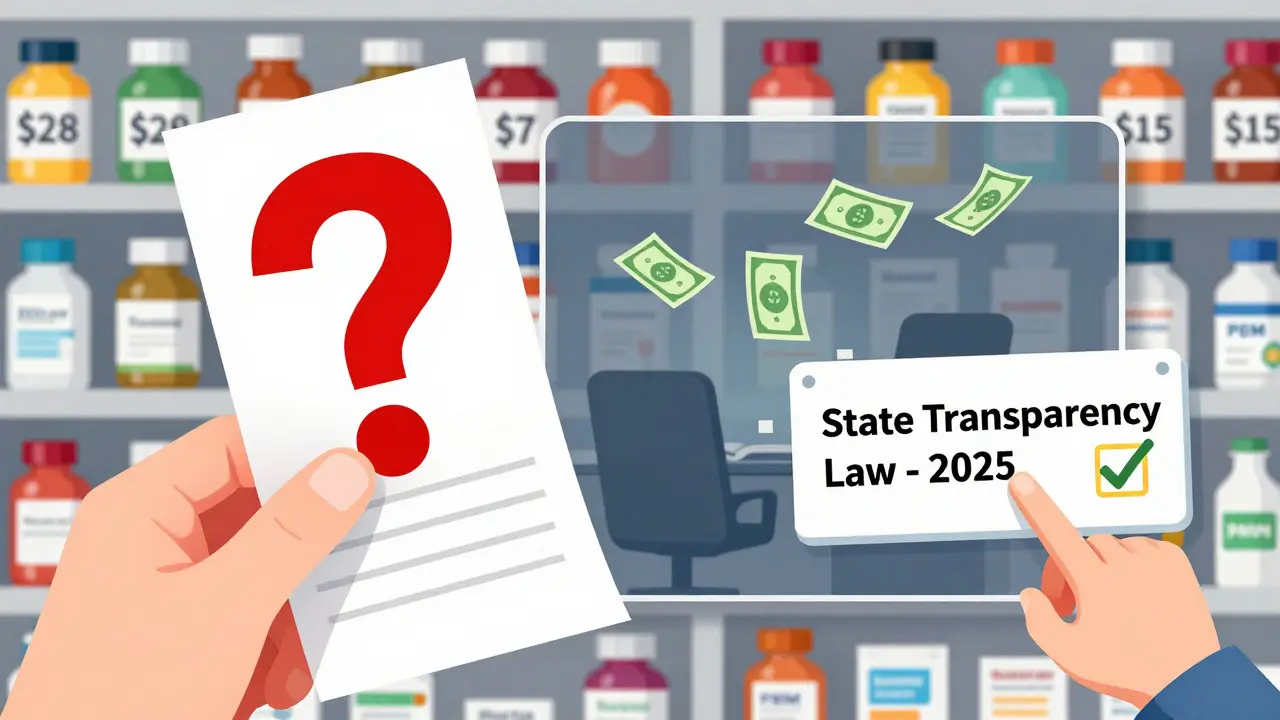
As of 2025, 23 states have passed laws requiring drugmakers to report price hikes. Minnesota, California, and New York lead the pack. Minnesota’s law even created a Prescription Drug Affordability Board that reviews drugs costing more than $10,000 a year.
Some states now require pharmacies to display price tags for common generics. In California, you can walk into a pharmacy and see a sign listing the cash price for 30-day supplies of drugs like lisinopril, levothyroxine, and simvastatin. No app needed.
These laws don’t force prices down. But they make it harder for pharmacies to hide markups. And they give you leverage. If you see a price that seems way off, you can ask: “Is this compliant with state transparency rules?”
What You Can Do Right Now
You don’t need to wait for your doctor’s office to upgrade its software. Here’s your action plan:
- Use GoodRx or SingleCare to compare cash prices for your generic drug. Note the lowest price.
- Call your pharmacy and ask: “What’s your cash price for [drug name]?” Don’t mention insurance yet.
- If the pharmacy’s price is higher than GoodRx, ask if they’ll match it. Many will.
- Check if your insurer has a preferred pharmacy network. Sometimes the cheapest price is at a mail-order pharmacy.
- Look into patient assistance programs. RxAssist.org lists free or low-cost drugs from manufacturers. Over 1.2 million people used them in 2024.
Pro tip: If you’re on Medicare Part D, ask your plan for a formulary list. Some plans have tiers - $5 for tier 1 generics, $40 for tier 3. You might be paying more than you need to.
The Big Limitation: Net Prices Are Still Hidden
Here’s the hard truth: no tool shows you the real net price. The $5 you pay at Walmart? The drugmaker probably got $2 back from your insurer as a rebate. But you don’t see that. The system rewards secrecy. That’s why prices keep climbing - because no one knows who’s really paying what.
Even the new federal rules, like the Drug-price Transparency for Consumers Act of 2025, only require ads to show the wholesale price - not the final cost to you. That’s still not enough.
But here’s the good news: you don’t need to know the whole system to save money. You just need to know what you’re paying today.
When Transparency Doesn’t Help
Some drugs - especially specialty ones for rare conditions - still have no price transparency. Their costs are locked in contracts between PBMs and manufacturers. If you’re on one of these, your best bet is to talk to your doctor about alternatives, or contact the manufacturer’s patient support program directly.
Also, don’t assume a lower price means lower quality. Generic drugs are regulated by the FDA. They must be identical in strength, safety, and effectiveness. The only difference is the price - and sometimes, the color of the pill.
Final Thought: Knowledge Is Your Power
Price transparency won’t fix the broken pharmaceutical system overnight. But it gives you back control. You don’t have to accept the first price you’re given. You don’t have to feel guilty for asking, “Is there a cheaper way?”
Every time you check a price, call a pharmacy, or switch to a generic, you’re pushing the system to be fairer. And if enough people do it, the system has to change.
Start today. Open GoodRx. Type in your next prescription. Compare. Ask. Save.
Are generic drugs really the same as brand-name drugs?
Yes. Generic drugs must meet the same strict standards as brand-name drugs set by the FDA. They contain the same active ingredients, work the same way, and have the same risks and benefits. The only differences are in the inactive ingredients (like fillers or dyes) and the price. Generic drugs cost less because they don’t include the research, marketing, and patent costs of the original drug.
Why does my insurance sometimes say a drug is covered but I still pay a lot?
Insurance plans use tiers and formularies. Even if a drug is covered, it might be on a higher tier with a bigger copay. Also, your plan might have a deductible you haven’t met yet, or the pharmacy might not be in-network. Always check your plan’s formulary list and confirm the pharmacy is covered before filling your prescription.
Can I use GoodRx with my insurance?
You can’t combine GoodRx with insurance - you have to choose one. GoodRx gives you a cash price discount, while insurance uses your plan’s negotiated rate. Sometimes GoodRx is cheaper. Sometimes your insurance is. Always compare both before paying. Some pharmacies let you switch at the register if you realize your insurance price is higher.
Why do prices vary so much between pharmacies?
Pharmacies negotiate different prices with pharmacy benefit managers (PBMs). Big chains like CVS or Walgreens may pay more per pill but offer lower prices to attract customers. Independent pharmacies might have higher costs but lower overhead, so they price differently. Some pharmacies also offer loyalty discounts or cash-only deals. That’s why checking multiple locations matters.
What if I can’t afford my medication even with price checks?
Contact the drug manufacturer directly. Most have patient assistance programs that offer free or deeply discounted medications to those who qualify based on income. Websites like RxAssist.org and NeedyMeds.org list these programs. You can also ask your doctor for samples or switch to a lower-cost generic. Don’t skip doses - there are options.
Katherine Blumhardt
December 24, 2025 AT 22:46omg i just saved $200 this month by using goodrx lol my lisinopril was $48 at walgreens then i found it for $12 at target 😭
Sophie Stallkind
December 25, 2025 AT 01:38While the utility of price transparency tools is undeniable, one must not overlook the structural inequities embedded within pharmaceutical supply chains. The disparity in pricing reflects a broader systemic failure wherein consumer autonomy is commodified, and access to essential therapeutics remains contingent upon socioeconomic status. A moral imperative exists to advocate for regulatory reform beyond mere consumer-facing applications.
sagar patel
December 26, 2025 AT 18:54India prices are way lower. Metformin 500mg 100 tablets $2.50 at local pharmacy. US system is broken. No one talks about how PBMs control everything. Pharma companies are just puppets.
Bailey Adkison
December 27, 2025 AT 11:04GoodRx is a scam. It's not a discount it's a middleman fee disguised as savings. You think you're saving money but you're just paying cash so the insurance companies don't have to. The real problem is insurance itself. Stop pretending this is about transparency. It's about shifting costs onto the poor.
Oluwatosin Ayodele
December 28, 2025 AT 01:01Let me clarify this for those who don't understand how PBMs work. Pharmacy Benefit Managers negotiate rebates with manufacturers. These rebates are not passed to the consumer. Instead, they inflate list prices so the PBM can take a cut. The $5 price on GoodRx? The PBM got $3 back from the manufacturer. You're still paying more than you should. This isn't transparency. It's theater.
Mussin Machhour
December 29, 2025 AT 01:28Y'all need to stop overthinking this. Just open GoodRx. Compare. Call the pharmacy. Say 'I'm paying cash' and ask if they'll beat the app price. I did it last week for my dad's atorvastatin and saved $80. It's that simple. No drama. No conspiracy. Just do the thing.
Rick Kimberly
December 29, 2025 AT 19:48It is worth noting that while consumer-facing tools provide immediate relief, they do not address the root cause: the absence of price regulation and the opacity of rebate structures. One might reasonably ask whether market-based solutions, when applied to essential healthcare goods, are ethically defensible. The fact that individuals must become price detectives to access basic medication suggests a profound failure of public policy.
Terry Free
December 31, 2025 AT 11:03Oh wow. So the solution to $120 insulin is... a coupon app? That’s like giving a starving person a coupon for a free crumb. The system is rigged. PBMs, insurers, pharma - all in cahoots. And you’re telling me the answer is to check GoodRx before you die of diabetes? Brilliant. Truly. The genius of capitalism.
Lindsay Hensel
January 2, 2026 AT 10:35My mother in Nigeria pays less for metformin than I do in Texas. This isn’t healthcare. It’s a market experiment on the backs of the sick. We must demand universal pricing standards. Not coupons. Not apps. Justice.
Linda B.
January 4, 2026 AT 03:23GoodRx is a front. Did you know the same company that runs it also owns a PBM? The whole thing is a shell game. They show you low prices so you think you’re winning - but they’re the ones collecting the rebates from the drugmakers. You’re not saving money. You’re funding the scam. The government knows. They just don’t care.
Christopher King
January 4, 2026 AT 19:46Think about it - if you’re paying $5 for a pill, who’s really paying the other $45? The insurance company? No. The government? No. It’s the future. It’s the next generation. It’s the collapse of the entire system. We’re being fed lies wrapped in QR codes. The real price isn’t on your receipt. It’s on your child’s future medical bill. And they’re not even telling you that.
Ben Harris
January 6, 2026 AT 03:09Look I’m not gonna lie. I used to think this was about saving money. Then I found out my pharmacy was charging me $30 for a drug that was $8 on GoodRx. I went in and yelled. They gave me the lower price. Then they told me to 'be grateful.' Grateful for being gouged? Nah. This isn’t capitalism. It’s feudalism with a pharmacy counter.