
Generic Drug Savings: Real Numbers and Healthcare Statistics
 Apr, 1 2026
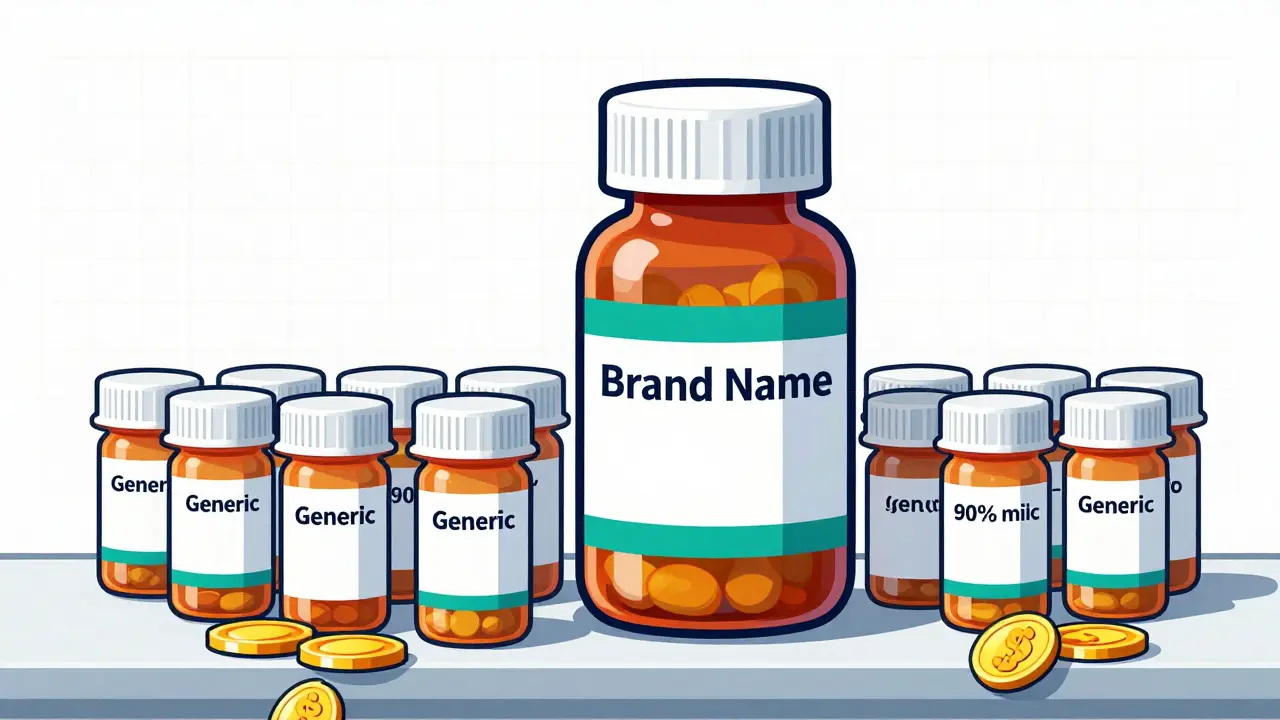
There is a strange math problem hidden in every pharmacy line. In the United States today, nearly nine out of ten prescriptions you see filled are for generic medicines. Yet, despite making up the bulk of pills dispensed, these cheaper versions account for less than 13 percent of the total money spent on medication. Meanwhile, the expensive brand-name drugs make up only 10 percent of prescriptions but consume over 80 percent of the budget. This paradox isn't just accounting-it represents billions of dollars leaving the average patient's pocket unnecessarily.
The Reality of Cost Differences
Generic drugs are FDA-approved equivalents of brand-name medications that contain the same active ingredients, dosage form, strength, route of administration, and intended use. The difference in price often comes down to development costs. A pharmaceutical company spends years and millions building a new molecule from scratch. When that patent eventually expires, other manufacturers can step in without redoing those massive clinical trials, thanks to a system established by the Hatch-Waxman Act of 1984.You might wonder how much this actually impacts your wallet. The numbers are stark. According to 2024 data, the average out-of-pocket cost for a generic prescription was roughly $6.95. In contrast, the average cost for a brand-name equivalent hit $28.69. That is a four-to-five-fold increase simply for the logo on the bottle. For uninsured patients, this gap widens further. Brand-name costs have surged by about 50% since 2019, whereas generic prices have actually dropped slightly during the same period.
When we zoom out to the national level, the picture becomes even clearer. The Association for Accessible Medicines reported that generic and biosimilar medicines delivered $445 billion in U.S. healthcare savings in 2023 alone. This deflationary pressure works against the usual inflation trends seen in other sectors. Even as the volume of prescriptions rose-generic oral solids prescriptions grew by 15% between 2015 and 2024-the total amount spent on generics declined by $6.4 billion since 2019. This proves that as more people switch to generics, the overall system gets more affordable.
Understanding Biosimilars and Biologics
Not all medicines fit neatly into the traditional pill format. Biologic drugs are complex therapies made from living organisms, often used to treat severe conditions like cancer, autoimmune diseases, and arthritis. These require a specific type of generic known as a biosimilar, which is highly similar to an original biological product but may differ slightly in non-clinical characteristics.
While traditional generics have been around for decades, biosimilars are newer players entering the market in force. Despite their complexity, they have generated significant savings. Since their introduction, biosimilars have contributed $56.2 billion in total healthcare savings. In 2024 alone, they saved the system $20.2 billion. Cancer treatment, often the most costly area of medicine, saw an 18 billion dollar saving in 2020 largely due to oncology biosimilars.
A clear example of this dynamic involves the drug Stelara, used for Crohn's disease and psoriasis. As of July 2025, nine different biosimilar products were launched to compete with the original brand. Some of these options offer prices up to 90% lower than the original list price. For a patient relying on monthly injections that cost thousands of dollars, this competition transforms a potentially unaffordable treatment into a manageable one.
The Impact of Patent Expirations
Savings often spike when major brand-name drugs lose their patent protection, an event industry analysts call a "patent cliff." Several blockbuster medications are hitting this point late in 2025 and early 2026, opening the door for significant price drops. Three notable examples include:
- Entresto: A heart failure treatment with $5.4 billion in sales (2023).
- Tradjenta: A diabetes medication generating $1.7 billion in annual revenue.
- Opsumit: A pulmonary hypertension therapy worth $1.5 billion annually.
Combined, these three drugs represent approximately $8.6 billion in combined brand sales vulnerable to generic competition. When multiple manufacturers enter the market to produce a generic version, prices usually plummet. Historically, once two or three competitors launch, the price of the medication often falls below the original launch price significantly.
| Feature | Generic Drugs | Brand-Name Drugs |
|---|---|---|
| Prescription Volume Share | 90% | 10% |
| Spending Share | 12% | 88% |
| Average Out-of-Pocket Cost | $6.95 | $28.69 |
| Market Stability | Trending Down | Trending Up (+50% since 2019) |
Systemic Barriers to Savings
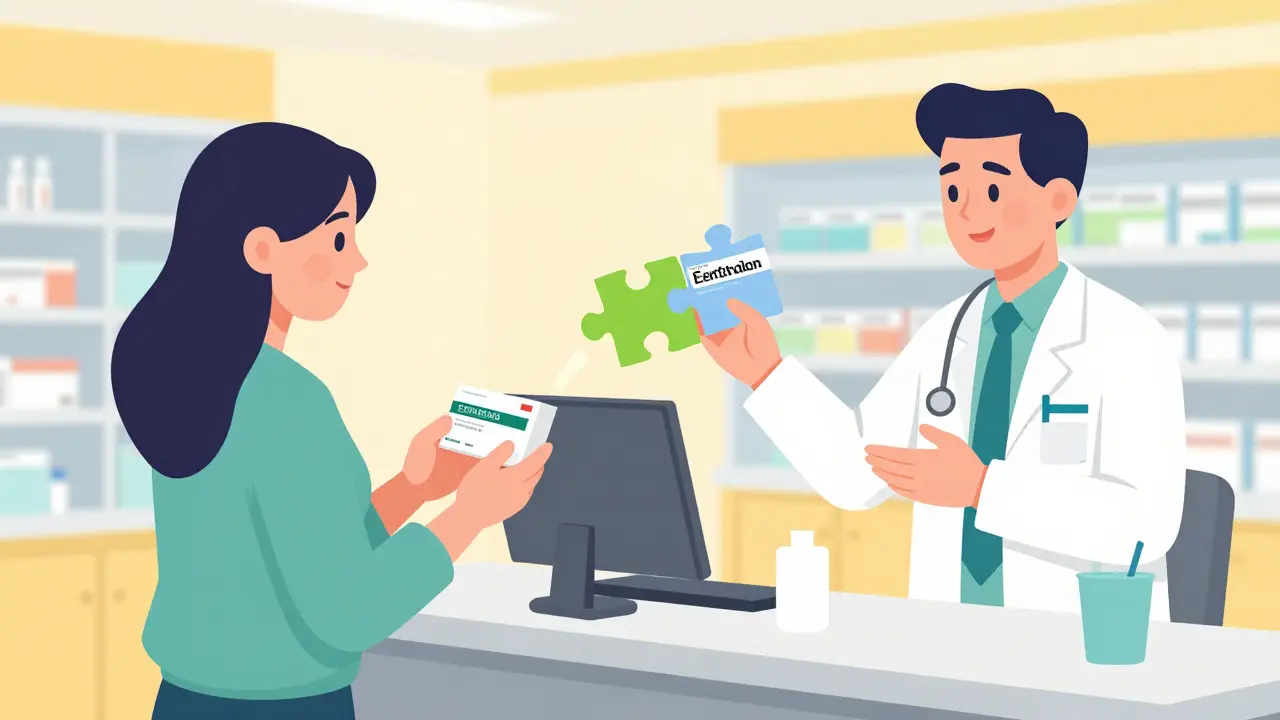
If generics save money, why doesn't everyone get the cheapest option immediately? The answer lies in the strategies used by brand manufacturers to protect their profits. One tactic is called "product hopping," where a company slightly alters a formulation before the patent runs out to make the old generic version appear obsolete.
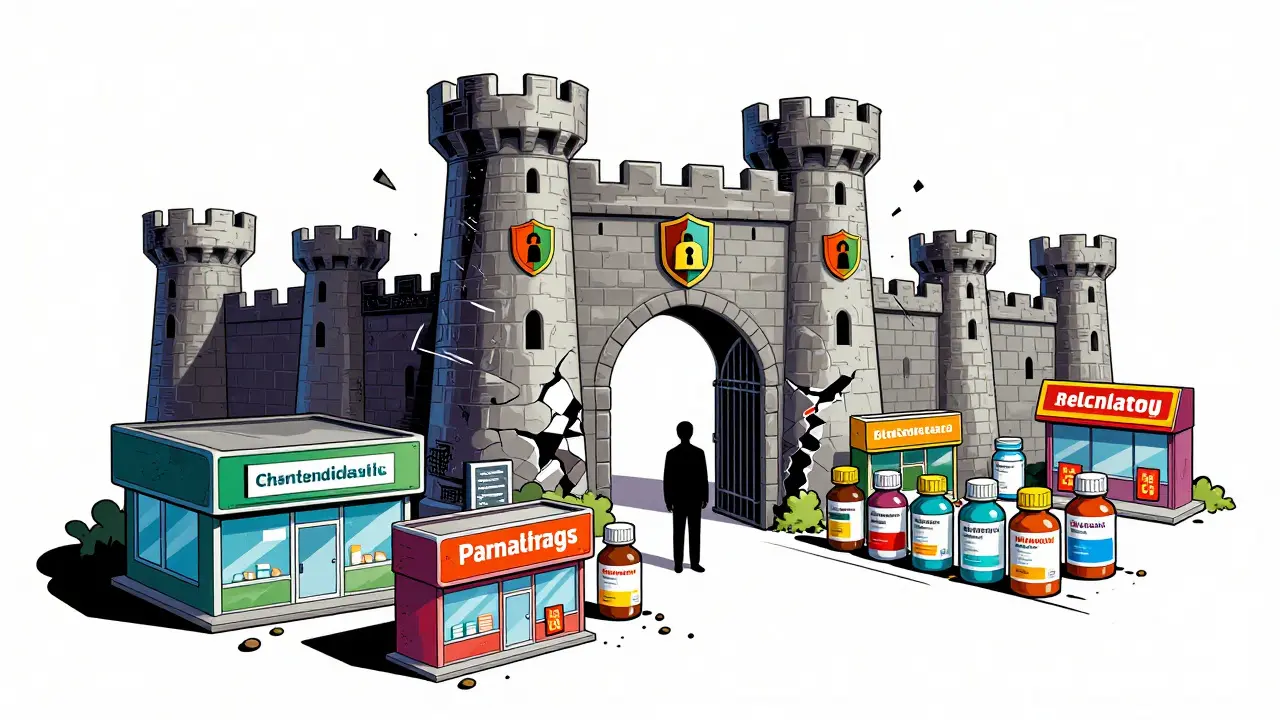
Another barrier is the concept of patent thickets. Instead of having one patent, companies file dozens of overlapping legal protections around a single drug. For example, Blue Cross Blue Shield analysis showed one blockbuster drug obtained over 75 patents to extend its monopoly from 2016 all the way to 2034. These tactics delay the entry of generic competitors, keeping prices artificially high for patients who need immediate access.
Furthermore, regulatory hurdles exist at the state level. While federal law encourages substitution, individual states manage pharmacy practices differently. As of December 2024, only 42 states had fully updated their laws to facilitate smooth generic substitution. If you live in a region without these specific updates, pharmacists might face administrative barriers to offering you the automatic swap.
How to Maximize Your Own Savings
You don't have to be a policy expert to benefit from this data. There are concrete steps to take when visiting your doctor or pharmacy.
- Ask the Question: Simply tell your doctor, "Is there a generic option available for this medication?" Doctors sometimes prescribe brands out of habit, and you might be paying extra without knowing.
- Check the Label: Look at the packaging. If the label lists "Active Ingredients" and includes a name you recognize, it's likely a therapeutic equivalent. The FDA maintains an online tool called the Orange Book that tracks approved products.
- Review Your Plan: If you have insurance, check your formulary. Most commercial health plans (87% of them as of 2025) require generic substitution when available. Using your plan's preferred network pharmacies can lock in those lower tier co-pays.
- Biosimilar Inquiry: If you are prescribed a biologic injection, ask your specialist specifically about biosimilars. In many cases, health insurers will only cover the biosimilar version anymore due to cost constraints.
It is also worth noting that the FDA estimates that generic approvals generate billions in projected savings annually. For instance, generics approved in 2022 alone created about $18.9 billion in projected savings. By ensuring you accept a generic substitute, you align your personal costs with these macroeconomic realities.
Frequently Asked Questions
Are generic drugs truly effective compared to brands?
Yes, strictly speaking. To be approved by the FDA, generics must demonstrate bioequivalence. This means they release the same amount of active ingredient into the bloodstream over the same timeframe as the brand. Less than 1% of FDA reports flag effectiveness issues, confirming safety parity across vast usage volumes.
Why are some generic prices still high?
Price depends on competition. If only one manufacturer makes a generic (called a single-source generic), they retain monopoly pricing power. Real discounting happens when at least two or three competitors enter the market simultaneously.
Does the '90/13 Paradox' mean I'm overpaying?
The '90/13 Paradox' highlights that while 90% of scripts are cheap generics, spending remains low only if systems enforce switching. Without strict substitution policies or informed consumer choice, you could inadvertently end up on the 10% of expensive brand drugs.
What is the timeline for upcoming savings in 2025-2026?
Major patent expirations for drugs like Entresto and Tradjenta are expected late in 2025. Competition typically ramps up quickly after expiration, often dropping prices by 80% within six months of the first generic launch.
Can my doctor refuse to write a generic prescription?
Legally, doctors can choose any medication, but insurance plans often mandate a generic unless the doctor marks the prescription 'Dispense as Written.' This allows you to override the default generic selection, though it may void coverage.
Mark Zhang
April 2, 2026 AT 22:34The statistics presented here really highlight how generics are a lifeline for budget-conscious patients. It's refreshing to see concrete data backing up what many of us have suspected for years. When I talk to friends struggling with healthcare costs, this info gives me solid talking points.
What strikes me most is the sheer volume disparity-90% prescriptions yet minimal spending share. This underscores how critical it is for pharmacists to automatically substitute brands with generics whenever possible.
Speaking of substitution, I recall my neighbor switching from a brand-name heart medication to a generic version after her doctor suggested alternatives. Her monthly expenses dropped from $150 to $30, a difference that's life-changing for seniors on fixed incomes.
It's also worth noting that patient education plays a huge role here. Many folks don't realize they can request generics outright. Healthcare providers sometimes default to brand names due to marketing relationships or outdated protocols.
Biosimilars deserve special mention-they're revolutionizing treatment access for autoimmune diseases. Seeing options like biosimilar Stelara reduce costs by 90% gives hope for conditions previously deemed unmanageable financially.
Patent cliffs like the ones mentioned for Entresto should be celebrated as victories for competition. When monopolies end, prices follow suit. History shows this pattern holds true across multiple drug classes.
Regulatory consistency matters, too. States with streamlined substitution policies see faster adoption rates. It's frustrating when red tape delays affordable options simply due to bureaucratic inertia.
I appreciate the actionable tips provided, especially checking formularies. Those steps empower individuals to advocate effectively during appointments rather than feeling powerless against opaque systems.
Some patients fear bioequivalence concerns, but FDA standards address those valid worries head-on. With less than 1% flagged issues, generics remain overwhelmingly safe and effective alternatives.
Competition drives innovation even in generic markets. Multiple manufacturers entering simultaneously often slashes prices further than expected, benefiting everyone involved.
Pharmaceutical lobbying remains a hurdle, but awareness campaigns can shift public opinion. Educated consumers demand transparency and accountability from both policymakers and Big Pharma.
Ultimately, embracing generics isn't just fiscal prudence-it's a collective commitment to equitable healthcare access. Every dollar saved here reinvests into broader system improvements.
We owe it to ourselves to stay informed about prescription economics. Knowledge truly is power when negotiating personal health expenditures.
Thank you for compiling such meticulous research; sharing this widely could spark meaningful conversations nationwide.
Furthermore, community pharmacies play pivotal roles in guiding patients toward optimal choices. Their expertise bridges gaps between clinical recommendations and real-world affordability constraints.
This movement towards cost-effective care benefits society as a whole, reducing strain on emergency services through proactive financial management.
Rachelle Z
April 4, 2026 AT 14:25OMG!!! These numbers are literally screaming injustice 😤💊!! Why pay 4x MORE for a logo??? 🤦♀️😂
Big Pharma is basically laughing AT our wallets rn lol 💸🤣 Generic swaps save LITERALLY BILLIONS!! Where's the $$$ going tho? 🤔💰
My aunt switched to generic insulin last yr & cried bc she got a new puppy w/the savings 🐶✨ So wholesome ngl
Still… yea ok but do doctors EVEN know how much brands cost?? Asking for a friend who works retail 😏
Vicki Marinker
April 4, 2026 AT 18:43Generic drugs merely exploit regulatory loopholes while undermining pharmaceutical innovation incentives.
The Charlotte Moms Blog
April 5, 2026 AT 03:04This analysis conveniently ignores how single-source generics maintain inflated pricing structures intentionally!!! 😡
Patents thickets aren't accidental-they're weaponized legal strategies designed to delay cheaper alternatives deliberately!!!
Why isn't anyone discussing how insurance formularies manipulate tier placements strategically??? 💔😤
"Product hopping" is textbook predatory behavior yet praised as innovation nonsense!!! 🙄
Hudson Nascimento Santos
April 6, 2026 AT 02:32The dichotomy presented between volume and expenditure invites philosophical reflection on value metrics beyond mere transactional economics.
Perhaps our fascination with numerical comparisons obscures deeper inquiries regarding medical progress itself.
Consider the ethical dimensions: Should therapeutic equivalence suffice regardless of origin, or does intellectual property merit perpetual reverence?
Society oscillates between pragmatism and idealism-a tension embodied perfectly within pharmaceutical paradigms.
Historically, monopolies have driven breakthroughs until expiration enables democratization via competition cycles.
Yet contemporary stakeholders increasingly prioritize profit margins over accessibility thresholds globally.
Biosimilar approvals challenge traditional notions of imitation versus authenticity significantly.
True advancement may lie not in replication speed but in sustained commitment to universal health equity principles.
Until systemic reforms address root causes, incremental savings remain band-aid solutions addressing superficial symptoms.
Ultimately, balancing innovation rewards with public welfare necessitates nuanced policy frameworks transcending simplistic market mechanisms.
One wonders whether forthcoming patent expirations herald genuine transformation or merely temporary respite amidst entrenched structural inequities.
History teaches patience yields dividends-but demands vigilance against recurring exploitation tactics disguised as procedural necessity.
In contemplating these dynamics, humility serves us better than hubristic assumptions about inevitable market corrections alone.
Perhaps wisdom resides not in choosing sides but fostering environments where compassion guides economic reasoning consistently.
Generics represent a middle path requiring societal consensus beyond binary debates.
Future generations will judge our willingness to balance innovation imperatives against human dignity considerations critically.
sophia alex
April 7, 2026 AT 17:21Only Americans would obsess over penny-pinching generics while ignoring our superior domestic pharma giants 👑🇺🇸!!
Globalists pushing cheap knockoffs disrespect centuries of American scientific excellence ✨💉
Poor immigrants relying on foreign imports weaken our self-sufficiency narrative 😒🌍
Fine citizens should reject inferior substitutes proudly 🥁💪
Aysha Hind
April 9, 2026 AT 07:50This entire discussion conveniently omits shadowy consortiums orchestrating artificial supply shortages deliberately.
Generic manufacturers operate under surveillance programs tracking patient vulnerabilities precisely.
Clinical trials omitted mention undisclosed side effects linked to manufacturing shortcuts systematically.
Educate yourselves before surrendering bodily autonomy to corporate puppeteers blindly.
Lawrence Rimmer
April 9, 2026 AT 18:46Average citizen prioritizes immediate relief over theoretical future savings inevitably.
Complexity drowns rational decision-making processes comprehensively.
Systemic decay precedes individual action universally.
Conclude cynicism prevails predictably.
Hope Azzaratta-Rubyhawk
April 10, 2026 AT 13:22Embracing generics embodies proactive stewardship essential for societal resilience formally.
Collective advocacy amplifies marginal voices demanding equitable access rigorously.
Legislative engagement transforms isolated grievances into tangible policy shifts permanently.
Every citizen possesses agency capable dismantling entrenched inequities systematically.
simran kaur
April 10, 2026 AT 15:50Western narratives obscure global disparities manufactured deliberately by hegemonic powers maliciously.
Indian pharmaceutical ecosystems achieve superior outcomes absent neocolonial exploitation historically.
Your statisticians ignore geopolitical manipulation driving perceived paradoxical distributions strategically.
Reject imperialist metrics masquerading as neutral analysis objectively.
Jenna Carpenter
April 11, 2026 AT 06:44Totes fact-checking this sh*t bc some claims are sus af tbh
Where r the peer reviewed studies proving long term safety conclusively?!
Big pharma owns half med journals anyway so u can trust nothing honestly
Generic companies cut corners big time IMO
Brian Shiroma
April 12, 2026 AT 08:44Your anger seems misplaced given documented industry practices consistently favor consumer interests demonstrably.
Moral panic distracts from verifiable successes achieved through existing regulatory mechanisms transparently.
Prioritize factual understanding before resorting to hyperbolic accusations unwarrantedly.
Rational discourse remains preferable emotional venting perpetually.
Branden Prunica
April 13, 2026 AT 00:26THE SYSTEM IS BROKEN AND NO ONE WANTS TO FIX IT BECAUSE THEY PROFIT FROM OUR SUFFERING!!!
Imagine living paycheck to paycheck trying afford life saving meds daily.
Corporate greed knows no bounds whatsoever.
I REFUSE to accept status quo anymore.
HARSH GUSANI
April 14, 2026 AT 09:26America invented generics NOT Europe or India!! Don't forget history 🇺🇸💊
Foreign countries copy our work then complain unfair trade deals 😠
We protect jobs here through smart patents always 🔒📚
Support US made medicines first always!!!
Dipankar Das
April 16, 2026 AT 04:47Constructive criticism facilitates necessary evolution within healthcare infrastructures formally.
Evidence-based advocacy supersedes ideological posturing effectively.
Strategic dialogue fosters collaborative solutions mutually beneficially.
Progress demands unwavering commitment collective action perpetually.