
Drug Recall Authority: How the FDA Legally Removes Unsafe Medications
 Feb, 20 2026
When you take a prescription or over-the-counter medicine, you expect it to be safe. But what happens when a drug turns out to be contaminated, mislabeled, or dangerously ineffective? Who decides it gets pulled from shelves? And most importantly - can the government force a company to remove it?
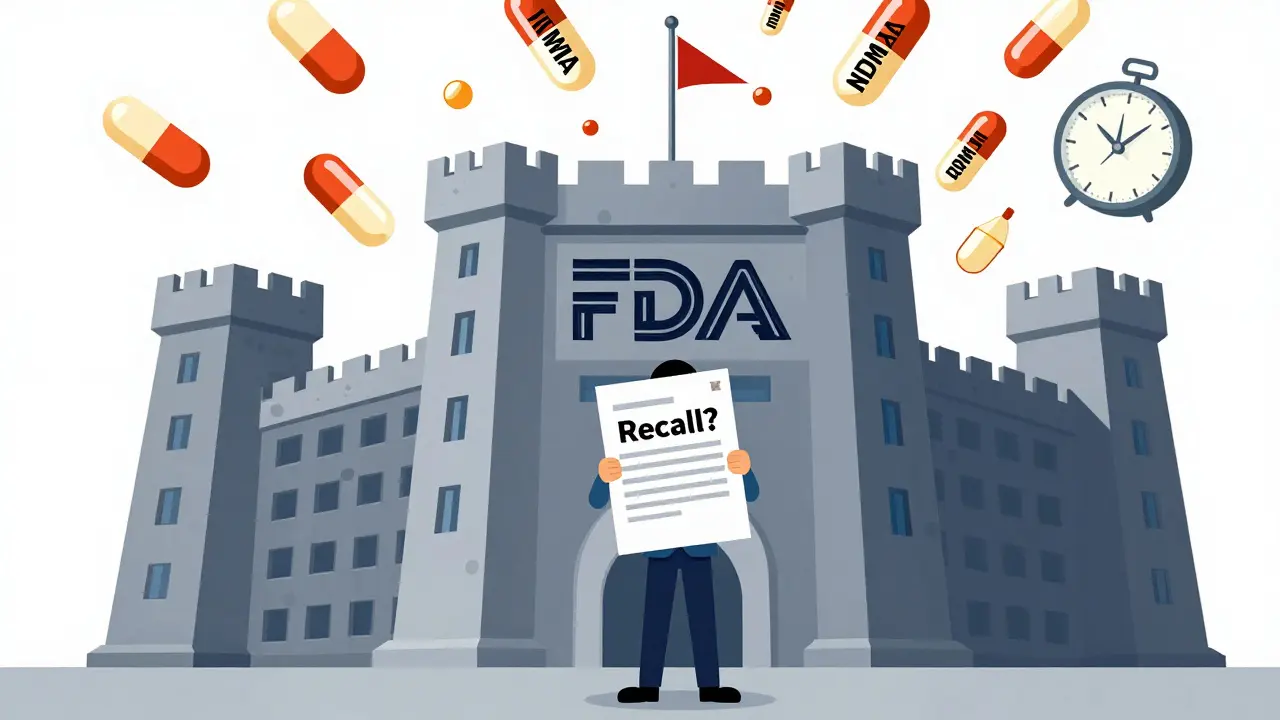
The answer isn’t what most people think. Despite common belief, the U.S. Food and Drug Administration (FDA) doesn’t have the legal power to directly order a drug recall. Instead, it asks - and often, the manufacturer agrees. This system works most of the time. But when it doesn’t, the consequences can be life-threatening.
How the FDA Actually Removes Unsafe Drugs
The FDA’s authority over drug recalls comes from the Federal Food, Drug, and Cosmetic Act (FD&C Act), passed in 1938. Under this law, the agency can’t issue a mandatory recall for most medications. It can only request one. That means if a company refuses to pull a dangerous product, the FDA can’t just step in and seize it.
Instead, the agency must go to court. Under Section 304 of the FD&C Act, the FDA can ask a federal judge to issue an injunction - a legal order that stops the company from manufacturing or selling the drug. This process can take weeks or even months. During that time, the unsafe medication may still be in pharmacies, hospitals, and homes.
Take the 2018 valsartan recall. A cancer-causing contaminant called NDMA was found in a common blood pressure medication. The FDA issued a public alert on June 8, 2018. But it wasn’t until June 29 - over three weeks later - that all major manufacturers voluntarily recalled affected lots. Why the delay? Some suppliers in China, where the active ingredient was made, took 17 days to respond. Without mandatory recall power, the FDA had to wait.
Class I, II, and III: How Recalls Are Ranked
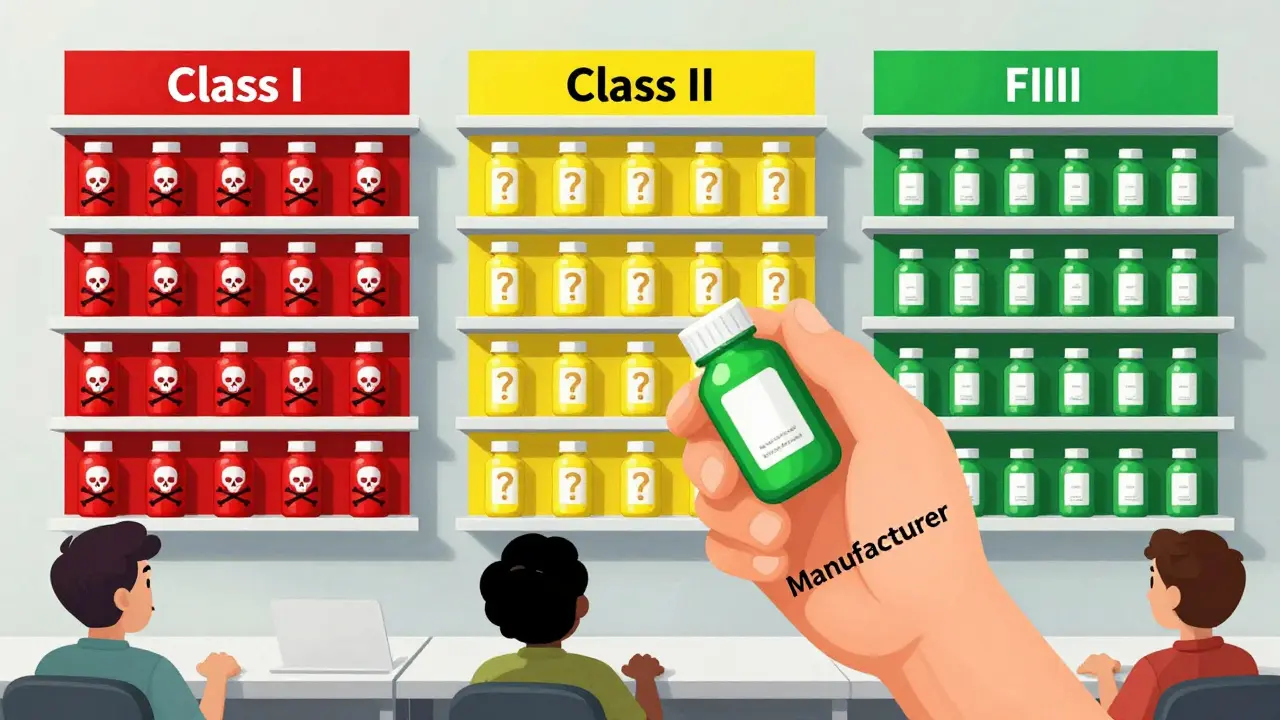
Not all recalls are created equal. The FDA uses a three-tier system to classify how serious a recall is:
- Class I: The most dangerous. There’s a reasonable chance the drug will cause serious harm or death. Examples: contaminated injectables, pills with wrong dosage, or drugs that contain toxic substances like NDMA.
- Class II: May cause temporary or reversible health problems. This is the most common type - about 70% of all drug recalls fall here. Think: mislabeled bottles, packaging errors, or minor contamination.
- Class III: Unlikely to cause harm. These are usually about labeling mistakes - like a typo in the instructions or missing expiration date. No real health risk, but still a violation.
In 2022, the FDA logged 4,312 drug recalls. Only 2.1% were Class I. But those few cases are the ones that matter most. A single Class I recall can mean hundreds of hospitalizations or deaths if not acted on quickly.
Why Devices Are Treated Differently
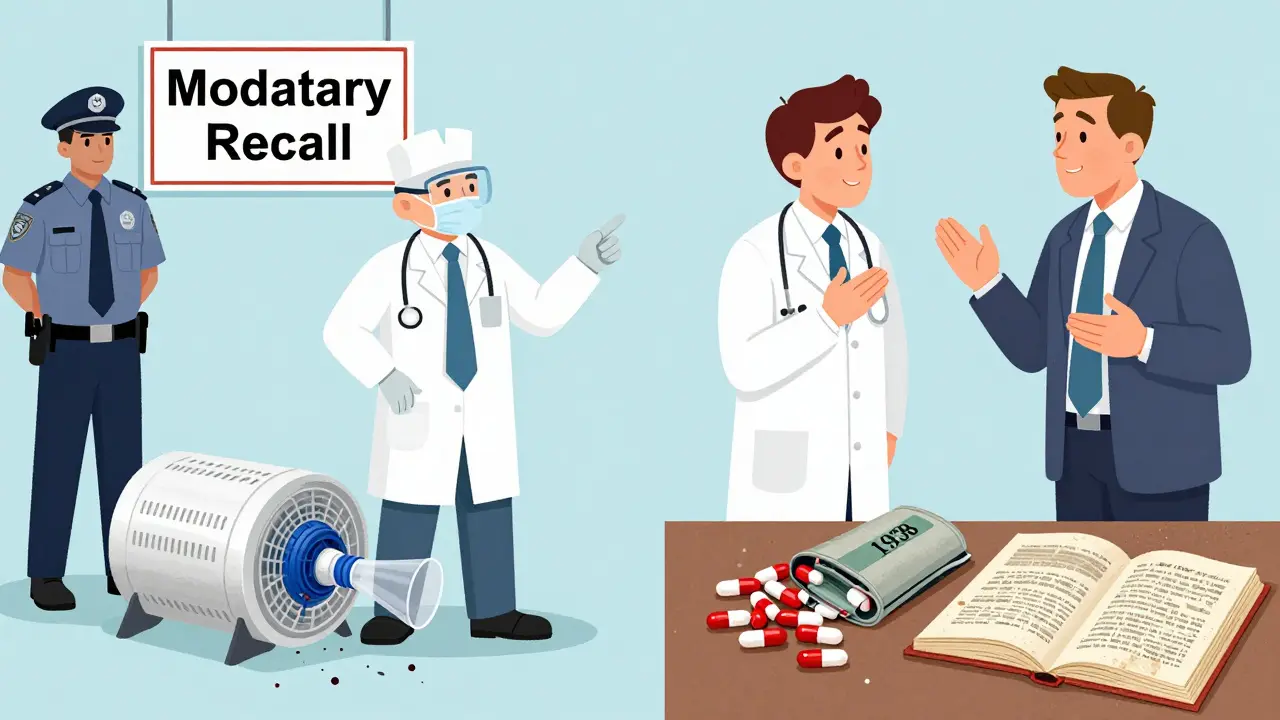
Here’s where things get strange. The FDA can force a recall of medical devices - things like pacemakers, ventilators, or insulin pumps. Under 21 CFR 810, the agency has clear legal authority to order a mandatory recall if a device poses a serious risk to health.
Why the difference? It comes down to history. The Medical Device Amendments of 1976 gave the FDA stronger powers over devices because of past failures - like faulty breast implants and defective heart valves. But drug regulation hasn’t changed since the 1930s. That means a broken ventilator can be pulled immediately. A contaminated painkiller? The FDA has to plead its case.
Experts say this gap is dangerous. Dr. Sidney Wolfe, former director of Public Citizen’s Health Research Group, testified before Congress in 2019 that the lack of mandatory recall power for drugs creates “dangerous delays.” He pointed to the valsartan case as proof that the system is too slow.
How Recalls Start - And Who Triggers Them
Most recalls begin with the manufacturer. Companies are required to run stability tests on their products at least once a year. If they find a problem - like a batch that’s breaking down too fast - they’re supposed to notify the FDA and start a recall.
But sometimes, the FDA finds the problem first. Its post-marketing surveillance system, called MedWatch, collects over 1.2 million reports every year from doctors, pharmacists, and patients. These reports flag unexpected side effects, allergic reactions, or contamination.
Once the FDA identifies a risk, it contacts the manufacturer. The agency doesn’t say, “You must recall this.” Instead, it says, “We believe this product poses a risk. We recommend a recall.” Most companies comply - 99.7% of recalls are voluntary, according to FDA data from 2021.
But compliance isn’t guaranteed. When a company refuses? The FDA’s options are limited. It can issue a public warning. It can inspect the facility. It can sue. But it can’t shut down production without a court order.
The Real-World Impact on Hospitals and Pharmacies
When a recall happens, the burden doesn’t fall on the FDA - it falls on hospitals and pharmacies. They’re the ones who have to track down affected lots, pull pills from shelves, and notify patients.
A 2022 survey by the American Society of Health-System Pharmacists (ASHP) found that 68% of hospital pharmacies struggled to identify which batches were recalled. Why? Because manufacturers use inconsistent lot numbering systems. One company might label a batch as “L12345,” another as “BATCH-2023-089.” There’s no standard.
And even when they find the right lot, communication delays are common. The same survey found that during Class I recalls, patient notifications were delayed by an average of 3.7 days. That’s critical time lost - especially for drugs like insulin, blood thinners, or seizure medications.
Some hospitals now pay third-party companies - like Recall Masters or Recall Index - to track recalls automatically. The drug recall management industry is now worth $287 million a year. That’s not because the FDA is failing - it’s because the system forces them to hire help just to stay safe.
Is Change Coming?
There have been repeated attempts to give the FDA mandatory recall power for drugs. In 2022, the FDA Modernization Act included Section 604 - a provision that would have granted the agency direct authority to order recalls. But it was removed during committee review.
Industry groups like PhRMA argue that the current system works. They say only 3 out of 15,241 drug recalls between 2012 and 2022 required FDA enforcement. That’s true - but it ignores the fact that most companies comply because they fear bad publicity, lawsuits, or loss of trust.
Meanwhile, experts like Dr. Peter Lurie of the Center for Science in the Public Interest warn that the system is breaking down. “We’re seeing more complex biologics, global supply chains, and contamination risks,” he wrote in a 2023 Health Affairs blog. “The 1938 law isn’t built for this.”
Proposals like the PREVENT Pandemics Act (S.2871) now include language that would finally give the FDA the power to order mandatory recalls. But pharmaceutical lobbying remains strong. In Q2 2023 alone, PhRMA spent $8.2 million fighting those changes.
What You Should Do
If you take prescription medication:
- Check the FDA’s recall page monthly - it’s updated daily.
- Keep the original packaging. The lot number and expiration date are your first line of defense.
- Ask your pharmacist: “Has there been a recall on this drug?” They’re required to check.
- Sign up for MedWatch alerts. You don’t need to be a doctor - anyone can report a side effect.
Don’t assume your doctor or pharmacist will catch every recall. The system is designed to rely on voluntary action - not government enforcement. That means you have to be your own watchdog.
The truth is simple: the FDA doesn’t pull drugs off the market. Manufacturers do. And right now, the law gives them too much control over when - or if - they act.
Can the FDA force a drug company to recall a medication?
No, the FDA cannot directly force a drug company to recall a medication. Under current law, it can only request a recall. If a company refuses, the FDA must go to court to get a judge to issue an injunction that stops sales or distribution. This process can take weeks or months.
What’s the difference between a Class I and Class III drug recall?
A Class I recall is the most serious - it means the drug could cause serious injury or death. Examples include contamination with toxic substances or wrong dosage. A Class III recall is the least serious - it usually involves labeling errors or packaging issues that are unlikely to harm health. Class I recalls require immediate action and patient-level notification; Class III may only need distributor-level updates.
Why can the FDA mandate recalls for medical devices but not drugs?
The FDA gained mandatory recall authority for medical devices in 1976 under the Medical Device Amendments. But drug regulation hasn’t changed since the 1938 Federal Food, Drug, and Cosmetic Act. This creates a major gap: a faulty pacemaker can be pulled immediately, but a contaminated blood pressure pill can’t - unless the manufacturer agrees.
How do I know if my medication has been recalled?
Check the FDA’s official recall website daily - it’s updated in real time. Also, keep your medication’s original packaging to find the lot number. Contact your pharmacist and ask if there’s been a recall on your drug. You can also sign up for FDA MedWatch alerts to get notifications directly.
Do recalls happen often?
Yes. In 2022, there were 4,312 drug recalls in the U.S. Most (68.7%) were Class II - minor issues like mislabeled bottles. Only 2.1% were Class I - the most dangerous. But even one Class I recall can put lives at risk if not acted on quickly.
aine power
February 21, 2026 AT 15:50Manufacturers hold life-or-death decisions in their hands.
This isn't regulation. It's corporate hostage-taking.
Jayanta Boruah
February 22, 2026 AT 15:13Ashley Paashuis
February 22, 2026 AT 16:58The 99.7% voluntary recall rate isn't just coincidence-it's a reflection of professional integrity in pharma.
We should push for reform, not assume malice.
Marie Crick
February 23, 2026 AT 02:15Not from bad medicine.
From a government too scared to act.
Benjamin Fox
February 23, 2026 AT 03:19Jonathan Rutter
February 24, 2026 AT 11:28They'll start pulling everything.
Every little typo. Every expired label. Every batch with a 0.001% variance.
They'll shut down pharmacies over a misplaced decimal.
And then you'll be begging for the old system.
Because bureaucracy doesn't fix problems-it multiplies them.
They'll make recall notices longer than the drug instructions.
They'll require 17 forms before you can even ask if your medicine is safe.
And don't get me started on the audits.
Every pharmacist will be drowning in paperwork while patients go without.
The system works because it's simple.
Let the companies do the right thing.
And if they don't?
They get sued.
That's how capitalism works.
Not by government mandates.
By consequences.
Jana Eiffel
February 24, 2026 AT 18:16Robert Shiu
February 24, 2026 AT 23:18Most people don’t even know their meds have been recalled.
And yet they keep taking them.
It’s not the FDA’s fault.
It’s our fault.
We’re too lazy to check.
Too trusting.
Too scared to ask questions.
But here’s the good news-you can change that.
Start today.
Check the FDA site.
Keep your box.
Ask your pharmacist.
One person doing this changes everything.
You’re not powerless.
You’re the missing piece.
Scott Dunne
February 26, 2026 AT 21:40Our regulator mandates recalls within 48 hours.
No court.
No begging.
No corporate tantrums.
Just action.
Why can't America do this?
Because we worship corporations more than citizens.
Davis teo
February 26, 2026 AT 23:02So I called the FDA.
They said ‘check the website.’
I did.
It was updated 12 hours ago.
My bottle?
Expired last month.
But the lot number?
Still in circulation.
So yeah.
They’re not pulling drugs.
They’re just posting them.
And waiting for us to die.
James Roberts
February 28, 2026 AT 15:14So the FDA can’t force a recall… but it can fine you $500,000 for mislabeling a bottle of ibuprofen?
That’s not a system.
That’s a punchline.
And the fact that we pay $287 million a year for third-party recall trackers?
That’s not innovation.
That’s capitalism’s version of ‘I told you so.’
Meanwhile, the same companies lobbying against mandatory recall power?
They spent $8.2M last quarter.
On *preventing* safety.
So yeah.
We’re not just trusting them.
We’re paying them to not save our lives.
Danielle Gerrish
March 2, 2026 AT 10:55Last year, we had a Class I recall on a blood thinner.
Three days passed before we got the official notice.
Meanwhile, patients were getting doses from the wrong batch.
We had to manually cross-reference 12 different lot-number formats.
One patient had a stroke.
She survived.
But her left side never moved again.
The manufacturer?
They didn’t even issue a press release.
Just quietly pulled the batch.
And kept selling the rest.
Because the FDA couldn’t stop them.
And now?
They’re lobbying Congress again.
They call it ‘regulatory burden.’
We call it murder by bureaucracy.
Jeremy Williams
March 2, 2026 AT 23:52Let me tell you something no one says out loud:
The voluntary system works because companies are terrified of lawsuits, bad press, and losing their license to operate.
The FDA doesn’t need more power.
It needs more teeth.
Like public shaming.
Like naming names.
Like forcing CEOs to testify when someone dies because their drug wasn’t pulled fast enough.
Right now?
They hide behind ‘voluntary.’
But if you make them look bad?
They’ll move mountains.
That’s not regulation.
That’s human nature.