
Diabetes and Heart Disease: How Medications and Lifestyle Together Lower Your Risk
 Dec, 15 2025
If you have type 2 diabetes, your risk of heart disease isn’t just higher-it’s dangerously close. About 65% of people with diabetes die from heart-related causes, according to the American Heart Association. That’s not a coincidence. High blood sugar damages blood vessels over time, making them stiff and prone to plaque buildup. At the same time, many people with diabetes also carry extra weight, have high blood pressure, or struggle with cholesterol-each of these pulls the heart closer to failure.
Why Diabetes and Heart Disease Are a Dangerous Pair
Diabetes doesn’t just affect your pancreas. It rewires your whole metabolism. When insulin doesn’t work right, your body holds onto fat, especially around your belly. That fat isn’t just storage-it’s active tissue that pumps out inflammation, raises blood pressure, and messes with your cholesterol levels. The result? A perfect storm for heart attacks and strokes.
For years, doctors told people to lose weight, eat better, and move more before even thinking about medication. But the data now shows that waiting doesn’t work for most. By the time someone loses 5% of their body weight through diet and exercise alone, their heart may already be damaged. That’s why guidelines changed in 2025. The American College of Cardiology now says: Don’t make people fail at lifestyle changes before giving them medicine.
The New Power Players: GLP-1 Receptor Agonists
Medications like semaglutide (Wegovy, Ozempic) and tirzepatide (Mounjaro, Zepbound) aren’t just for weight loss anymore. They’re now FDA-approved to directly reduce your risk of heart attack, stroke, and death in people with diabetes and obesity.
These drugs work by mimicking a natural hormone that tells your brain you’re full, slows digestion, and helps your pancreas release insulin only when needed. But their real superpower? They don’t just lower blood sugar-they protect your heart. In the LEADER trial, liraglutide cut major heart events by 13%. In the STEP and SURMOUNT trials, semaglutide and tirzepatide helped people lose 15% to over 22% of their body weight-numbers no diet alone could match.
And here’s the kicker: the FDA approved Wegovy in 2023 specifically for cardiovascular risk reduction in people with heart disease and overweight or obesity. That’s the first time a weight-loss drug got this kind of official heart protection stamp.
Lifestyle Changes Still Matter-More Than Ever
Medications are powerful, but they’re not magic. They work best when paired with real, daily habits. The American Diabetes Association doesn’t push one magic diet. Instead, they recommend patterns that have proven results: Mediterranean, DASH, or plant-based eating. That means more vegetables, beans, whole grains, fish, nuts, and olive oil-and less processed food, sugary drinks, and red meat.
Exercise isn’t optional. The CDC and American Heart Association agree: aim for 150 minutes a week of moderate activity-like brisk walking, swimming, or cycling. You don’t have to do it all at once. Three 10-minute walks after meals can be just as effective as one 30-minute session. And it’s not just about your heart. Movement lowers stress, improves sleep, and helps your body use insulin better.
Blood pressure targets for people with diabetes are now <130/80 mm Hg. Cholesterol goals are tighter too. If you smoke, quitting cuts your heart risk by half in just one year. Even small steps like getting 7 hours of sleep and staying connected with friends lower inflammation and help your body heal.
The Real Magic: When Medication Meets Lifestyle
Here’s what the data doesn’t lie about: combining GLP-1 RAs with healthy habits does something neither can do alone.
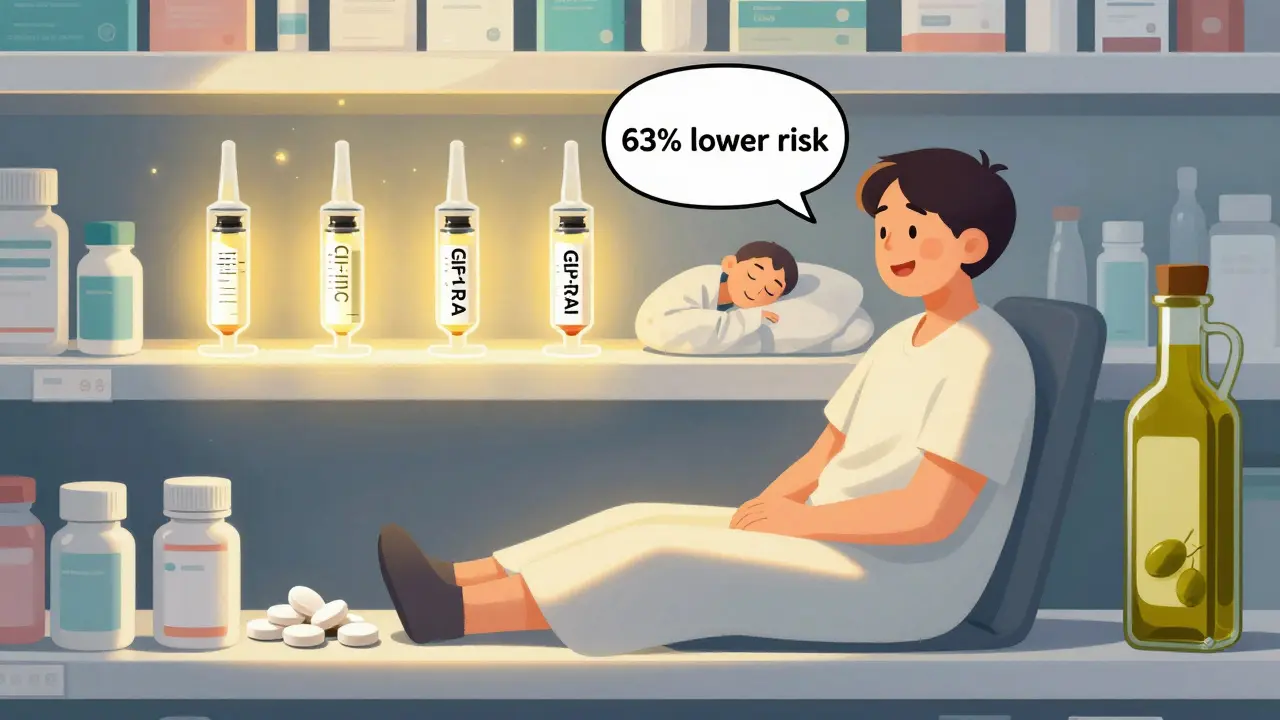
A study of U.S. veterans found that those taking a GLP-1 RA and following eight heart-healthy habits-like eating well, moving daily, not smoking, managing stress-had a 63% lower risk of heart attack or stroke. Those who only took the medication saw a 20% reduction. That’s a huge difference.
Why? Because medication handles the biology-slowing appetite, improving insulin, burning fat. Lifestyle handles the behavior-breaking the cycle of stress-eating, building routines, creating support systems. One fixes your chemistry. The other rebuilds your life.
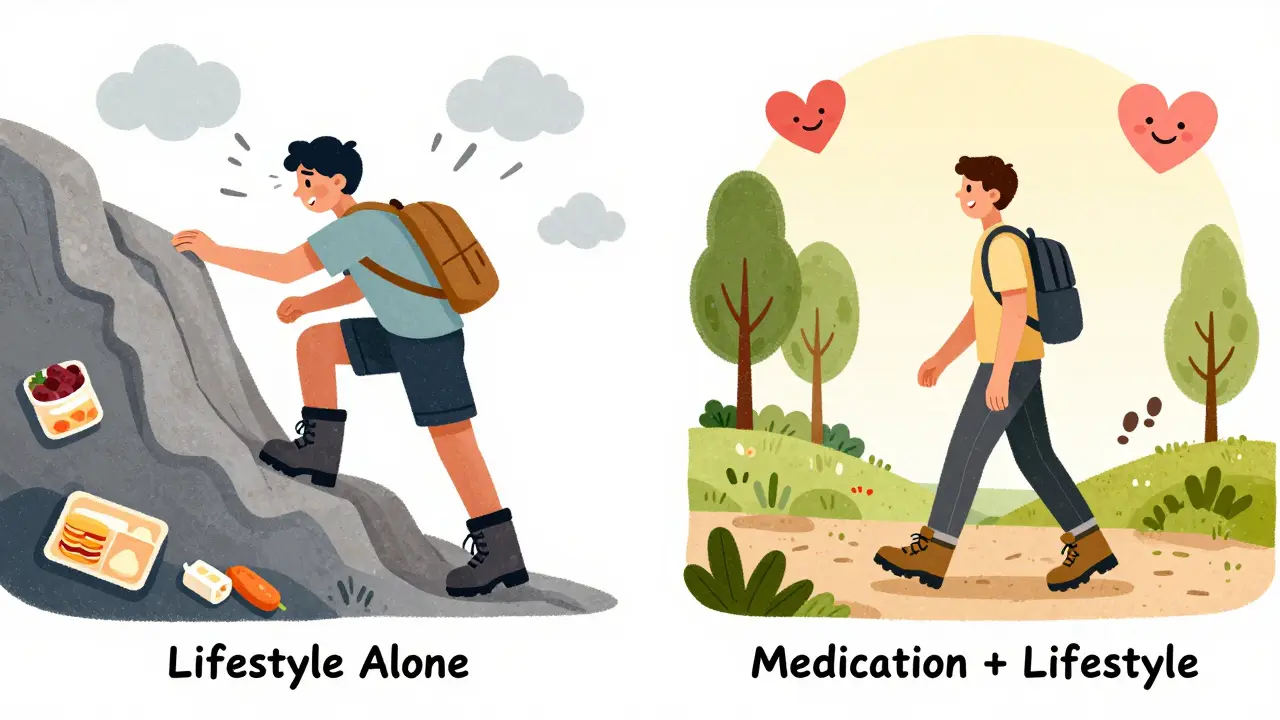
Think of it like this: GLP-1 RAs give you the energy and appetite control to make better choices. Without them, changing habits feels like climbing a mountain in heavy boots. With them, you’re wearing hiking shoes.
What About Metformin? Is It Still Enough?
Metformin is still the first-line drug for type 2 diabetes-and it’s safe, cheap, and helps with weight. But when it comes to protecting your heart, it doesn’t compete with the newer GLP-1 RAs. The LEADER trial showed liraglutide outperformed placebo. Metformin’s heart benefits are real but more modest. For someone with existing heart disease or high risk, metformin alone isn’t enough anymore.
That’s why doctors are now starting patients on GLP-1 RAs earlier-sometimes even before metformin-if they have obesity and heart disease risk factors. The goal isn’t just to control blood sugar. It’s to stop the heart damage before it starts.
Barriers to Getting Help
These medications are life-changing-but they’re not easy to access. Insurance often won’t cover them unless you’ve tried other drugs first. Many people pay out of pocket-$1,000 or more a month. That’s why only about 2% of eligible patients are getting them right now.
Cost isn’t the only hurdle. Some people fear injections. Others worry about side effects like nausea or diarrhea. These usually fade after a few weeks. And if you’re not working with a provider who understands these drugs, you might miss out on the full benefit.
Don’t wait for perfection. Start with one change. Maybe it’s swapping soda for water. Or walking after dinner. Then talk to your doctor about whether a GLP-1 RA could help you go further.
What’s Next for Treatment?
The science is moving fast. Tirzepatide, which targets two hormones instead of one, is showing even bigger weight loss and heart benefits. Researchers are now testing combinations of these drugs with other therapies to target inflammation, fat storage, and blood pressure all at once.
Long-term, experts predict GLP-1 RAs will become standard for anyone with diabetes and obesity by 2030. But the goal isn’t just to rely on pills. It’s to use them as tools-so you can build a life where you don’t need them as much. Better food, more movement, less stress-they’re not just backups. They’re the foundation.
The message is clear: you don’t have to choose between medication and lifestyle. You need both. And the sooner you start, the more your heart will thank you.
Josh Potter
December 16, 2025 AT 04:10Bro this is the real deal. I lost 30 lbs on Ozempic and my A1C dropped from 8.2 to 5.8. No more midnight cravings, no more brain fog. My doc said my arteries look like a 30-year-old’s. Fuck yes.
Evelyn Vélez Mejía
December 17, 2025 AT 11:07The convergence of metabolic physiology and pharmacological innovation represents a paradigmatic shift in the management of type 2 diabetes and its cardiovascular sequelae. The GLP-1 agonists, by modulating central satiety pathways and peripheral insulin sensitivity, do not merely ameliorate symptoms-they recalibrate the body’s homeostatic architecture. This is not medicine as intervention; it is medicine as reclamation.
Victoria Rogers
December 18, 2025 AT 15:02They’re just pushing drugs to make Big Pharma richer. Nobody needs to take weight loss pills if they’d just stop eating donuts. My grandpa had diabetes in the 50s and he walked 5 miles a day. Now everyone’s on meds and still fat. Weak.
Jane Wei
December 18, 2025 AT 22:07Just started tirzepatide last month. Honestly? I feel like I can breathe again. Not because I lost weight (though I did) but because I’m not terrified every time my foot goes numb.
Nishant Desae
December 20, 2025 AT 03:16For those who are new to this journey, please know you are not alone. The path is not about perfection, it is about persistence. Small steps like walking after dinner, drinking water instead of soda, choosing brown rice over white-these are not small victories, they are life-saving acts. Medication helps, yes, but your daily choices are the quiet heroes. I’ve seen people turn their lives around with just these habits and a little support. You can too.
Meghan O'Shaughnessy
December 20, 2025 AT 06:30My abuela ate beans, corn tortillas, and chiles every day. No meds. Lived to 94. Maybe we’re overcomplicating this. Food isn’t the enemy. Processed crap is.
Kaylee Esdale
December 21, 2025 AT 23:55Medicine is a tool not a crutch. Walk more. Eat real food. Sleep. That’s the triad. The pills help you do those things easier. They don’t replace them.
Jody Patrick
December 22, 2025 AT 11:51India has over 100 million diabetics. We need access to these drugs. They cost too much here. Doctors say ‘eat less rice’ but rice is our staple. We need affordable options, not just fancy injections.
Radhika M
December 23, 2025 AT 20:29My mom was on metformin for 12 years. She started semaglutide last year. Now she hikes on weekends. I cried when she told me she didn’t need her cane anymore. This isn’t magic. It’s hope.
Philippa Skiadopoulou
December 24, 2025 AT 06:35The evidence base for GLP-1 agonists in cardiovascular risk reduction is robust and aligns with current clinical guidelines. However, long-term safety data beyond five years remains limited. Caution is warranted in patients with a history of medullary thyroid carcinoma or multiple endocrine neoplasia syndrome type 2.
Pawan Chaudhary
December 24, 2025 AT 19:09Man I was skeptical at first but now I’m telling everyone I know. I used to hate exercise. Now I walk 20 mins after dinner and I actually look forward to it. The meds helped me get started. The habit kept me going.
Jonathan Morris
December 25, 2025 AT 08:30Notice how the FDA approved this right after the 2024 election cycle? Coincidence? The pharmaceutical lobby spent $200 million on lobbying that year. They’re not saving lives-they’re selling addiction disguised as prevention. Your insulin resistance was never the problem. The system is.