
Creatine and Kidney Disease Medications: How to Monitor Renal Function Safely
 Jan, 7 2026
Kidney Function Calculator
How Creatine Affects Your Kidney Tests
When you take creatine supplements (3-5g/day), your body produces extra creatinine that can falsely lower your eGFR result. This calculator shows the difference between standard creatinine-based eGFR and accurate cystatin C-based eGFR.
Important Note
Your creatinine-based eGFR might be 30% lower than your true kidney function when you take creatine supplements.
Why This Matters
Doctors often use creatinine to estimate kidney function. If you're taking creatine, this can mislead them into thinking your kidneys are damaged when they're actually fine.
Your Kidney Function Results
Cystatin C-Based eGFR
--
Accurate kidney function measurement
Creatinine-Based eGFR
--
May be falsely low due to creatine
Your cystatin C eGFR shows normal kidney function. If you were using standard creatinine-based tests, your eGFR might incorrectly suggest kidney impairment.
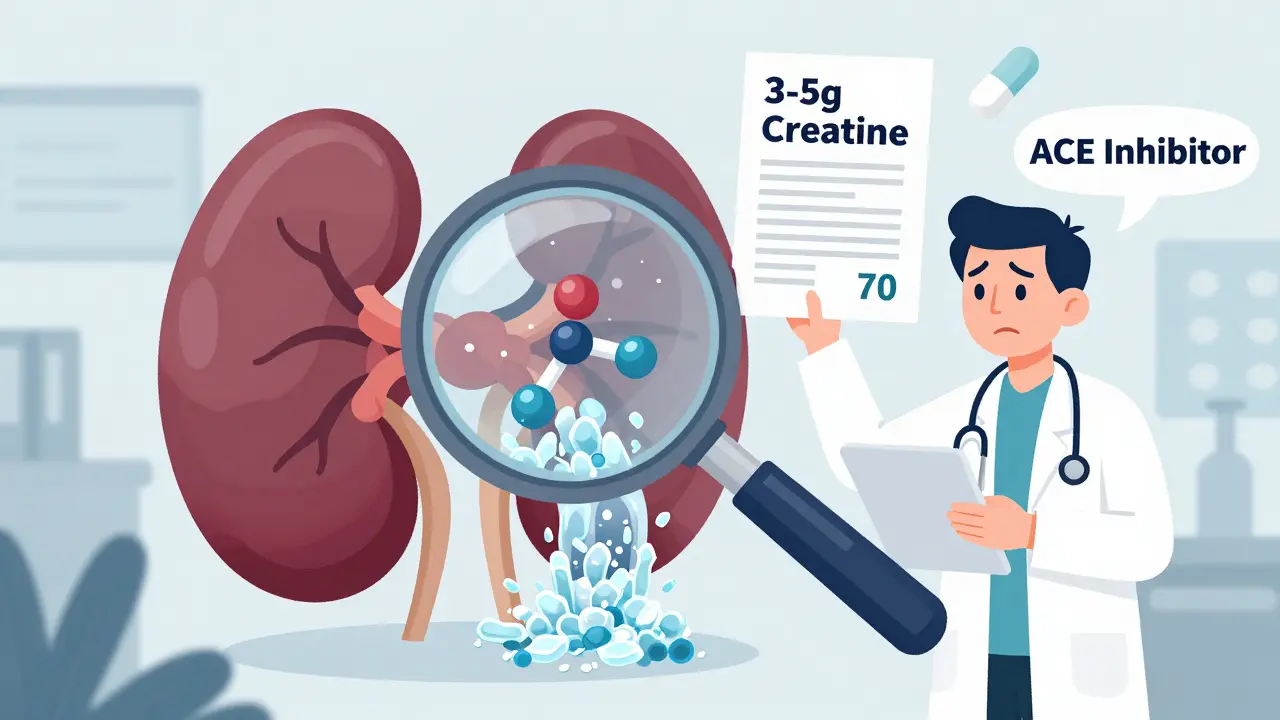
When you take creatine to boost strength or recovery, you’re not just adding a supplement-you’re changing how your body looks to your kidneys. For people managing kidney disease or taking medications like ACE inhibitors, NSAIDs, or diuretics, this change can trigger false alarms in blood tests. A simple rise in creatinine might make your doctor think your kidneys are failing-when they’re not. This isn’t speculation. It’s happening every day to people who follow the recommended dose: 3-5 grams a day.
Why Creatine Skews Kidney Test Results
Creatine breaks down naturally into creatinine, a waste product your kidneys filter out. That’s why serum creatinine is the go-to marker for estimating kidney function through eGFR (estimated glomerular filtration rate). But here’s the catch: when you supplement with creatine, your body produces more creatinine-even if your kidneys are working perfectly. Studies show that after just a few days of taking 5 grams daily, creatinine levels jump by 10-30%. That’s enough to drop your eGFR from 90 to 70, which could falsely classify you as having stage 2 chronic kidney disease. You didn’t get sick. Your kidneys didn’t fail. You just took a supplement that tricks the test. This isn’t a myth. In 2023, a Reddit user named FitMedStudent shared their story: after taking creatine for six months, their doctor diagnosed them with early kidney disease based on an eGFR of 78. They stopped creatine. Two weeks later, their eGFR bounced back to 95. No medication. No treatment. Just stopping the supplement.What Happens in Your Body When You Take Creatine
Your body makes about 1-2 grams of creatine a day naturally. Supplementing adds more. Around 90% of what you take ends up as creatinine. That creatinine doesn’t mean damage-it’s just noise in the system. Here’s what stays normal when you take creatine:- Urinary creatinine clearance (your kidneys are still filtering properly)
- Blood urea nitrogen (BUN) levels
- Cystatin C (a better kidney marker that doesn’t rise with creatine)
- Electrolytes and urine protein
Why This Matters for People on Kidney Disease Medications
If you’re on ACE inhibitors or ARBs for high blood pressure or kidney protection, your doctor is watching your creatinine closely. A small rise might mean your medication is working. But if you’re also taking creatine? That rise could be fake. Same goes for NSAIDs like ibuprofen or naproxen. These can stress kidneys, and doctors assume any creatinine spike is from the drug. But if you’re on both? It’s impossible to tell what’s causing the change. And here’s the real danger: if your doctor sees a rising creatinine and assumes kidney damage, they might reduce your kidney-protective meds. That could backfire. You lose protection-not because your kidneys are failing-but because the test lied.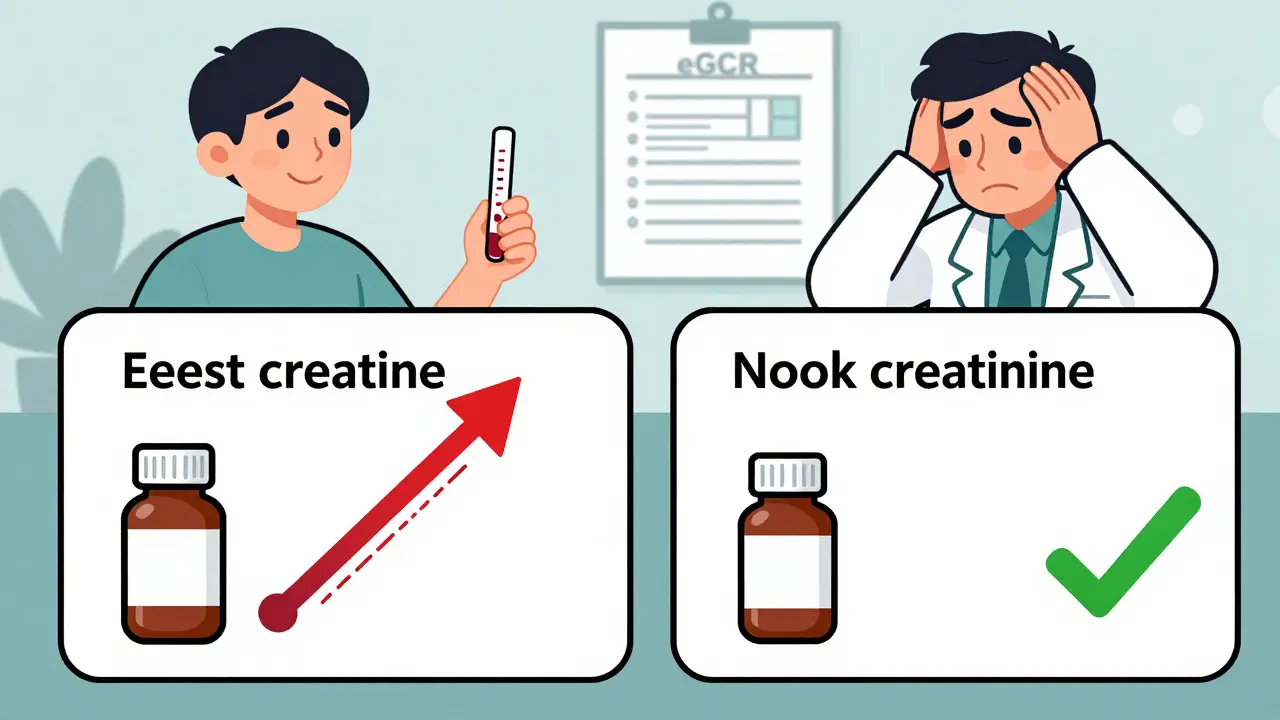
How to Avoid Misdiagnosis
The solution isn’t to stop creatine. It’s to test smarter. Step 1: Get a baseline before you start. Have your creatinine and eGFR checked right before beginning creatine. Keep that result. You’ll need it later. Step 2: Ask for cystatin C. This is the game-changer. Unlike creatinine, cystatin C isn’t affected by creatine supplements. It’s a more accurate reflection of actual kidney function. If your cystatin C-based eGFR stays stable, your kidneys are fine-even if creatinine climbs. Step 3: If cystatin C isn’t available, request a 24-hour urine creatinine clearance. This test measures exactly how much creatinine your kidneys are flushing out in a day. It doesn’t get skewed by supplement use. If your clearance stays normal, your kidneys are working as they should. Step 4: Tell every doctor you see. Primary care physicians miss this in 67% of cases, according to the American Family Physician journal. You can’t assume they know. Say it clearly: “I take creatine. My creatinine might be high, but my kidneys are fine.”What the Experts Say
The National Kidney Foundation updated their guidelines in 2023: creatine is safe for healthy people. But they also warn: don’t use it if you already have kidney disease. Why? Because the data isn’t clear enough for those with existing damage. UCLA Health says long-term creatine use doesn’t harm kidneys in healthy adults. The American College of Sports Medicine agrees-but stresses baseline testing and monitoring. The exceptions? Case reports. One 2011 study described a person developing acute kidney injury while taking 3 grams a day. No other risk factors. No other drugs. But this was one case out of millions. The odds? Less than 1 in 100,000. Still, if you have a history of kidney stones, diabetes, or high blood pressure, talk to your nephrologist before starting.
What About ‘Kidney-Safe’ Creatine?
You’ll see products labeled “kidney-friendly” or “low-creatinine.” They don’t exist. Creatine monohydrate breaks down into creatinine no matter the brand. There’s no magic formula that stops this. ConsumerLab tested 12 popular brands in 2024. All produced the same creatinine rise. Marketing claims like “gentler on kidneys” are just that-marketing. Stick to plain creatine monohydrate. It’s the most studied, cheapest, and most reliable form. Avoid blends with caffeine, diuretics, or herbal extracts. Those can actually stress your kidneys.What You Should Do Right Now
If you’re on kidney disease meds and taking creatine:- Don’t panic. Your kidneys are likely fine.
- Check your last blood test. Was creatinine elevated? Did your doctor ask about supplements?
- Ask your doctor for a cystatin C test. If they don’t know what it is, ask for a nephrologist referral.
- Bring this article with you. Or print the 2023 National Kidney Foundation guidelines.
- If you’re not on meds but plan to start creatine: get a baseline creatinine and cystatin C before you begin.
What’s Coming Next
Researchers are working on adjustment formulas. Early data from the University of Toronto suggests multiplying your creatinine result by 0.9 if you’re on creatine. That could fix eGFR errors automatically. The National Kidney Foundation plans to release formal guidance in late 2024. Until then, the rule is simple: creatine doesn’t break kidneys. But it breaks tests. And that’s dangerous enough.Don’t stop taking creatine because of fear. Stop taking it only if your doctor, armed with the right tests, tells you your kidneys are truly at risk. Otherwise, stay informed. Stay loud. And make sure your care team knows what you’re taking.
Donny Airlangga
January 8, 2026 AT 17:20I’ve been on ACE inhibitors for years and started creatine last year. My doc almost dropped me into stage 2 CKD until I mentioned the supplement. She had no idea. Now I get cystatin C every 6 months. Life’s easier.
Molly Silvernale
January 9, 2026 AT 09:14Think about it: our entire medical system is built on metrics that were designed before the fitness industry exploded. Creatinine isn’t a disease-it’s a mathematical ghost. We’re diagnosing ghosts. And then we medicate them. We’re not treating bodies-we’re treating spreadsheets. And someone’s paying for it. Probably you. Probably me.
Ken Porter
January 10, 2026 AT 00:51Stop taking creatine if you have kidney issues. Simple. No magic tests needed. Your body isn’t a lab experiment. Stop being a guinea pig for gym bro science.
Annette Robinson
January 11, 2026 AT 08:55Thank you for writing this. I’ve seen too many people panic because their eGFR dropped after starting creatine. It’s not your fault if your doctor doesn’t know this. But now you do. Go in there with your data, stay calm, and ask for cystatin C. You’ve got this.
Luke Crump
January 12, 2026 AT 09:51So… what you’re saying is… the entire medical-industrial complex is built on a lie? And creatine is the tiny pebble that cracks the dam? I’m not sure if I’m relieved or terrified. Either way, I’m telling my nephrologist to read this. And if she doesn’t? I’m firing her.
Aubrey Mallory
January 14, 2026 AT 06:19If you’re on diuretics or NSAIDs and taking creatine, you’re already playing with fire. Don’t blame the test. Blame the combo. Talk to your pharmacist before you even open the tub.
Evan Smith
January 15, 2026 AT 21:02Wait so creatine is like a fake positive on a pregnancy test? That’s wild. I thought it was just for gaining muscle. Now I feel like I’ve been lied to by science.
Lois Li
January 17, 2026 AT 00:11Just got my cystatin C results last week-normal while creatinine was high. I printed this article and gave it to my PCP. She said ‘I’ll look into it.’ I’m not holding my breath. But at least I tried.
christy lianto
January 18, 2026 AT 19:36My mom’s on dialysis. She’s terrified of supplements. I showed her this. She said, ‘If it tricks the test, it’s not magic-it’s math.’ Then she asked if I’d stop taking it. I said yes. She cried. I cried. We hugged. Sometimes the right thing isn’t the most exciting thing.
swati Thounaojam
January 19, 2026 AT 21:38creatine not good for kidney? i take it since 2020. no problem. but i am from india, maybe our bodies different?
Manish Kumar
January 20, 2026 AT 01:51Let’s not forget that creatine is not a drug-it’s a molecule that’s been in our muscles since before we evolved into bipeds. The problem isn’t creatine. The problem is that modern medicine has outsourced its thinking to algorithms. eGFR is a statistical illusion wrapped in a lab report. We’ve forgotten how to see the person behind the number. And now we’re treating ghosts while the real issues-poor diet, stress, sedentary life-go unaddressed. Creatine didn’t break the system. The system broke itself. And creatine? It just showed us the cracks.
Dave Old-Wolf
January 20, 2026 AT 08:59So if I stop creatine for two weeks, will my numbers go back to normal? My doc just upped my blood pressure med because of a ‘spike.’ I didn’t say anything. Should I?
Prakash Sharma
January 21, 2026 AT 00:40India has 100 million people with kidney disease. You think creatine is the problem? Look at the sugar, the salt, the pollution. Stop blaming supplements. Fix your food. Fix your water. Fix your life. Then talk to me about creatine.