
Contact Allergy: How Patch Testing Identifies Metal and Fragrance Triggers
 Jan, 28 2026
What Is Contact Allergy, and Why Does It Keep Coming Back?
You’ve tried every moisturizer. You switched to “hypoallergenic” soap. You even stopped wearing jewelry. But your skin still itches, flares up, or cracks open every few weeks. If this sounds familiar, you’re not alone. Millions of people deal with chronic skin rashes that don’t respond to creams or steroids-and the real culprit is hiding in plain sight. This isn’t just dry skin. It’s allergic contact dermatitis, a delayed reaction your immune system has to everyday things like metals in your watchband or fragrance in your lotion.
Unlike immediate allergies (like peanut or bee sting reactions), contact allergies take time. Your body doesn’t react right away. It takes 48 to 72 hours for the redness, bumps, or blisters to show up. That’s why most people never connect their rash to the shampoo they used three days ago, or the belt buckle they wore last Monday. The delay makes it confusing. But there’s a test that cuts through the guesswork: patch testing.
How Patch Testing Works-And Why It’s the Only Reliable Method
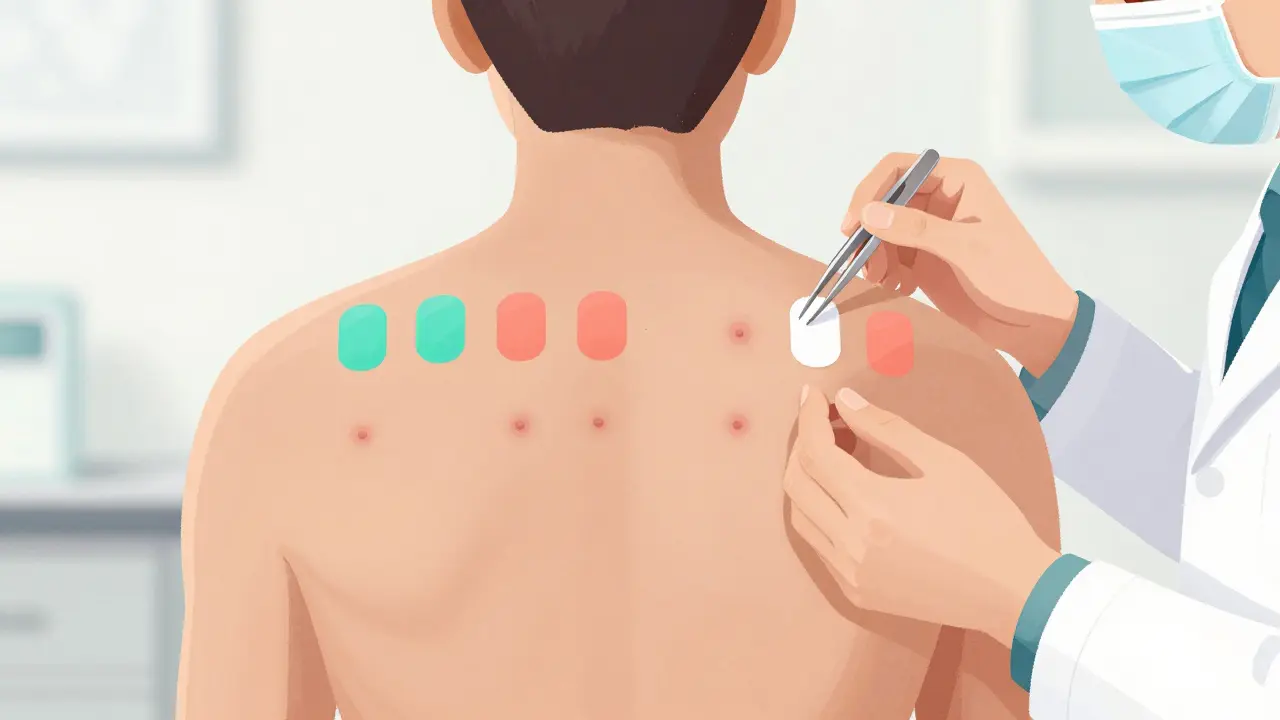
Patch testing isn’t a blood test. It’s not a skin prick. It’s not even done with needles. Instead, tiny amounts of common allergens are taped to your upper back, where your skin is thick and less likely to move around. These patches stay on for exactly 48 hours. You can’t shower, sweat, or swim during that time. After two days, your doctor removes the patches and checks for reactions. Then they check again at 72 hours, and sometimes even at 7 days, because some allergies take longer to show up.
Why does this work? Because contact allergies are T-cell mediated. That means your immune system remembers the substance and reacts slowly, like a delayed warning system. Blood tests can’t detect this kind of reaction. Only patch testing can. According to a 2022 meta-analysis in Contact Dermatitis, patch testing has a specificity of 95-98%. That means if the test says you’re allergic to nickel, you almost certainly are. No false alarms. No guesswork.
Metals Are the Biggest Culprits-Nickel, Cobalt, Chromium
Of all the substances people react to, metals top the list. Nickel is the #1 offender. It’s in everything: earrings, belt buckles, watch straps, zippers, phone cases, even some dental fillings. About 18.5% of people tested in North America show a positive reaction to nickel sulfate, according to the North American Contact Dermatitis Group (NACDG). Cobalt and chromium are next. Chromium is often found in leather, cement, and some paints. Cobalt shows up in metal alloys, makeup, and even some blue pigments.
One nurse in Cleveland traced her chronic hand eczema to nickel in surgical instruments. After patch testing confirmed it, she switched to nickel-free tools. Her skin cleared up completely within weeks. That’s the power of knowing the exact trigger. Without testing, she might have kept blaming stress, soap, or dry air-wasting years of discomfort.

Fragrance Allergy Is More Common Than You Think
Fragrance isn’t just about perfume. It’s in laundry detergent, body wash, shampoo, deodorant, even baby wipes. The word “fragrance” on a label can mean hundreds of different chemicals. And here’s the problem: most patch test panels only test a few of them. If your doctor only uses the basic fragrance mix (FM I and FM II), they might miss up to 15% of your allergies.
That’s because the mixes contain only 14 chemicals total. But there are over 50 known fragrance allergens. In 2023, the NACDG added eight new ones to their testing panel-like citral, farnesol, and hydroxycitronellal-because these are showing up more often in reactions. A 2021 study by Goossens et al. found that 10% of fragrance-allergic patients would’ve been missed without testing these individual chemicals. One Reddit user wrote: “I avoided all ‘perfumed’ products but still got rashes. Patch test found I was allergic to lyral in my body wash. Switched brands-and my hands haven’t cracked in a year.”
The Testing Process: What to Expect
Patch testing isn’t quick, and it’s not comfortable-but it’s simple. Here’s what happens:
- Day 1 (Monday): You visit the clinic. A technician applies 30-80 small patches to your back using medical tape. The process takes 30-45 minutes. You won’t feel anything.
- Day 3 (Wednesday): You return. The patches are removed. Your skin is checked for redness, bumps, or blisters. This is the first reading.
- Day 5 (Friday): You come back again. The final reading happens here. Some reactions only appear after 7 days.
You can’t get the test area wet for 48 hours. That means no showers, swimming, or sweating. Most clinics recommend wearing loose cotton shirts and avoiding bending over or lifting heavy things. If you scratch or pull off a patch, your results could be ruined. About 15% of patients accidentally remove them, according to the Cleveland Clinic.
False positives happen too-about 5-10% of the time. That’s when the skin reacts because of irritation, not allergy. That’s why only board-certified dermatologists trained in patch testing should interpret the results. A weak red spot might be nothing. A raised, blistering reaction? That’s a clear allergy.
What Happens After the Test?
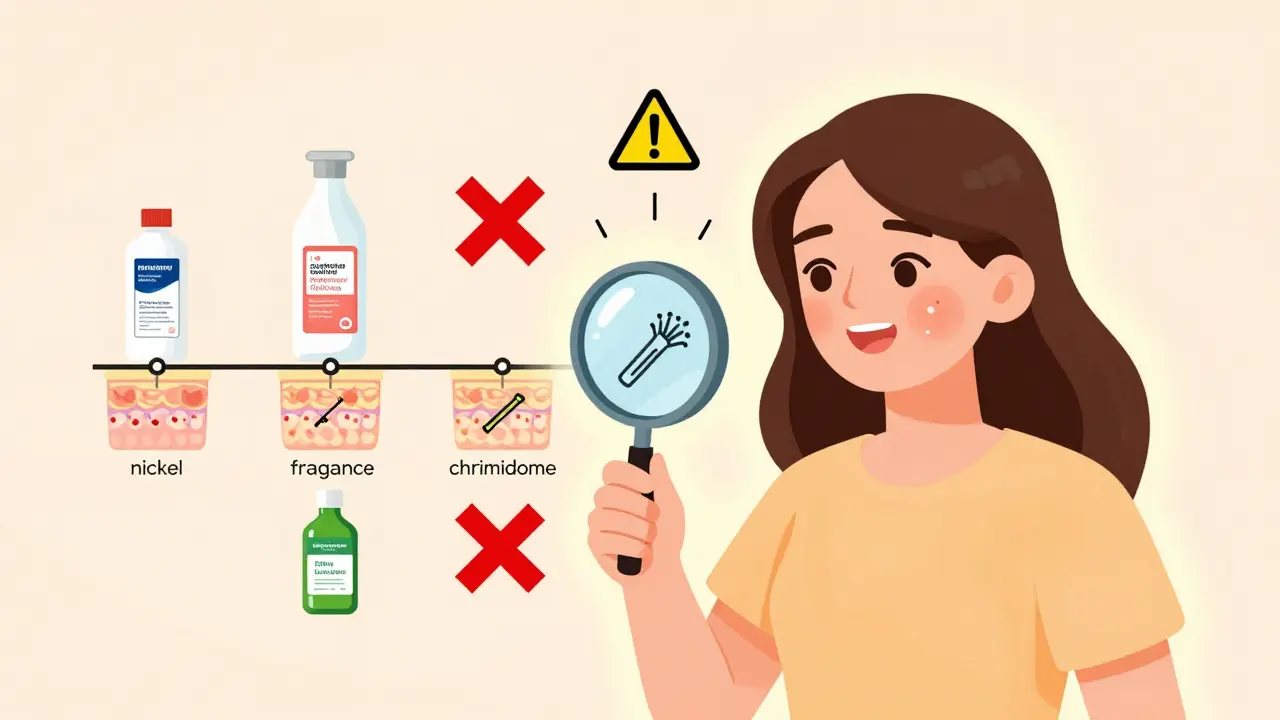
The real value isn’t in the test itself-it’s in what you do next. Once you know you’re allergic to nickel, you start checking labels. Look for “nickel-free” jewelry. Use a magnet to test metal items-nickel is magnetic. For fragrance, avoid anything that says “fragrance,” “parfum,” or “essential oil blend.” Even “unscented” products can contain masking fragrances.
Studies show that 60-80% of patients get complete clearance of their rash once they avoid their triggers. One woman in Ohio had hand eczema for 12 years. She tested positive for balsam of Peru (a common fragrance in cosmetics) and cinnamon aldehyde (in cinnamon-flavored toothpaste). After switching products, her skin was clear in six weeks. “I didn’t realize toothpaste could cause this,” she said.
But avoiding allergens isn’t always easy. Some products don’t list ingredients clearly. Some brands use “proprietary blends.” That’s why follow-up visits are important. About 78% of patients need at least one more appointment to learn how to read labels, find safe products, or test new items at home.
Why Most People Get It Wrong
Many dermatologists still use outdated panels. Some only test for the basics: nickel, cobalt, chromium, and the two fragrance mixes. But that’s not enough. The European Society of Contact Dermatitis says testing fragrance mixes alone misses 10-15% of cases. The NACDG now recommends testing at least 15 individual fragrance chemicals in addition to the mixes.
If you’ve had patch testing before and still have rashes, ask if you were tested for the full fragrance panel. If your doctor says, “We only test the standard series,” you might need to find a specialist. Only 22% of solo dermatology practices offer comprehensive testing, according to a 2023 industry report. Larger clinics with 5+ providers are much more likely to have the full panel.
What’s New in 2026
The science is evolving. In January 2024, the European baseline series added two more fragrance allergens, bringing the total to 32. The U.S. FDA is also considering new rules requiring clearer labeling of fragrance allergens-similar to the EU’s regulation, which already requires disclosure of 26 specific chemicals if they’re above 0.001% in leave-on products.
Researchers are also exploring alternatives. A 2024 study in the British Journal of Dermatology tested peptide-based blood markers for nickel allergy. It’s still experimental, but it could one day reduce the need for patch testing. For now, though, patch testing remains the gold standard.
Is It Worth It?
On RealSelf.com, 87% of users who had patch testing said it was “worth it,” even with the inconvenience. On Reddit, people call it “life-changing.” The cost? Typically $200-$500, depending on location and insurance. Most insurance plans cover it if you have chronic dermatitis.
Think about it: If you’ve spent years buying expensive creams, avoiding random products, and wondering why your skin won’t heal-wouldn’t you want to know the exact cause? Patch testing doesn’t cure your allergy. But it gives you control. You can finally stop guessing. And that’s priceless.
Can patch testing diagnose all types of skin allergies?
No. Patch testing only detects allergic contact dermatitis, which is a delayed reaction (Type IV hypersensitivity). It won’t detect immediate allergies like hives from food or insect stings (Type I). It also won’t diagnose conditions like eczema (atopic dermatitis) unless they’re triggered by a contact allergen. If your rash comes on within minutes of contact, it’s likely not a contact allergy.
How long do patch test results last?
Once you’re diagnosed with an allergy, it usually lasts for life. Your immune system remembers the allergen. But you can avoid it. That’s the goal. Some people develop new allergies over time, especially if they’re exposed to new chemicals in products. That’s why it’s smart to retest every 3-5 years if your skin flares up again.
Can I do patch testing at home?
No. Patch testing requires standardized allergens, precise concentrations, and professional interpretation. Over-the-counter “allergy kits” or DIY methods using your own products are unreliable and can cause severe irritation or false results. Only a trained dermatologist should perform this test.
Why do I have to avoid water for 48 hours?
Water can loosen the adhesive tape holding the patches, causing them to fall off. Sweat can also cause irritation that looks like an allergic reaction, leading to false positives. Even showering can disrupt the test. That’s why clinics give strict instructions: no showers, swimming, or heavy sweating for two full days.
What if my patch test is negative but I still have a rash?
A negative result doesn’t mean there’s no allergy. It could mean the allergen wasn’t in the test panel. Some rare allergens aren’t included in standard series. It could also mean you’re reacting to something you haven’t been exposed to recently-like an old perfume you haven’t used in months. In rare cases, the reaction might be irritant, not allergic. Your doctor may suggest testing with additional allergens or trying a “use test” under supervision.
Jasneet Minhas
January 29, 2026 AT 17:26So I got patch tested last year after 5 years of hand eczema. Turns out I’m allergic to cobalt in my cheap headphones and chromium in my work gloves. Changed both? Skin’s been clear for 14 months. This isn’t magic-it’s science. Stop guessing and get tested.
Kacey Yates
January 30, 2026 AT 13:56Why do dermatologists still use the old 15-item panel? My test missed lyral and farnesol. I had to beg for the full 32-chemical panel. If your doc doesn’t offer it, find a new one. Your skin deserves better.
ryan Sifontes
January 31, 2026 AT 03:19patch testing is a scam. they just want to sell you expensive products. i had a rash and they said nickel. i stopped wearing watches. still itched. turns out it was stress. they make money off your confusion.
Laura Arnal
February 2, 2026 AT 00:43My mom had this for 20 years. She thought it was eczema. Got patch tested-balsam of Peru in her lip balm. Switched to plain petroleum jelly and never looked back. If you’re still scratching after years of creams, don’t wait. Do it.
Ryan Pagan
February 3, 2026 AT 15:04Let me tell you something wild-fragrance isn’t just ‘perfume.’ It’s in your damn laundry detergent, your baby wipes, your hand sanitizer, even your yoga mat. I thought I was avoiding all scents, but my body wash had ‘natural botanicals’-turns out that’s code for hydroxycitronellal. Patch test saved me from a lifetime of itching.
And no, ‘unscented’ doesn’t mean free of fragrance. It means they masked the smell with another chemical. That’s how you get a reaction without smelling a thing. The industry is laughing all the way to the bank.
After my test, I started reading ingredient lists like a forensic analyst. If it says ‘fragrance,’ ‘parfum,’ or ‘essential oil blend’-I toss it. Even ‘clean’ brands do this. I found a brand that lists every single fragrance component. They’re small, they’re obscure, but they’re my heroes.
And yeah, it’s annoying. You can’t just grab a body wash off the shelf anymore. You have to research. You have to compare. You have to sacrifice convenience. But when your skin stops bleeding? Worth every minute.
People think allergies are about sneezing or swelling. Nah. This is slow torture. Your skin cracks like dry riverbeds. You can’t shake hands without flinching. You avoid hugs because you’re scared of touching someone’s lotion. Patch testing doesn’t just give you answers-it gives you back your life.
And if your dermatologist says ‘we only do the basics’? Tell them you’re not a lab rat. You’re a patient. Demand the full panel. If they balk, go elsewhere. Your skin is worth it.
Robin Keith
February 4, 2026 AT 03:55It’s fascinating, isn’t it?-how our immune systems, evolved over millennia to fend off parasites and pathogens, now misfire at the scent of lavender in a bar of soap? We’ve sanitized ourselves into a biological paradox: the very cleanliness we worship has turned our bodies against the mundane, the ordinary, the everyday. The nickel in our jeans, the fragrance in our shampoo-they’re not villains; they’re innocent bystanders in a war our immune system never asked to fight.
And yet, we’re told to ‘avoid triggers’-as if the solution lies in consumer choice alone. But what of the working-class woman who can’t afford ‘nickel-free’ jewelry? Or the single parent who can’t spend hours decoding ingredient lists while juggling two jobs? Patch testing reveals the truth, yes-but it doesn’t fix the system that makes that truth so inaccessible.
There’s a quiet cruelty here: the burden of diagnosis falls on the sufferer, while corporations profit from ambiguity. ‘Fragrance’ remains a legal loophole. ‘Hypoallergenic’ is a marketing term, not a regulated standard. We’re left to self-educate, to become amateur toxicologists, while the real power lies with manufacturers who don’t have to disclose what’s inside.
So yes, patch testing is brilliant. But it’s also a Band-Aid on a bullet wound. We need regulation. We need transparency. We need to stop treating allergic contact dermatitis like a personal failure and start treating it like the public health crisis it is.
And until then? I’ll keep reading labels like a monk reading scripture. Because if I don’t, my skin will pay the price.
LOUIS YOUANES
February 5, 2026 AT 08:11My dermatologist refused to do the full fragrance panel. Said it was ‘not standard.’ I went to a university clinic. They tested 47 allergens. Found three I didn’t know about. One was in my cat’s shampoo. Yes. My cat’s shampoo. I’m not joking.
Eli In
February 6, 2026 AT 19:29I’m from India and we don’t have access to this kind of testing here. But I’ve been using the same soap for 10 years and never had a problem-until I moved to the US. Now my hands crack every winter. I think it’s the combination of hard water and new products. Maybe I need to get tested. Thanks for the info.
Sheryl Dhlamini
February 7, 2026 AT 02:09I cried after my patch test results. Not because I was allergic-but because I finally understood why I’d been suffering for 11 years. I thought I was broken. Turns out I just needed someone to listen… and tape a few patches to my back.
Megan Brooks
February 8, 2026 AT 15:06The notion that patch testing is ‘inconvenient’ is a luxury perspective. For many, the cost, the time off work, the travel to a specialist-it’s prohibitive. We celebrate the ‘life-changing’ results, but rarely acknowledge the structural barriers that make this knowledge a privilege, not a right. True progress requires access, not just awareness.
Paul Adler
February 9, 2026 AT 15:00I had a negative patch test but still had rashes. My dermatologist suggested a ‘use test’-I applied my old lotion to a small patch of skin for 72 hours. It flared up. Turns out I was allergic to an ingredient not on the standard panel. So even if your test is negative, don’t give up. Keep tracking.
Kristie Horst
February 10, 2026 AT 15:12It’s ironic that the word ‘fragrance’ is legally allowed to conceal hundreds of chemicals-while ‘natural’ is unregulated, ‘hypoallergenic’ is meaningless, and ‘organic’ means nothing about allergens. We’ve turned skincare into a minefield of linguistic obfuscation. Patch testing is the only thing that cuts through the corporate fog.
Keith Oliver
February 12, 2026 AT 09:38Did you know nickel is in your phone? And your keys? And your door handle? And your car steering wheel? They’re testing you every day. This isn’t medicine-it’s surveillance capitalism with a dermatology coat.
Laia Freeman
February 13, 2026 AT 23:07OMG I JUST FOUND OUT I’M ALLERGIC TO CINNAMON ALDEHYDE IN MY TOOTHPASTE??? I’VE BEEN USING CINNAMON TOOTHPASTE FOR 8 YEARS AND MY HANDS WERE CRACKED??? I’M SO MAD BUT ALSO SO RELIEVED???
Andy Steenberge
February 14, 2026 AT 08:25For anyone considering patch testing: go to a university-affiliated allergy clinic. They’re more likely to use the full panel, have trained technicians, and offer follow-up guidance. Don’t settle for a solo practitioner who does this once a month. This isn’t a routine check-up-it’s a diagnostic procedure that requires expertise.