
Community Health Presentations: Public Education Resources on Generic Drugs
 Mar, 10 2026
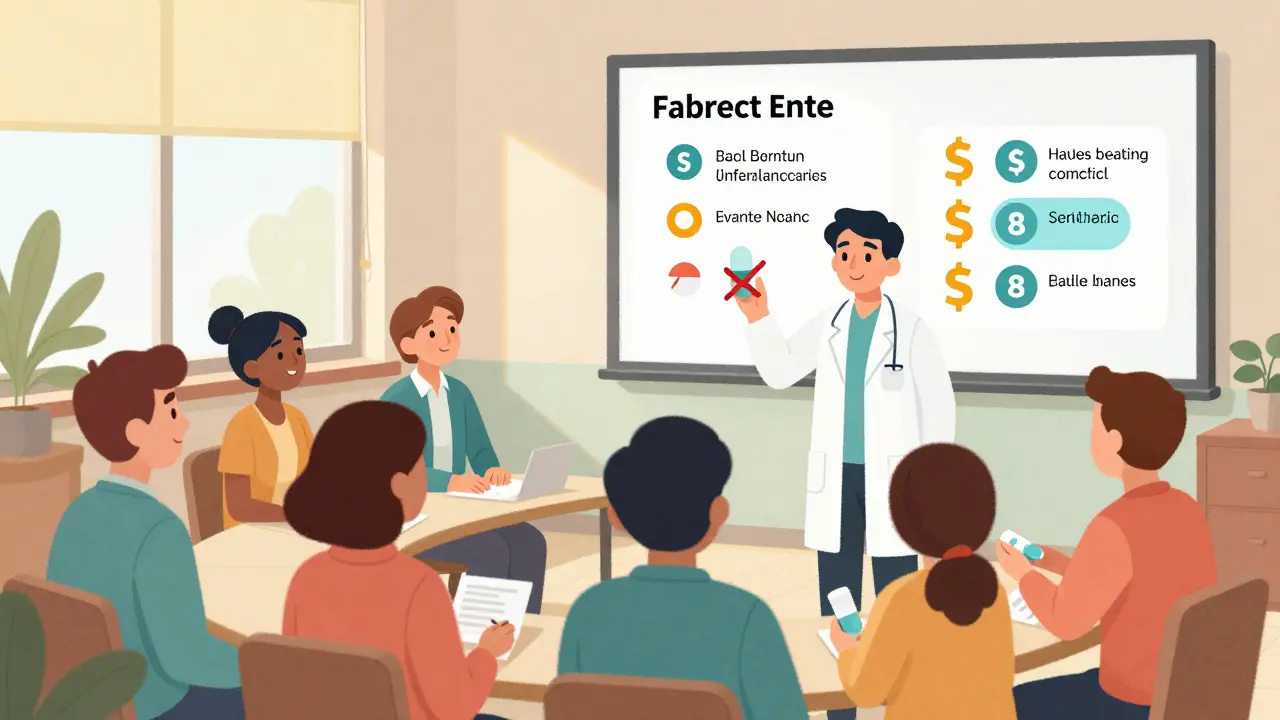
Many people still think generic drugs are weaker, less safe, or not as good as brand-name medicines. That’s not true. In fact, generic drugs are the exact same as brand-name drugs in every way that matters - same active ingredient, same strength, same way you take it. The only difference? They cost 80-85% less. And yet, nearly half of Americans still believe generics aren’t as effective. This misunderstanding isn’t just outdated - it’s expensive. It costs the U.S. healthcare system over $377 billion a year in unnecessary spending. Community health presentations are stepping in to fix this gap, one conversation at a time.
What Exactly Is a Generic Drug?
A generic drug is a copy of a brand-name drug that has the same active ingredient, dosage, strength, and how it’s taken - whether it’s a pill, injection, or inhaler. The FDA requires that generics meet the same strict standards as brand-name drugs. They must deliver 80-125% of the active ingredient into the bloodstream at the same rate. That’s called bioequivalence. It’s not a guess. It’s tested in clinical studies with real people. The FDA reviews about 1,000 generic drug applications every year. Every single one must prove it works just like the original.
Some people get confused because generics look different. They might be a different color, shape, or size. That’s because the inactive ingredients - like fillers or dyes - can vary. But those don’t affect how the medicine works. Think of it like two identical cars painted different colors. Under the hood, they’re the same.
Why Do People Doubt Generics?
The doubt isn’t random. It comes from real experiences. A 2022 University of Michigan survey found that 23% of patients questioned whether a generic was working because it looked different from what they were used to. Others were told by well-meaning family members or even some doctors that brand-name was "better." And then there’s the nocebo effect - when people expect side effects, they start to feel them. A 2021 study in Annals of Internal Medicine showed that patients who knew they were taking a generic were 18.7% more likely to stop taking it, even though their symptoms didn’t change.
Some therapeutic areas see more confusion. For example, in central nervous system drugs like antidepressants or epilepsy meds, patient acceptance is lower. Only 68% of prescriptions for these are filled with generics, compared to 95% for heart medications. Why? Because small changes in blood levels can feel more noticeable in the brain. But even here, the science is clear: for nearly all patients, generics work just as well. The Epilepsy & Behavior study that found a slightly higher seizure rate with switches involved a tiny fraction of cases - and the American Academy of Neurology still says generics are safe for the vast majority.
How Much Money Do Generics Save?
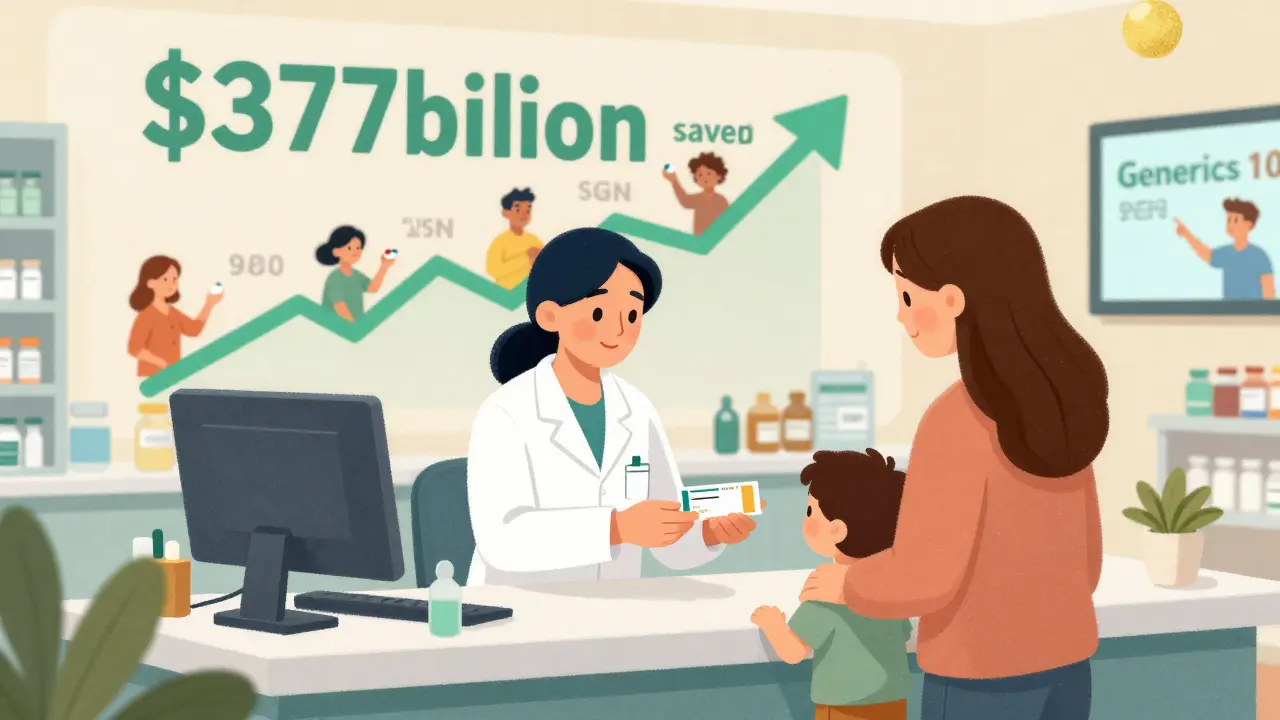
In 2022, 90.8% of all prescriptions filled in the U.S. were for generic drugs. That’s 6.8 billion prescriptions. And those generics saved the system $377 billion that year. On average, a generic version of a drug costs $10-$30 a month. The brand-name version? Often $300-$500. For someone on Medicare or Medicaid, that’s the difference between taking their medicine every day or skipping doses because they can’t afford it.
And it’s not just about cost. A 2021 study in Health Affairs tracked 3.2 million low-income patients. When they switched to generics, their medication adherence improved by 22%. That means fewer hospital visits, fewer ER trips, and better long-term health. The FDA now calls this one of the biggest equity tools in modern medicine.

What’s the FDA Doing?
The FDA launched its formal Generic Drugs Patient Education program in 2017. Since then, they’ve built a library of 2,147 free resources - videos, infographics, fact sheets, and toolkits for clinics - all available in English and Spanish. They didn’t just make materials. They tested them. The "Teach-Back" method, where providers ask patients to explain the info back in their own words, improved understanding by 28-42% in clinical trials. One simple phrase works wonders: "The FDA requires generic drugs to have the same active ingredient, strength, and dosage form as brand-name drugs."
In 2023, the FDA rolled out "Generics 101," a video series aimed at Medicare beneficiaries. Early results show a 31% improvement in knowledge among people 65 and older. And starting in 2025, Medicare Part D plans will be required by law to give every beneficiary standardized education about generics.
What Do Pharmacists and Doctors Say?
Here’s the truth: pharmacists are the most confident group when it comes to generics. A 2021 American Pharmacists Association survey found that 97% of pharmacists would choose a generic for themselves or a family member. Doctors? Less so - but that’s changing. A 2022 JAMA Internal Medicine study showed that when a doctor said, "I’m prescribing this generic because it’s just as good and will save you money," patient acceptance jumped from 52% to 89%.
The American Medical Association and the Academy of Managed Care Pharmacy both officially support generic use. In 2022, the AMA adopted Resolution 307, calling for physician-led education to help patients understand that generics are safe and effective. The message is clear: if you trust your doctor’s advice, you can trust their choice of a generic.
Real Impact in the Community
At the Community Health Center of Burlington, staff started using the FDA’s Generic Drug Stakeholder Toolkit in 2021. They trained every front-desk worker, nurse, and pharmacist to use simple, clear language. Within six months, patient acceptance of generics rose by 37%. One patient, Maria, told them: "I thought the blue pill wasn’t as strong. But my blood pressure is better now, and I’m saving $80 a month. I wish I’d known sooner."
These kinds of wins aren’t rare. In rural areas, where access to care is harder and incomes are lower, generic use is only 78% - compared to 93% in cities. That’s why the National Association of Community Health Centers made generic education mandatory in all patient counseling sessions starting in January 2024. It’s not just about savings. It’s about fairness.
What’s Coming Next?
Between 2023 and 2028, 287 brand-name drugs will lose patent protection. That means hundreds of new generics will hit the market. But some of these are complex - inhalers, creams, injectables - and harder to copy. The FDA’s 2023 survey found that 40% of patients are confused by these types of generics. That’s why education is evolving. New materials are being designed with visuals, step-by-step instructions, and even audio guides for people with low literacy.
The European Medicines Agency confirms that U.S. and EU generic approval standards are identical. So if you’re worried about quality, know this: the same science that approves a generic in the U.S. is used in 37 other countries. It’s not a loophole. It’s a global standard.
What You Can Do
- Ask your pharmacist: "Is there a generic version of this?" If they say no, ask why.
- Don’t assume a different-looking pill is weaker. Check the name of the active ingredient - it should match your brand-name drug exactly.
- If you’re worried about side effects, talk to your provider. The issue might not be the drug - it might be your expectation.
- Use free resources. The FDA’s website has videos, printable fact sheets, and even a quiz to test your knowledge.
- Share what you learn. A simple conversation with a friend or neighbor can change how they see their medicine.
Generics aren’t second-choice drugs. They’re the standard. And when we understand that, we don’t just save money - we save lives.
Are generic drugs really as effective as brand-name drugs?
Yes. The FDA requires generic drugs to have the exact same active ingredient, strength, dosage form, and route of administration as the brand-name version. They must also prove bioequivalence - meaning they deliver the same amount of medicine into your bloodstream at the same rate. This is tested in clinical studies. Over 90% of prescriptions in the U.S. are for generics, and they’ve been used safely for over 40 years.
Why do generic pills look different?
The differences in color, shape, or size come from inactive ingredients - like fillers, dyes, or coatings - which don’t affect how the drug works. These are changed to avoid trademark issues. The active ingredient, which does the healing, is identical. If you’re unsure, check the drug name on the label or ask your pharmacist.
Can switching to a generic cause side effects?
For most people, no. But in rare cases - especially with certain epilepsy or psychiatric drugs - small differences in how the body absorbs the medicine can cause temporary adjustments. These are not due to lower quality, but individual sensitivity. If you notice changes after switching, talk to your doctor. They can help determine if it’s the drug or something else.
Why do some doctors still prescribe brand-name drugs?
Sometimes it’s habit. Or they’re not aware of the latest data. In rare cases, a patient has a documented reaction to a specific generic version - which is why the FDA allows a brand-name exception if medically necessary. But for over 95% of drugs, there’s no medical reason to avoid a generic. If your doctor doesn’t mention it, ask: "Is there a generic option?"
How can I find reliable information about generics?
The FDA’s website (fda.gov/generics) offers free, science-backed materials in English and Spanish, including videos, infographics, and fact sheets. The Association for Accessible Medicines (AAM) also provides public education tools. Avoid blogs or social media posts that make claims without citing scientific sources. Stick to government or medical association resources.
LiV Beau
March 11, 2026 AT 01:38OMG I just learned this and I’m SO mad I didn’t know sooner 😭 My blood pressure med used to cost $280 a month - now it’s $12. I thought the generic was "watered down" because it looked different. Turns out I was just being scammed by marketing. Thanks for this post - I’m sharing it with my whole family.
Adam Kleinberg
March 12, 2026 AT 19:02Generics are a government scam to control the population and make us dependent on cheap meds so they can monitor our bio-data through the pill coatings. You think they really test these things? Nah. The FDA is just a front for Big Pharma and the CDC. My cousin took a generic and his liver turned to jelly. He’s lucky he’s still alive.
Denise Jordan
March 14, 2026 AT 11:52Yeah but like… what if I just… don’t care? I mean I’m not rich but I’d rather pay extra and not have to think about it. Also I hate when my pills look different. Feels like a gamble.
Gene Forte
March 16, 2026 AT 10:52Let me say this plainly: generics are not just good - they are a moral imperative. Every dollar saved on a generic is a dollar that can go toward food, housing, or a child’s education. When we choose generics, we choose dignity. We choose health over hype. This isn’t about chemistry - it’s about justice. And it’s about time we started treating medicine like a right, not a luxury.
Kenneth Zieden-Weber
March 18, 2026 AT 01:11So you’re telling me the FDA tests these things? Like… with real humans? Not just lab rats and a PowerPoint? 😏 I’m impressed. Also, I told my mom to switch to generic statins last year. She said she felt "weird" at first - turns out she was just anxious. Now she calls them her "poor people’s miracle pills." Love that.
Mike Winter
March 19, 2026 AT 16:38It’s fascinating how deeply embedded the stigma is - even among educated people. I’ve seen this in my own GP practice. One elderly patient refused clopidogrel generics because "they’re not the same colour." The solution? A simple laminated card showing side-by-side bioequivalence graphs. No jargon. Just proof. It worked. Sometimes all we need is clarity - not a lecture.
Randall Walker
March 21, 2026 AT 07:33...I used to think generics were sketchy too... until my doctor said "I take them myself." Then I realized I was the one being ridiculous. The fact that I needed to hear that from a professional says a lot about how broken our system is. I’m not mad at people for believing this stuff. I’m mad at the system that let it get this bad.
Miranda Varn-Harper
March 22, 2026 AT 04:31While I appreciate the intention behind this initiative, one must consider the long-term ramifications of institutionalized substitution. The erosion of pharmaceutical innovation stems from this very mindset. If we prioritize cost over quality, we risk undermining the very research that delivers life-saving breakthroughs. Generics may be adequate - but adequacy is not excellence.