
Autoimmune Uveitis: Understanding Eye Inflammation and Steroid-Sparing Therapy
 Apr, 29 2026
Imagine waking up to find your vision blurred, your eyes painfully red, and every flicker of light feeling like a needle. For people dealing with Autoimmune Uveitis is an inflammatory process of the uveal components caused by an autoimmune reaction where the body attacks its own self-antigens , this isn't just a bad case of allergies. It is a serious, often rare condition that can lead to permanent blindness if not managed with precision. The real challenge isn't just stopping the inflammation, but doing so without destroying the rest of your health with long-term steroid use.
The Hidden Trigger: Why Your Eyes Inflame
Uveitis isn't a single disease but a symptom of a deeper systemic struggle. In autoimmune cases, your immune system gets confused and attacks the uvea-the middle layer of the eye. This inflammation can hit the front (anterior), the middle (intermediate), the back (posterior), or the entire eye (panuveitis). Because it's an orphan disease, affecting fewer than 200,000 people in the US, many patients spend months or years searching for a correct diagnosis.
Often, your eyes are the first signal that something else is happening in your body. Autoimmune Uveitis frequently travels with other systemic conditions. You might see it alongside joint-destroying diseases like Rheumatoid Arthritis or Ankylosing Spondylitis. It also shows up in people battling Multiple Sclerosis, Systemic Lupus Erythematosus, or inflammatory bowel diseases like Crohn's Disease and Ulcerative Colitis. If you're experiencing unexplained eye pain and have a history of autoimmune issues, these two worlds are likely connected.
Spotting the Red Flags
The symptoms of uveitis can sneak up on you or hit like a lightning bolt. Common warning signs include intense redness, eye swelling, and a deep ache. Many people report "floaters"-tiny spots or webs drifting across their vision-and a harsh sensitivity to light known as photophobia. In some cases, you might even feel a persistent headache accompanying the eye pressure.
Why is the rush to treat so critical? Because inflammation in the eye doesn't just stay as "redness." If left unchecked, it triggers a domino effect of complications. You could develop Cataracts (clouding of the lens) or Glaucoma (increased eye pressure). In severe cases, the inflammation can cause retinal detachment, where the light-sensing layer of the eye peels away, leading to permanent vision loss. Promptly getting to an ophthalmologist-ideally within 24 hours of symptoms appearing-is the only way to prevent these outcomes.
The Steroid Dilemma: First Response vs. Long-Term Harm
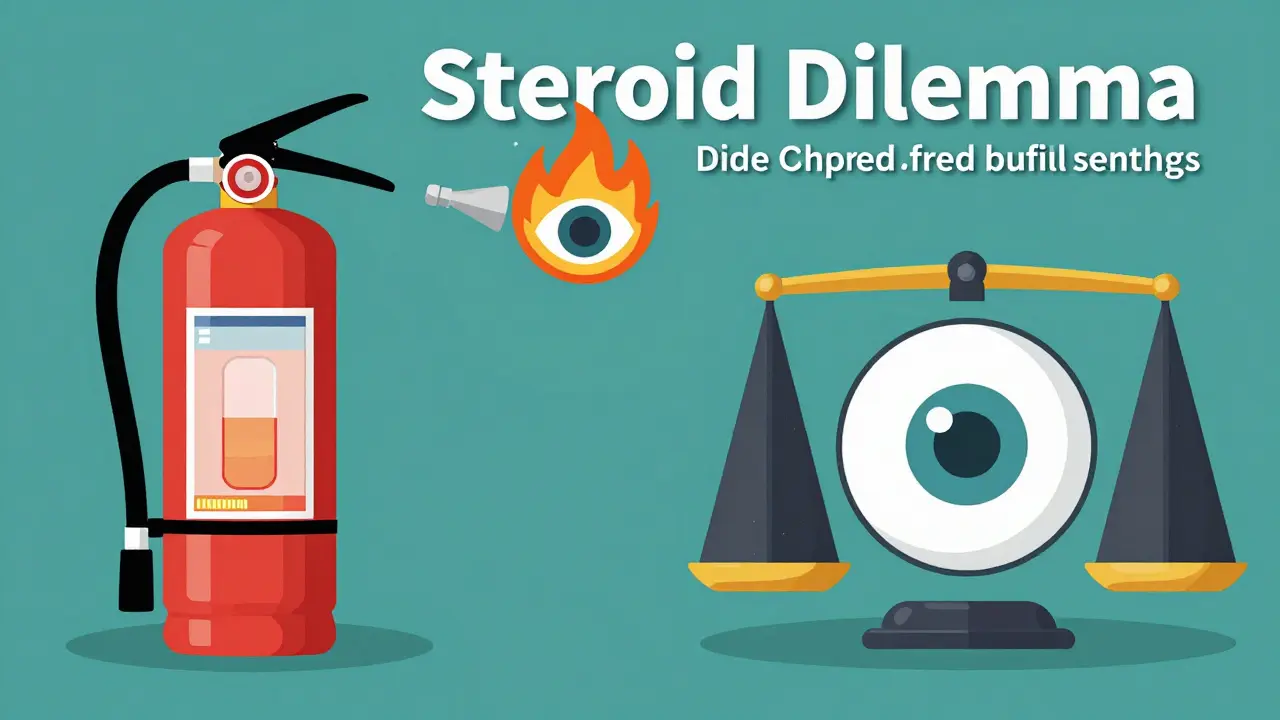
When you first walk into a clinic with an active flare, Corticosteroids are the gold standard for immediate control. They act like a fire extinguisher, putting out the inflammation quickly. Depending on where the fire is, your doctor might use drops for the front of the eye, injections directly into or around the eye for deeper inflammation, or oral tablets for systemic, severe cases.
Here is the catch: steroids are a miracle for a week, but a nightmare for a decade. Long-term use of corticosteroids can actually cause the very problems we are trying to avoid, such as inducing glaucoma and cataracts. Beyond the eye, systemic steroids can lead to bone loss, weight gain, and high blood sugar. This is why doctors move toward steroid-sparing therapy. The goal is to find a secondary medication that keeps the inflammation at bay, allowing the patient to taper off the steroids entirely or use them only during rare, acute flare-ups.
Steroid-Sparing Options: Moving Beyond the Basics
Steroid-sparing therapy is essentially a strategy to switch from a "broad-brush" anti-inflammatory to a more targeted approach. This usually involves Immunosuppressants or biologics that calibrate the immune system rather than shutting it down entirely.
One of the biggest breakthroughs in this field is the use of TNF inhibitors. Adalimumab (commonly known by the brand name Humira) is a pivotal biologic that blocks the production of TNF-alpha, a protein that drives the inflammation in uveitis. Unlike many other treatments that are used "off-label," Humira received FDA approval specifically for non-infectious uveitis, providing a standardized path for care.
For those who don't respond to TNF blockers, other options include:
- Methotrexate: A classic immunosuppressant that slows down the overactive immune response.
- Cyclosporine: Often used to target specific T-cell activity to reduce inflammation.
- Infliximab: Another biologic that has shown high success rates, particularly in pediatric patients, helping them drastically reduce their steroid dependence.
| Medication Type | Example | Primary Action | Common Use Case |
|---|---|---|---|
| TNF Inhibitor (Biologic) | Adalimumab | Blocks TNF-alpha protein | Non-infectious, chronic uveitis |
| Antimetabolite | Methotrexate | Inhibits cell growth of immune cells | Moderate to severe chronic cases |
| Calcineurin Inhibitor | Cyclosporine | Suppresses T-cell activation | Steroid-resistant inflammation |
| Biologic (Infusion) | Infliximab | Binds to TNF-alpha | Pediatric or refractory uveitis |
The Collaborative Path to Recovery
Treating autoimmune uveitis isn't a one-person job. Because the inflammation is often a symptom of a whole-body issue, you need a "bridge" between two specialists. Your ophthalmologist handles the ocular health, but a rheumatologist manages the systemic autoimmune disease. If these two aren't talking, the treatment can become disjointed.
The diagnostic journey is rigorous. To make sure you aren't accidentally giving immunosuppressants to someone with an infection (which would be dangerous), doctors use a battery of tests. This includes tonometry to check eye pressure, slit-lamp examinations, Optical Coherence Tomography (OCT) for retinal imaging, and fluorescein angiography. Blood tests are used to rule out infections and confirm the autoimmune markers.
Once on a steroid-sparing regimen, the focus shifts to monitoring. Regular visits are mandatory to check for the side effects of immunosuppressants, such as an increased risk of infections. The goal is a "maintenance phase" where the eyes remain quiet, vision stays stable, and the systemic side effects of steroids are eliminated.

What the Future Holds for Uveitis Care
We are moving away from the "one size fits all" approach. While TNF inhibitors like Humira were a giant leap forward, research is now diving into even more specific pathways. Scientists are investigating interleukin inhibitors and JAK-STAT pathway modulators, which could offer hope to those who don't respond to current biologics.
The ultimate goal is personalized medicine. Imagine a future where a simple genetic or biomarker test tells your doctor exactly which drug will work for your specific type of uveitis before you even start the first dose. This would remove the "trial and error" phase of steroid-sparing therapy, protecting your vision faster and more effectively.
Is autoimmune uveitis curable?
While there is currently no permanent cure for the underlying autoimmune tendency, the condition is highly manageable. Through the use of steroid-sparing therapies and biologics, most patients can achieve long-term remission where the inflammation is suppressed and vision is preserved.
Why can't I just use steroid drops forever?
Prolonged steroid use can lead to serious ocular complications, most notably the development of cataracts and an increase in intraocular pressure, which leads to glaucoma. Systemically, steroids can cause osteoporosis, weight gain, and diabetes, making them unsuitable for long-term maintenance.
How do I know if I need a steroid-sparing agent?
Typically, your doctor will suggest a steroid-sparing agent if your uveitis is chronic or recurrent, if you experience a "rebound" flare every time you try to lower your steroid dose, or if you are already showing signs of steroid-induced side effects like rising eye pressure.
Are biologics like Humira safe for long-term use?
Biologics are generally safe, but because they suppress part of the immune system, they can increase your susceptibility to certain infections. Doctors monitor this through regular blood work and screenings to ensure the benefits of preventing blindness outweigh the risks of immunosuppression.
What is the difference between infectious and autoimmune uveitis?
Infectious uveitis is caused by bacteria, viruses, or fungi and requires antimicrobial treatment. Autoimmune uveitis is caused by the body's own immune system attacking the eye. It is critical to distinguish between the two because treating an infection with immunosuppressants can make the infection much worse and potentially lead to total vision loss.
Next Steps and Troubleshooting
If you have been diagnosed with autoimmune uveitis, your first priority is establishing a communication channel between your eye doctor and your rheumatologist. Ensure both are aligned on your medication dosages to avoid conflicting treatments.
- For New Patients: Keep a visual diary of your symptoms. Note when floaters increase or when photophobia worsens, as this helps your doctor determine if you are in a flare or a maintenance phase.
- For Those on Biologics: Be vigilant about new infections. If you develop a high fever or a persistent cough while on immunosuppressants, contact your care team immediately, as your body's ability to fight off common bugs is lowered.
- For Those Tapering Steroids: Do not stop taking oral steroids abruptly. This can cause a systemic crash (adrenal insufficiency). Always follow your doctor's specific tapering schedule to the letter.
J. Walter Jenkem
May 1, 2026 AT 09:27Dealing with these chronic conditions is a real journey. It's good to see the focus on the bridge between ophthalmologists and rheumatologists here.
Srinivas Komakula
May 1, 2026 AT 12:55The timing of the FDA approval for these biologics is far too convenient...!!! Why are we ignoring the possible epigenetic triggers being pushed by the industrial complex??? This "autoimmune" label is often just a convenient shroud for systemic toxicity in our water supply...!!! The pharmaceutical industry thrives on the lifelong dependency of steroid-sparing agents to maintain a perpetual revenue stream...!!! It's a textbook case of institutional capture where the diagnostic criteria are narrow-casted to favor high-margin infusions over holistic remediation...!!!
Andrew Hanssen
May 2, 2026 AT 10:54I find it remarkably naive to assume that a "collaborative path" actually works in a fragmented healthcare system. Most doctors barely look at the same chart, let alone coordinate a complex tapering schedule. It is a fantasy to believe the average patient has the leverage to force two specialists to synchronize their efforts. In reality, the patient ends up as a glorified courier, carrying paper notes between offices while their vision continues to deteriorate. This idealized version of care ignores the systemic inefficiency of modern medicine.
Seema Karanje
May 4, 2026 AT 05:16STOP FEELING SORRY FOR YOURSELF AND GET TO THE DOCTOR NOW!!! If you have these symptoms, there is zero time to waste!!! Fight for your sight and demand the best treatment available!!! NO EXCUSES!!!
SWATI NAWANGE
May 5, 2026 AT 04:24One must simply acknowledge that the nuance of panuveitis is far beyond the grasp of the layperson. The transition to TNF inhibitors is, quite frankly, the bare minimum of modern therapeutic intervention. It is almost quaint to think that some patients are still grappling with the basic dichotomy of steroids versus immunosuppressants when the academic world has already moved toward more sophisticated molecular targets. The tragedy of this condition is not merely the inflammation, but the sheer lack of intellectual rigor in how patients are informed about their own pathology. Truly, the disparity in care is an absolute travesty for those who actually understand the biochemistry involved.
Divya Patel
May 6, 2026 AT 14:39The eye is such a delicate mirror of the soul...!!! It is fascinating how the body's own defense mechanism becomes its own enemy, turning the light of the world into a source of pain...!!! Perhaps there is a deeper lesson in this struggle, a reminder that balance is the only true health...!!!
Preety Singh
May 7, 2026 AT 16:09The prose is pedestrian but the clinical utility is acceptable
One simply does not "search" for a diagnosis if one possesses the intellectual foresight to present the correct systemic markers initially
Prudence Wesson
May 8, 2026 AT 07:47Your analaysis of the steroid dilema is quite superficial...!!! The lack of laurent-style rigor here is simply appallng...!!! One must consider the psychologicall impact of chronic steroid use, which you completely overloooked...!!! Utterly mediocre...!!!