
Authorized Generics vs Brand Drugs: What You Need to Know About Identical Medications
 Dec, 15 2025
When you pick up a prescription, you might see two pills that look completely different - one with a well-known brand name, another with no name at all. You might wonder: Is the cheaper one just as good? The answer, in many cases, is yes - especially if it’s an authorized generic.
What exactly is an authorized generic?
An authorized generic is the exact same medication as the brand-name drug you’ve been prescribed - same active ingredients, same inactive ingredients, same size, same shape, same packaging, just without the brand name on the label. It’s not a copy. It’s not a knockoff. It’s the real thing, made in the same factory, using the same formula, under the same approval as the brand-name version.
The U.S. Food and Drug Administration (FDA) defines it clearly: an authorized generic is a brand-name drug sold without the brand name. It’s produced under the original brand’s New Drug Application (NDA), meaning it never went through the separate approval process that traditional generics do. That’s why it’s identical down to the last milligram of filler or coating.
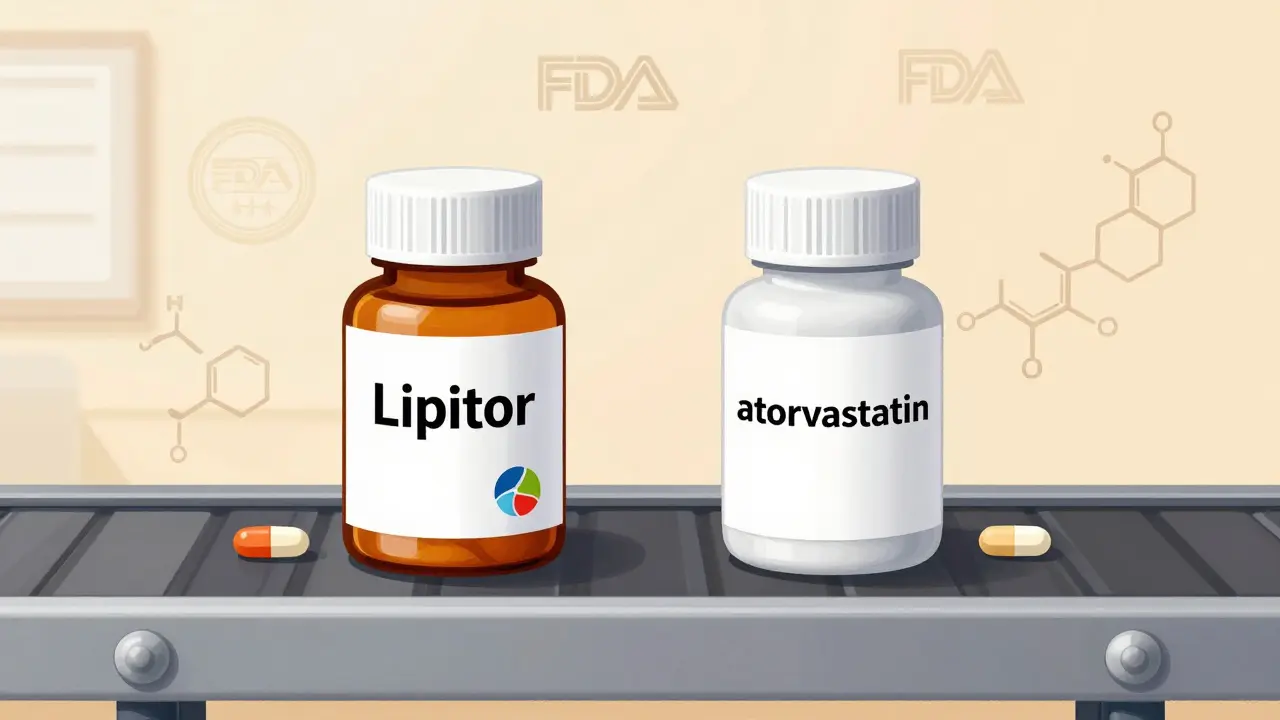
For example, if you take the brand-name drug Lipitor for cholesterol, the authorized generic version is made by Pfizer - the same company - using the exact same recipe. The only difference? The bottle says "atorvastatin" instead of "Lipitor."
How is it different from a regular generic?
This is where things get confusing - and it’s important to get right.
Regular generics are approved through an Abbreviated New Drug Application (ANDA). They must prove they’re bioequivalent to the brand drug - meaning they deliver the same amount of active ingredient into your bloodstream at a similar rate. But here’s the catch: they’re allowed to use different inactive ingredients. That means fillers, dyes, preservatives, and coatings can vary. For most people, that doesn’t matter. But for some - especially those with allergies, sensitivities, or digestive issues - those tiny differences can cause problems.
Authorized generics don’t have that risk. Because they’re made under the brand’s NDA, they use the exact same inactive ingredients. If you had a reaction to the brand version - maybe a rash from a dye, or stomach upset from a coating - you’ll likely have the same reaction to the authorized generic. But you won’t get a new reaction because of a different filler.
Think of it this way: a regular generic is like a copy of a recipe using slightly different spices. An authorized generic is the same dish, cooked in the same kitchen with the same ingredients.
Why do brand companies make authorized generics?
It sounds strange - why would a drug company sell a version of its own product for less money? The answer is business strategy.
When a brand drug’s patent expires, other companies can legally make generics. To protect their market share, brand manufacturers often launch their own authorized generic right away. This lets them keep some of the sales - and often keeps the price of traditional generics higher than it would be otherwise.
According to a 2022 Health Affairs study, over 55 brand-name drugs had authorized generic versions on the market. In some cases, the authorized generic is priced only 15-20% lower than the brand. Meanwhile, traditional generics can be 80-85% cheaper. That means if you’re looking for the lowest price, the authorized generic might not be your best bet.
But if you’ve had issues with traditional generics - maybe your blood pressure didn’t stabilize, or your skin broke out - switching to the authorized generic could be the fix you need.

Are authorized generics safe and effective?
Yes - completely.
The FDA states unequivocally that authorized generics are therapeutically equivalent to their brand-name counterparts. There’s no variation in active ingredient levels. No difference in absorption. No hidden changes in how the drug works in your body.
A 2018 study published by the National Center for Biotechnology Information analyzed over 5,000 patients switching from brand drugs to either traditional generics or authorized generics. The results? Patients using authorized generics had the same rates of hospital visits, emergency room trips, and medication discontinuation as those on the brand name. In fact, they were more consistent than traditional generics in some cases.
Doctors like Dr. Choudhry from Harvard Health point out that while traditional generics can vary by up to 20% in active ingredient concentration (though actual variation is usually around 4%), authorized generics have zero variation. They’re the brand drug - period.
For patients with allergies, asthma, or autoimmune conditions, this matters. The American Academy of Allergy, Asthma & Immunology confirms that authorized generics are the only generic option that guarantees identical inactive ingredients - making them the safest choice for sensitive individuals.
Why don’t more people know about them?
Because the system is designed to confuse you.
Pharmacists are trained to substitute generics when allowed - but they often don’t distinguish between traditional generics and authorized generics. When you get your prescription filled, you might be handed an authorized generic and think it’s just another generic. You might even be told it’s "just as good" - which is true - but not the full story.
Pharmacy Times reports that about 30% of patients question the switch when they see a different-looking pill. Many assume the cheaper version is lower quality. But if you’ve been prescribed an authorized generic, you’re getting the same drug your doctor intended - just without the brand name.
Some patients specifically ask for authorized generics after bad experiences with traditional generics. One user on a patient forum shared: "I switched from the brand to a regular generic for my allergy meds and started getting headaches. When I asked for the authorized generic, the headaches stopped. Same drug, no surprises."
How do you get an authorized generic?
It’s not always easy - but it’s possible.
- Ask your pharmacist: "Is there an authorized generic for this drug?" They can check their inventory or order it if it’s available.
- Check your insurance formulary. Some plans cover authorized generics at the same tier as traditional generics. Others treat them closer to brand-name pricing.
- If your doctor wrote "dispense as written" (DAW) on the prescription, your pharmacist can’t substitute anything without calling them back. If you want the authorized generic, you may need to ask your doctor to remove that restriction.
- Use tools like GoodRx to compare prices. Sometimes the authorized generic is priced higher than the traditional generic - but if you’ve had issues before, it might be worth the extra cost.
Some manufacturers list authorized generics on their websites. For example, Teva, Mylan, and Pfizer all have sections explaining which of their products have authorized versions.
When should you choose an authorized generic?
You should consider an authorized generic if:
- You’ve had side effects or poor results with a traditional generic
- You have known allergies to certain dyes, fillers, or preservatives
- You take a medication where small changes in absorption matter - like thyroid meds, seizure drugs, or blood thinners
- Your insurance covers it at a low cost
You might skip it if:
- The traditional generic is significantly cheaper and you’ve never had a problem with it
- You’re on a tight budget and every dollar counts
- Your doctor has no reason to believe you need the exact formulation
There’s no one-size-fits-all answer. But knowing the difference gives you power - not just to save money, but to choose the right version of your medicine.
What’s changing in the future?
The FDA is looking at ways to make authorized generics more transparent. Right now, they don’t appear in the Orange Book - the official list of approved drugs and their therapeutic ratings. That makes it harder for doctors and pharmacists to identify them.
There are also political pressures. Some lawmakers want to ban brand manufacturers from launching authorized generics as a way to block competition. The Affordable Prescriptions for Patients Act of 2023 proposed limits on this practice, arguing it delays true generic price drops.
But for now, authorized generics remain a legitimate, FDA-approved option. Evaluate Pharma predicts they’ll keep about 5-7% of the generic market through 2028 - mostly in areas where precision matters: chronic diseases, mental health, and immune conditions.
The bottom line? If you’ve been told generics are all the same, you’ve been misled. Authorized generics are the closest thing to the brand drug you can get - without the brand price tag. And for many people, that’s worth knowing.
Are authorized generics as safe as brand-name drugs?
Yes. Authorized generics are made under the same New Drug Application (NDA) as the brand-name drug, using identical active and inactive ingredients. The FDA confirms they are therapeutically equivalent - meaning they work the same way in your body with the same safety profile.
Can I trust an authorized generic if it looks different from my brand drug?
Absolutely. The only difference is the lack of brand name on the label. The pill’s size, shape, color, and ingredients are the same. If your brand drug was white and oval, the authorized generic will be too. If you notice a change in appearance, ask your pharmacist to confirm it’s the authorized version.
Why is the authorized generic sometimes more expensive than a regular generic?
Because it’s made by the original brand company or its affiliate, and they often price it to compete with - not undercut - their own brand. Traditional generics are made by third-party manufacturers who compete on price, driving costs down. Authorized generics don’t face the same competition, so prices can be higher.
Do insurance plans cover authorized generics?
Yes, many do - but coverage varies. Some plans treat them like traditional generics and put them on the lowest cost tier. Others treat them like brand-name drugs because they’re made by the same company. Always check your formulary or call your insurer before switching.
How do I know if my prescription is an authorized generic?
Check the label - if it has the drug’s generic name (like "atorvastatin") but no brand name (like "Lipitor"), it might be an authorized generic. Ask your pharmacist to confirm. You can also search the FDA’s authorized generic list or check the manufacturer’s website for details.
anthony epps
December 16, 2025 AT 23:41I never knew authorized generics existed until I read this. I always thought generics were just cheaper copies. Turns out my blood pressure med was an authorized generic this whole time and I didn't even notice.
Dan Padgett
December 17, 2025 AT 09:11Man, this feels like finding out your favorite chef made a no-name version of their signature dish - same kitchen, same hands, just no fancy logo on the plate. We treat medicine like it's a luxury brand sometimes, but it's just science with a price tag.
Hadi Santoso
December 17, 2025 AT 16:44So i just found out my doc prescribed me an authorized generic for my thyroid med and i thought it was a regular generic lol. i switched and no side effects, which is wild because i used to get weird headaches with the other generic. also, the bottle looked totally different but the pill was identical. why is this not more common knowledge???
Kim Hines
December 19, 2025 AT 01:05I’ve been on the same med for 7 years. Switched to generic once, got a rash. Switched back to brand. Then one day my pharmacist handed me a different bottle - same pill, no name. I didn’t even ask. Turns out it was an authorized generic. No rash. No drama. Just… quiet relief.
Aditya Kumar
December 20, 2025 AT 07:01Why does this even matter? Just take the cheapest one.
Randolph Rickman
December 21, 2025 AT 22:58Biggest myth out there: all generics are the same. Nope. I had a friend with severe allergies who broke out every time she took a regular generic for her asthma inhaler. Switched to the authorized version - zero reaction. Same drug, same filler, same everything. The FDA says it, doctors say it, and now I’m telling you: if you’ve had issues, don’t settle for ‘close enough.’ Ask for the authorized generic. It’s not a luxury - it’s precision medicine.
sue spark
December 22, 2025 AT 07:23I never knew the difference until my pharmacist asked if I wanted the authorized version for my antidepressant. I said yes because it was only 50 cents more. After two weeks I realized I hadn’t had that foggy brain feeling I got with the other generic. I didn’t even know it was happening until it stopped. Now I always ask. Just say the words: is there an authorized version?
Tiffany Machelski
December 22, 2025 AT 16:39So if the authorized generic is made by the same company… why do they make it cheaper? Is it just to keep the market from being flooded with other generics? Feels a little sneaky
SHAMSHEER SHAIKH
December 24, 2025 AT 01:28Let us not forget: the pharmaceutical industry operates under a complex matrix of intellectual property, market dynamics, and regulatory loopholes. The authorized generic is not merely a product - it is a strategic instrument deployed to preserve revenue streams during patent cliff transitions. One must appreciate the economic architecture behind what appears to be a simple pill substitution.
James Rayner
December 24, 2025 AT 01:37That’s wild… I always thought generics were just cheaper versions. But now I realize… the brand made the generic too. So it’s like they’re selling their own product under a different name. Kinda makes you wonder how much of the system is just… designed to confuse us. 🤔