
AI and Pharmacogenomics: How Personalized Generic Recommendations Are Changing Online Pharmacies
 Dec, 20 2025
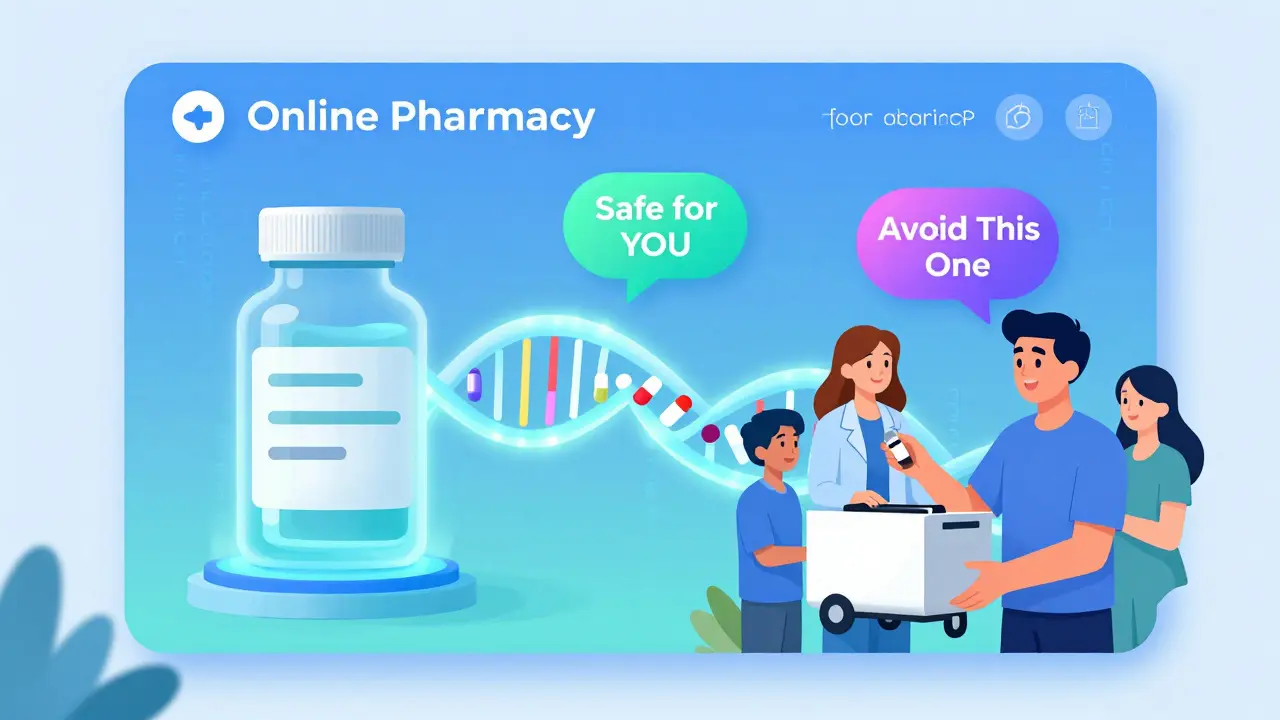
Imagine getting the right generic medication the first time-no trial and error, no dangerous side effects, no wasted months. That’s not science fiction anymore. Thanks to AI and pharmacogenomics, online pharmacies are starting to offer personalized generic recommendations based on your DNA. This isn’t just about fancy tech-it’s about making sure the cheap, common drug your doctor prescribes actually works for you.
What Exactly Is Pharmacogenomics?
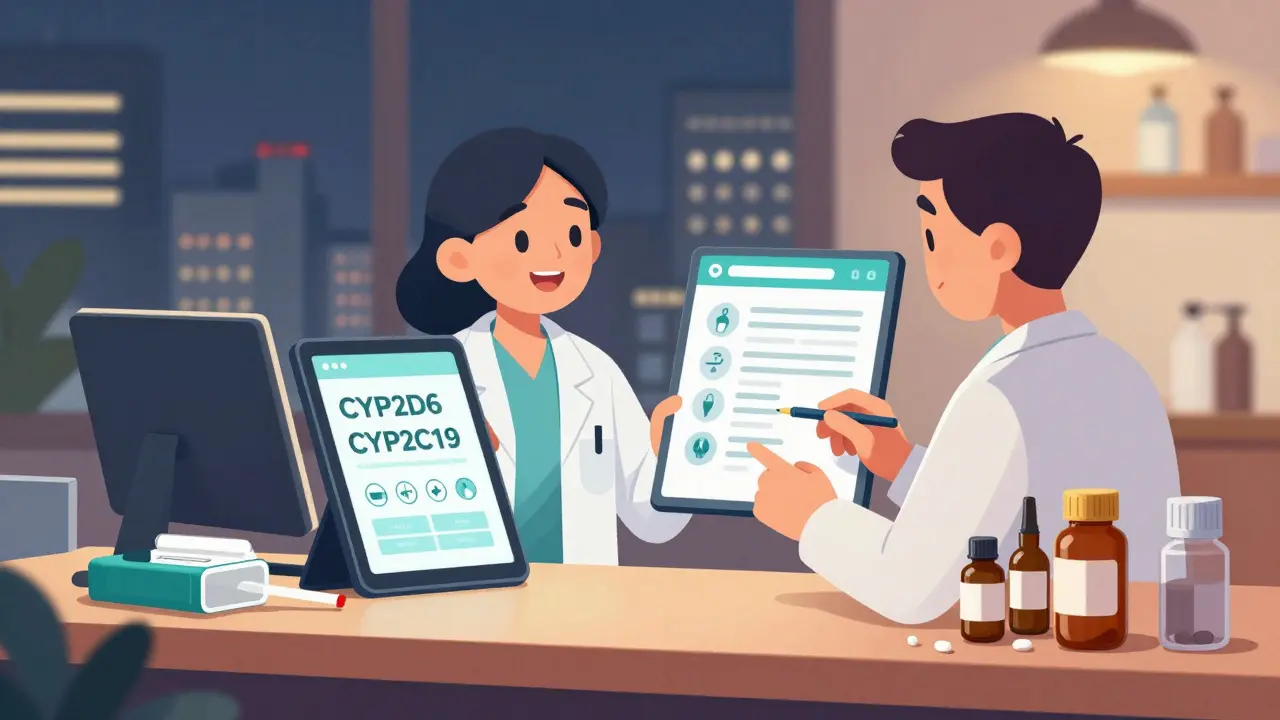
Pharmacogenomics (PGx) sounds complicated, but it’s simple in practice: it’s how your genes affect how your body handles drugs. Some people break down medications fast. Others break them down slow. And some can’t process certain drugs at all. These differences aren’t random-they’re written into your DNA. For example, if you have a variant in the CYP2D6 gene, you might be an ultra-rapid metabolizer of codeine. That means your body turns codeine into morphine too quickly, which can cause breathing problems-even at normal doses. On the flip side, if you’re a poor metabolizer, you might get zero pain relief from the same pill. The same goes for common drugs like clopidogrel (used after heart attacks), warfarin (a blood thinner), and even antidepressants like SSRIs. Traditional pharmacies don’t know this about you. They just fill the script. But with AI-powered PGx, online pharmacies can now check your genetic profile and recommend the safest, most effective generic version of a drug-before you even take it.How AI Makes Generic Drugs Work Better for You
Generic drugs are cheaper because they’re chemically identical to brand-name versions. But they’re not always the same for your body. Why? Because your genes control how your liver processes them. Two people can take the same generic pill and have totally different outcomes. That’s where AI steps in. Systems like the one built with GPT-4 and the Clinical Pharmacogenetics Implementation Consortium (CPIC) guidelines can analyze your genetic test results and tell you:- Which generic version of your drug will work best
- Which ones to avoid entirely
- What dosage adjustments you might need
- Which other medications could interact dangerously with your genes
How Online Pharmacies Are Using This Tech
Most online pharmacies still just ship pills. But a growing number are integrating PGx data into their systems. Here’s how it works in practice:- You take a simple at-home DNA test-usually a cheek swab-through a partner lab.
- You upload the results to the pharmacy’s secure portal.
- The AI analyzes your variants against CPIC and PharmGKB databases.
- When you order a medication, the system auto-suggests the best generic option based on your genes.
- You get a clear, plain-language explanation: “This generic works well for you. Avoid this one-it’s risky.”
Why This Matters More for Generics
Branded drugs often come with detailed clinical data and manufacturer support. Generics? Not so much. Their bioequivalence studies are done on small, homogeneous groups-usually young, healthy, white adults. That’s fine for most people. But if you’re not in that group, the generic might not work-or worse, it might harm you. AI changes that. It doesn’t care about your race, age, or income. It only cares about your genes. So whether you’re a 70-year-old Māori woman in Auckland or a 35-year-old South Asian man in Toronto, the AI gives you a recommendation based on your biology-not a population average. This is huge for cost-conscious shoppers. Generics make up over 90% of prescriptions in the U.S. and New Zealand. If you’re paying out of pocket, you want the cheapest option that actually works. AI ensures you’re not saving money on the pill, then losing it on ER visits or failed treatments.What’s Holding This Back?
It’s not perfect. And it’s not everywhere yet. First, you need a genetic test. Most people haven’t had one. Companies like OneOme and Myriad Genetics offer PGx panels, but they’re still pricey without insurance. Some online pharmacies now bundle the test with your first order for under $100. Second, AI can hallucinate. The same JAMIA study found that 3.2% of AI responses contained clinically significant errors. One Reddit user reported the system missed a dangerous CYP2D6 variant that could’ve caused respiratory failure in a child. That’s why every recommendation still needs a human pharmacist to review it. Third, the data is biased. Over 78% of PGx research is based on people of European descent. That means AI tools may give inaccurate advice to Black, Indigenous, or Asian patients. The NIH launched a $125 million initiative in April 2024 to fix this. But it’s a long road. Finally, integration is messy. Many online pharmacies still use old systems that can’t talk to genetic data platforms. FHIR-based APIs are helping, but it takes 6 to 9 months to fully connect everything.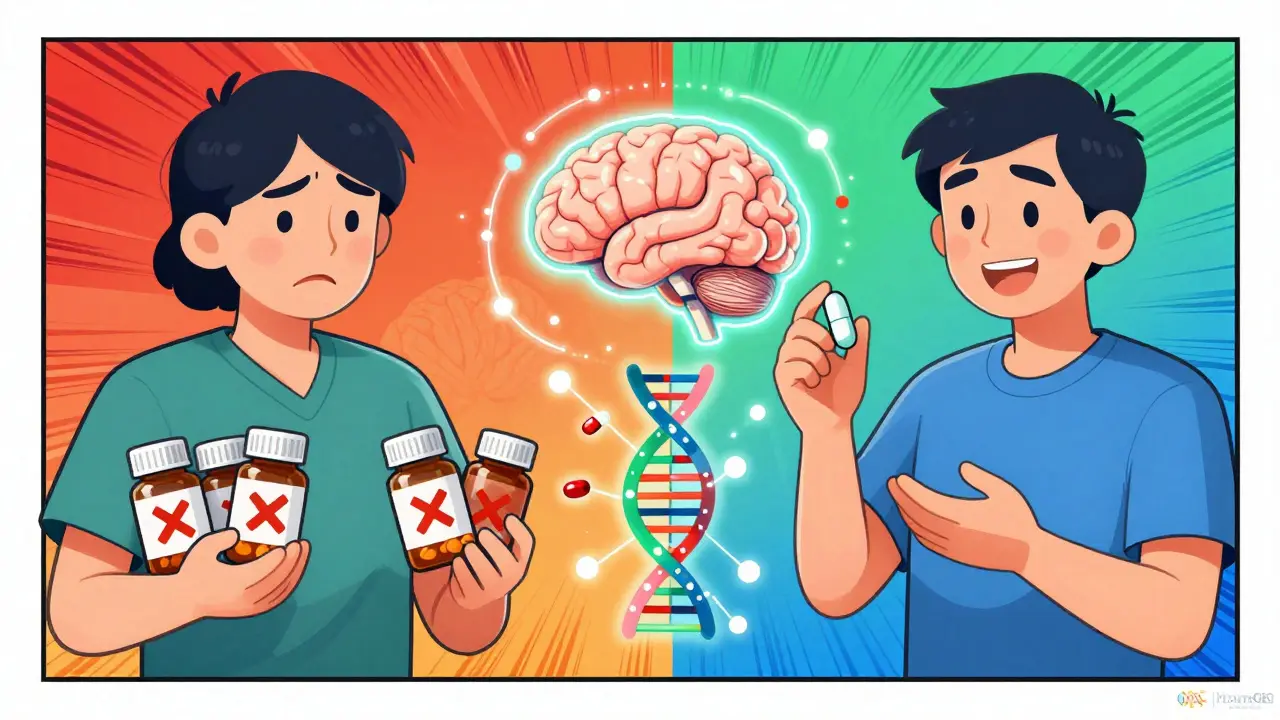
What You Can Do Today
You don’t need to wait for your pharmacy to catch up. Here’s how to take control now:- If you’ve had a DNA test from 23andMe or Ancestry, check if they offer pharmacogenomics reports. Some do, for an extra fee.
- Ask your doctor for a PGx test if you’ve had bad reactions to meds before.
- When ordering generics online, look for pharmacies that mention “personalized medication” or “genetic compatibility.”
- Use tools like PharmGKB’s public database to look up your gene variants and see what drugs they affect.
The Future: What’s Coming Next
By 2027, experts predict that 45% of academic medical centers will combine pharmacogenomics with polygenic risk scores. That means AI won’t just tell you which drug to take-it’ll predict your risk of side effects, how long the drug will last in your body, and even which lifestyle changes might boost its effect. DeepMind’s AlphaPGx, launching in 2025, will model drug-enzyme interactions at the atomic level. That’s like seeing exactly how your body breaks down a pill-down to the molecule. And yes, regulation is catching up. The FDA cleared the first AI-PGx tool, GeneSight Psychotropic, in February 2023. More will follow. The goal isn’t to replace doctors or pharmacists. It’s to give them superpowers. To make sure the $10 generic pill you order online doesn’t just cost less-it works better.Can I get personalized generic recommendations from any online pharmacy?
No, not yet. Only a small number of online pharmacies have integrated AI pharmacogenomics. Look for platforms that mention genetic compatibility, PGx testing, or personalized drug matching. Many are still in pilot phases, often tied to university hospitals or large health networks. If a pharmacy doesn’t mention genetics or DNA on their site, they’re likely not using this tech.
Do I need to take a DNA test to use this service?
Yes. You need a pharmacogenomic test that looks at key genes like CYP2D6, CYP2C19, CYP3A4, and SLCO1B1. These tests are usually done with a cheek swab and cost between $80 and $200. Some pharmacies now offer them bundled with your first order. If you’ve already done a DNA test with 23andMe or Ancestry, check if they offer a PGx add-on-you might already have the data.
Are AI-generated recommendations safe?
They’re generally accurate-89.7% in one major study-but not perfect. About 3% of AI responses have had serious errors, like missing a dangerous gene variant. That’s why every recommendation should be reviewed by a licensed pharmacist. AI is a tool, not a replacement. Always confirm with a human before changing your meds.
Is this only for expensive branded drugs?
No. In fact, it’s most valuable for generics. Since generics are chemically identical to brand names, most people assume they’re interchangeable. But your genes can make one generic work and another fail. AI helps you pick the right generic-so you save money without risking your health.
Will my insurance cover genetic testing for this?
It depends. In the U.S., some insurers cover PGx testing if you’ve had multiple failed drug trials or serious side effects. In New Zealand, it’s rarely covered unless you’re in a hospital program. Check with your provider. Some pharmacies offer payment plans or discounts if you’re paying out of pocket.
Can AI recommend the right dose for me?
Yes. For drugs like warfarin, clopidogrel, and some antidepressants, AI can suggest a starting dose based on your genes. This is especially helpful because standard doses often don’t work for people with certain variants. One study showed AI-guided dosing reduced hospitalizations for bleeding events by 30% in patients on warfarin.
Is this technology available in New Zealand?
Not widely yet. A few private clinics and research hospitals in Auckland and Wellington are testing AI-PGx systems, but most online pharmacies still don’t offer it. However, you can order PGx tests from U.S.-based companies that ship to New Zealand. Once you have your results, you can upload them to compatible platforms. Look for services that support international users and comply with NZ privacy laws.
Cara C
December 22, 2025 AT 02:06This is actually kind of amazing. I’ve been on three different antidepressants over the years, and each one either made me feel like a zombie or did absolutely nothing. If I’d known my CYP2D6 status earlier, I could’ve saved years of frustration and cash. Glad someone’s finally making this accessible.
My grandma’s on warfarin and keeps ending up in the ER because her dose keeps being wrong. This tech could’ve kept her out of hospitals for years. Honestly, it’s about time.
Not saying it’s perfect, but it’s a damn good start. We need more of this, not less.
Jay lawch
December 23, 2025 AT 23:25Let me guess-this is just another Silicon Valley scam to sell you DNA tests so they can sell your data to Big Pharma and the military. You think your genes are some kind of magic key? They’ve been doing this since the 1970s. The CIA used gene mapping to target ethnic groups during Cold War drug trials. Now they’re repackaging it as ‘personalized medicine’ so you’ll pay $150 for a cheek swab that tells you what your doctor should’ve learned in med school.
And don’t get me started on how 78% of the data is from white people. You think this AI knows how a Tamil woman’s liver metabolizes clopidogrel? It’s just guessing. And the FDA cleared it? Of course they did. They cleared 3D-printed opioids last year too. This isn’t progress-it’s corporate colonization wrapped in lab coats.
Christina Weber
December 24, 2025 AT 04:02There is a fundamental error in the article’s assertion that AI is ‘89.7% accurate.’ The study cited in JAMIA explicitly states that accuracy was measured against a gold standard of expert consensus, not clinical outcomes. Furthermore, the term ‘personalized generic recommendations’ is misleading-generics are, by definition, bioequivalent; the AI isn’t personalizing the drug, it’s personalizing the *selection* among bioequivalent options. Semantics matter.
Also, the claim that ‘AI fills the gap’ where pharmacists fail is statistically dubious. Pharmacists don’t manually read PGx reports-they use validated clinical decision support tools. The real gap is in physician education, not algorithmic precision. Please stop anthropomorphizing software.
Theo Newbold
December 24, 2025 AT 20:5089.7% accuracy? That’s a 1 in 10 chance you’re getting a recommendation that could kill you. And you’re okay with that? We’re talking about drugs that can cause internal bleeding, arrhythmias, or respiratory arrest. You don’t gamble with your life because some algorithm ran faster than a human.
And let’s not pretend the bias problem is ‘being fixed.’ The NIH threw $125 million at it and we’re still using data from 1980s Swedish cohorts. This isn’t innovation-it’s negligence dressed up in machine learning jargon.
I’ve seen AI misread a CYP2C19 variant and recommend clopidogrel to a patient who’d have a 95% chance of stent failure. It happened in a VA hospital. The patient died. No one got fired. Just another ‘edge case.’
Michael Ochieng
December 25, 2025 AT 22:07As someone from Kenya who moved to the U.S. and spent six months trying to find a medication that didn’t make me nauseous, this is the first thing in years that actually gave me hope.
I didn’t know my genes mattered until I got my 23andMe results and saw I was a poor CYP2C19 metabolizer. My doctor had no clue. The pharmacist just shrugged and said, ‘Try another pill.’
Now I use a pharmacy that checks my DNA before filling anything. I’ve saved money, avoided ER visits, and actually feel like my body’s being respected. This isn’t just tech-it’s dignity.
And yes, the data’s biased. But if we keep pushing for inclusion, maybe next time they’ll include African haplotypes instead of pretending we’re just ‘other.’
Erika Putri Aldana
December 27, 2025 AT 09:02Jerry Peterson
December 29, 2025 AT 07:46I work in a small-town pharmacy and we’ve started using one of these systems. Honestly? It’s been a game-changer. Patients who used to come in confused, angry, or scared now say, ‘Oh, so this one’s safe for me?’ and actually understand why.
It’s not magic. It’s just better info. And yeah, the AI messes up sometimes-but so do we. The difference is, now we catch it before the pill leaves the counter.
Also, the fact that it helps people who’ve been written off by the system-like elderly folks on 12 meds or low-income folks who can’t afford trial-and-error-that’s the real win. Tech should serve people, not the other way around.
Adrian Thompson
December 30, 2025 AT 02:49AI is just the new face of eugenics. They’re not trying to help you-they’re trying to categorize you. Once they know your genes, they’ll start denying you insurance, charging you more for meds, or labeling you ‘high-risk’ so you get the cheap generic that’s been sitting on the shelf for three years.
And don’t tell me it’s ‘for safety.’ They used to say the same thing about redlining. Now they’re redlining your DNA.
Next thing you know, your pharmacy will refuse to fill your prescription because your SNP profile says you’re ‘non-compliant.’ They already do this with opioid prescriptions. This is just the next step.
Jon Paramore
December 31, 2025 AT 02:27Key point missed: PGx doesn’t just affect metabolism-it affects transporters (SLCO1B1), targets (VKORC1), and even immune responses (HLA-B*57:01). AI models that only look at CYP enzymes are incomplete. The best systems integrate multi-gene haplotype scoring and drug-drug interaction networks.
Also, the 3.2% error rate? Most are class II errors-minor misclassifications. The real danger is class I: false negatives on high-risk variants like CYP2D6 ultra-rapid metabolizers. Those need mandatory human review. Any system that doesn’t flag those for pharmacist review is negligent.
Bottom line: AI is a force multiplier. Not a replacement. Use it right.
Ben Warren
December 31, 2025 AT 02:39It is imperative to underscore the profound ethical and regulatory deficiencies inherent in the current deployment of pharmacogenomic AI systems within commercial pharmacy environments. The conflation of bioinformatic probabilistic inference with clinical decision-making constitutes a fundamental violation of the Hippocratic principle of primum non nocere.
Furthermore, the normalization of consumer-driven genetic testing for pharmaceutical selection represents a dangerous commodification of biological identity, wherein individuals are reduced to genomic data points susceptible to corporate exploitation and algorithmic bias. The absence of mandatory federal oversight, coupled with the lack of standardized validation protocols across proprietary platforms, renders these systems legally and ethically untenable.
Until such time as the FDA enacts binding clinical validation requirements, mandates equitable genomic representation in training datasets, and requires real-time audit trails for AI-generated recommendations, the deployment of such technologies constitutes a gross dereliction of professional responsibility.
One must question: if a physician were to prescribe a drug based on a fortune cookie, would such conduct be permissible? Then why is it acceptable when the fortune cookie is generated by a neural network trained on Eurocentric datasets?